
Circulating cell-free DNA (cfDNA) has been proven to be useful for non-invasive prenatal screening/testing (NIPS, NIPT) of fetal an euploidies by assessing cell free fetal DNA (cffDNA) in maternal plasma/serum (1–3). The detection rates of NIPT for most common fetal aneuploidies including trisomy 21, trisomy 18, and trisomy 13 are >99%, 98%, and 99%, respectively, with false positive rate (FPR) of 0.13% when all are combined (4). Despite the use of NIPT for aneuploidy screening, cffDNA could be an important source for genetic and epigenetic screening of fetus, particularly for paternally inherited and de novo mutations. However, a great challenge remains in the detection of maternally inherited variants owing to the substantial background of maternal cfDNA.
The cffDNA fragment size (less than 200 base pairs) is smaller than that of maternal cell free DNA (5, 6) and it originates from apoptotic placental cells (trophoblasts) derived from the embryo (7). cffDNA concentration (fetal fraction) is about 10%–15% of total cfDNA between 10 and 20 weeks of pregnancy, which can be detected from the fourth week of gestation and can be quickly cleared from maternal blood following 2 hours after delivery (8–10). The use of cffDNA is still limited because cffDNA encompasses a minor proportion of total cfDNA in the plasma of pregnant women and commonly a minimum of 4% fetal fraction is required to provide a reliable test result (11–13). Different factors are reported to affect fetal fraction and there is high controversy in the literature for most factors. However, several factors’ correlation with fetal fraction is supported by a more consistent literature, such as maternal weight or BMI and gestational age (14–16). In this study, a review of literature was performed to assess factors affecting fetal fraction of cfDNA and evaluate the individual influence of each factor.
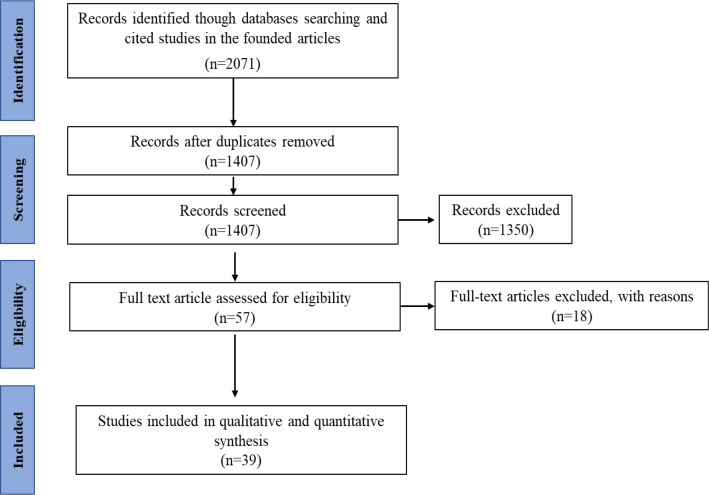
A systematic search was carried out through MEDLINE/PubMed, Scopus, Cochrane library, and Web of Science (WoS) databases until February 11, 2022 by two reviewers (AS, OK) independently. The following keywords were used to retrieve relevant studies: (“noninvasive prenatal screening” [Title/Abstract] OR “NIPT”[Title/Abstract] OR “noninvasive prenatal” [Title/Abstract]) AND (“cell free DNA” [Title/Abstract] OR “fetal fraction” [Title/Abstract]). Furthermore, papers that were not identified by the above databases were included by evaluating the reference sections of relevant studies. The Preferred Reporting Items for Systematic Reviews and Meta-Analysis (PRISMA) checklist was used for the selection process in our systematic review (Figure 1).
Randomized clinical trials, observational studies (cross-sectional, case–control, or cohort), and case series/reports were included. The inclusion criteria were the jri_articles including pregnant women who underwent NIPT test and factors affecting fetal fraction of cell free DNA as one of the primary objectives of the papers. EndNote citation management software was used for the study selection process and to manage the obtained jri_articles. The title and abstract of the studies were assessed based on the inclusion criteria after duplicate papers were rejected. Finally, a thorough screening of the full texts was done. The selection was carried out independently by two authors (AS, OK). Two researchers (AS, HS) independently extracted the following information including author, year, country, type of study, population, number of total patients, method of evaluating fetal fraction, and final outcome. A third reviewer resolved disagreements (OK).
Our preliminary search result yielded 2071 references. After duplicates were removed, a total of 1407 jri_articles were screened, using titles and abstracts. The full-text of 57 studies were retrieved and after an evaluation based on our inclusion criteria, 39 studies were found eligible (Figure 1).
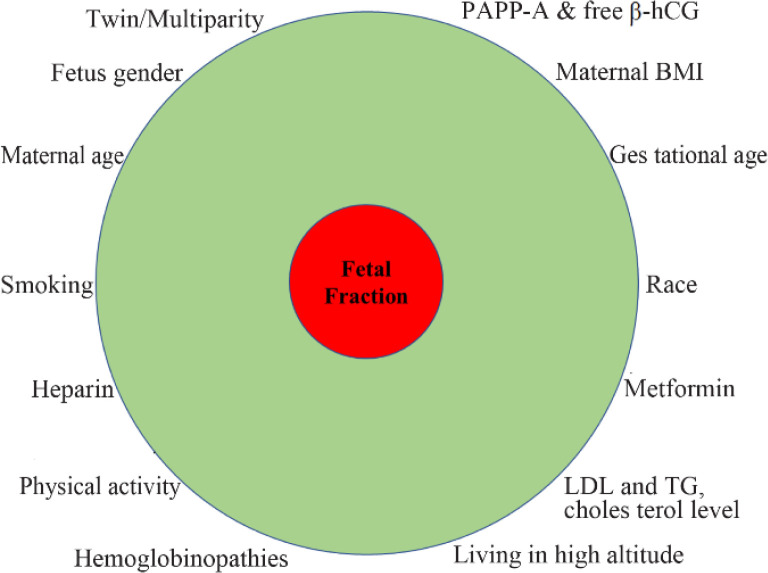
A summary of the characteristics of the included studies evaluating the factors affecting fetal fraction is available in supplementary table 1. Most of the studies were published between 2010 and 2020 which investigated singleton pregnancies including pregnancies at 11–13 weeks of gestation. Of 38 studies about fetal fraction, 18 investigated maternal age, 27 investigated maternal weight/BMI, 23 investigated gestational age, PAPP-A, and free β-hCG, 9 studies fetal fraction, 8 studies fetal gender, 10 studies smoking, and 9 investigated racial origin. A total of 5 studies investigated the effect of twin/multiple pregnancy on Fetal Faction (FF). In 9 studies, other factors were cited (Figure 2).
Of all the studies included, 18 reported the relationship between maternal age and fetal fraction (8, 17–33). Among them, 6 studies found decreased fetal fraction with increasing age (24–27, 29, 30). Interestingly, a study by Scott et al. reported a significant negative correlation between maternal age and FF; however, in their multivariate analysis, the influence of maternal age was found to be nonsignificant (8).
In a large cohort study done by Hou et al. (25), samples from 13661 singleton pregnancies were analyzed in 5 groups (group 1: 18–24 years old, group 2: 25–29 years old, group 3: 30–34 years old, group 4: 35–39 years old, and group 5: ≥40 years old). Compared with the first group, the fetal fraction of all other groups was decreased significantly. Additionally, when compared to the second group, a significant decline was also seen in the 30–34, 35–39, or 40 year old cases. Similarly, the fetal fraction in the third group was higher than that in the 35–39 year-old cases or the group above forties. Another study by Sarno et al. (29) which was performed on 10698 women with singleton pregnancies undergoing NIPT investigated the rate of failure in each of these trisomies and provided a further option in collecting information from failed NIPTs. In their study, they have shown possible effects of multiple fetal and maternal factors, including maternal age. They found that in both univariate and multivariate analysis, the rate of test failure increased with increasing maternal age. Although some research demonstrated that maternal age had a substantial impact on fetal fraction, the majority of the studies that were included found a nonsignificant correlation (17–23, 28, 31–33).
Of the total studies included, 27 reported the relationship between maternal weight/BMI and the fetal fraction. All studies found the relationship between decreased fetal fraction and increasing maternal weight/BMI (8, 18–44). Although all included studies proved the negative correlation between fetal fraction and maternal weight and BMI, there is some inconsistency regarding the strength of such correlation. Rava et al. have found a weak but significant correlation between FF and maternal BMI (35). The idea was further supported by Suzumori et al. who found a nonsignificant correlation in the 10–20 weeks of gestation (34). In contrast, some studies reported a strong negative correlation between FF and BMI. In a cohort by Scott et al., they reported a significant decrease of FF from 12% to 7% in individuals with a BMI of <24 kg/m2 and >30 kg/m2, respectively (8). Additionally, they have discovered that there is little impact when sample collection is delayed due to the positive effects of increasing gestational age on FF.
Of the total studies included, 23 reported the relationship between gestational age and the fetal fraction (8, 17–33). Also, 18 studies showed increased fetal fraction with increasing gestational age (24–27, 29, 30). A weak correlation between gestational age and FF was observed by the majority of these studies. Moreover, 5 studies reported a nonsignificant difference regarding gestational age (19, 31, 34, 35, 44). During early weeks of gestation (typically between 10 and 20 weeks), there was no significant change in FF. However, a rapid increase in fetal fraction percentage was observed after 20 weeks of gestation (23, 36). Also, 2 studies predicted the increase of fetal fraction during early gestational age and after (36, 40). Wang et al. showed that between 10–21 weeks of gestation, an increase of 0.1% per week is predictable. Compared with the earlier weeks, the percentage of FF rose at a rate of 1% per week beginning at 21 weeks of gestation (36). This rate was observed to grow by 0.44% each week between 10 and 12.5 weeks of gestation and by 0.083% each week between 12.5 and 20 weeks, according to a study by Kinnings et al. (40).
PAPP-A and free β-hCG were used as markers in the first trimester. There was a significant correlation between PAPP-A, free β-hCG, and fetal fraction in 9 studies (8, 18, 19, 21, 28, 29, 30, 33, 37). Regarding free β-hCG, all included studies showed a significant rise in fetal fraction with increasing free β-hCG. Regarding PAPP-A, only a single study found a nonsignificant positive correlation between PAPP-A and FF (21). The association between FF and biochemical markers in the first trimester suggests a strong correlation between FF and placental size and function.
Of the total studies included, 8 reported the relationship between fetal gender and the fetal fraction (20–23, 28, 33, 37, 40) and 3 studies reported that the fetal fraction in female fetuses is significantly higher than in male fetuses (20, 23, 28). However, 5 studies showed there was no significant association between fetal gender and FF (21, 22, 33, 37, 40).
Of the total studies included, 10 studies reported the relationship between smoking and the fetal fraction (21, 22, 28, 29, 30, 31, 33, 37, 44, 45). Furthermore, 3 studies reported that the fetal fraction is significantly correlated with smoking status and FF decreases among individuals who are active smokers (28, 33, 37). Also, 7 studies showed there was no significant correlation between smoking status and FF (21, 22, 29, 30, 31, 44, 45). A study by Tarquini et al. specifically investigated the impact of maternal smoking on FF during the first trimester of pregnancy (45). Using the DYS14 sequence as a fetal marker and the quantitative real time PCR for DNA analysis, the fetal fraction of cell free DNA of a total of 177 non-smokers, 18 smokers, and 22 ex-smokers was assessed. The results of their study showed that there was no significant difference between people who were active or ex-smokers and the non-smoker group.
Of the total studies included, 9 studies reported the relationship between racial origin and the fetal fraction (21, 27, 28, 29, 30, 31, 33, 37, 38). Among them, 6 studies found a significant negative correlation in individuals with South Asian ethnicity compared to Caucasians (21, 27, 29, 30, 37, 38). Four studies demonstrated a significant negative correlation in ethnicity of East Asians compared to Caucasians (21, 30, 37, 38). Four studies found a significant negative correlation in ethnicity of East Asians compared to Caucasians (29, 30, 33, 37). Two studies did not find any correlation between ethnicity and FF (28, 31).
A total of five studies investigated the effect of twin/multiple pregnancy on FF (24, 29, 32, 41, 44). A study by Sarno et al. examined failure rate of NIPT between twin and singleton pregnancies (29). They found a higher risk of failure among twins and the median fetal fraction in this group was lower compared to singleton pregnancies (8% vs. 11%). Hedriana et al. reported that the average rate of FF among twin pregnancies is 32% higher than that of singletons, although this finding was not consistent when it comes to comparing FF contribution between singleton and twin pregnancies (41).
Several other factors affecting the rate of fetal fraction include anticoagulation therapy (43), lipid metabolism (42), gestational diabetes (46), medication intake (39), heparin treatment (47), hemoglobinopathies (48), abnormal miRNA expression (17), physical activity (49), and high altitude (50).
Decreased fetal fraction was observed with increased low-density lipoprotein (LDL), cholesterol and triglyceride (TG) levels (42), metformin (39), heparin and enoxaparin therapy (43, 47), hemoglobin-related significant hemoglobinopathies (48), and physical activity (49). A positive correlation was observed in individuals living in high altitude (50). No association was found between FF and gestational diabetes (46).
In this study, factors affecting fetal fraction of cfDNA in plasma/serum of pregnant woman were evaluated. Based on the results of included studies, a negative correlation between maternal age and BMI/body weight with fetal fraction could be suggested. Although there was controversy on significance of this correlation among included studies, no study reported positive correlation. Decreased fetal fraction in patients with high BMI/body weight could be due to higher inflammation and necrotic adipose tissue in these patients (51).
Another factor that seems to have an interesting correlation with fetal fraction is gestational age. FF seems to increase with increasing gestational age and this increase is more significant after 20th week of gestation. PAPP-A and free β-hCG were reported to have a positive correlation with fetal fraction. Low levels of PAPP-A are found to be correlated with placental dysfunction (52–55); therefore, placental dysfunction could be the cause of negative correlation between PAPP-A and fetal fraction though further investigations are required to confirm the hypothesis. Interestingly, fetal fraction of pregnant women with female fetuses seems to be higher than pregnant women with male fetuses.
Tarquini et al. worked on the effect of smoking and they concluded that maternal smoking has no effect on fetal fraction during the first trimester (45), but there is controversy among other studies that reported smoking as one of their outcomes. In case of race and ethnicity, it seems the ethnicity of patients from South and East Asia has a negative correlation with fetal fraction compared to Caucasians.
Zhou et al. reported that the fetal fraction shared with each fetus in twin pregnancy has no significant difference with singleton fetus (32). Two studies reported that combined fetal fraction for monozygotic and dizygotic pregnancies is significantly higher than singleton pregnancies and dizygotic twins had a significantly higher fetal fraction compared to monozygotic twins (41, 44). Interestingly, Qiao et al.’s study showed that using smaller fragments of DNA for NIPT could improve fetal fraction in twin pregnancies (24).
Several studies reported that aneuploidies could affect fetal fraction. In a study by Zhou et al., it was found that pregnancies with trisomy 21 have higher fetal fraction (32). This finding is consistent with previously reported studies (33). However, a study by Lopes et al. showed nonsignificant reduction in fetal fraction in all trisomies (22). Increased fetal fraction in pregnancies with trisomy 21 could be due to higher levels of oxidative stress leading to more placental necrosis (56–59). This finding was reversed in pregnancies with trisomy 18, and most studies indicated a decreased fetal fraction in such pregnancies (30, 32, 34). On the other hand, two studies reported no significant association between trisomy 18 and fetal fraction (33, 60). Smaller placentas in trisomy 18 could be the cause of decreased fetal fraction in these patients (60). The study by Wataganara et al. reported a significant elevation in fetal fraction in patients with trisomy 13, but the outcome in other studies was not consisted with this one (30, 32, 34). Two main limitations among the included studies were inadequate adjustment of outcomes and the omission of fetal fraction as their primary focus of investigation.
Based on the reported studies, a negative correlation between maternal age and BMI/body weight, LDL, cholesterol, triglyceride level, metformin, heparin and enoxaparin therapy, hemoglobin-related hemoglobinopathies, and physical activity with fetal fraction could be suggested. It seems the ethnicity of patients from South and East Asia has a correlation with fetal fraction compared to Caucasians. Positive correlation was observed between gestational age, free β-hCG, PAPP-A, living in high altitude, and twin pregnancy. However, it is imperative to conduct studies that specifically focus on factors influencing fetal fraction, particularly those that have been sources of controversy, using adjusted populations based on BMI and gestational age.
