
Infertility is a “modern” disease with significant social implications and a distressing impact on the psychological health of families. Globally, the infertility rate is estimated to be around 15–20% with male infertility affecting approximately half of the infertile couples. To this day, the underlying causes of the majority of male subfertility and infertility cases remain unknown (1, 2).
The assessment of male fertility status is typically conducted through a standard semen analysis, following the guidelines provided by the World Health Organization (WHO) (3). While these guidelines are applied world-wide, a more efficient, accurate, and precise semen analysis procedure is needed to reach a better understanding for prediction of male fertility potential (4). Although it is becoming more obvious today that human seminal plasma (SP) can contribute significantly to a remarkable insight about male infertility and to develop a new diagnostic test, only a limited analysis of SP is available to characterize subfertile and infertile men (5).
To our surprise, even though SP is a rich source of biological material such as proteins and metabolites, it is an underestimated biological material in the study of the male reproductive system and infertility. During the last couple of years, researchers have started paying attention to this non-invasive precious biological material using omics analytical techniques (6, 7). Specifically, metabolomics has opened a new window to a better understanding of male infertility and the development of new potential diagnostic tests (5, 8). Metabolomics is the study of the metabolome (small molecules less than 2000 Da) existing in tissues, cells, and biological fluids. Moreover, metabolites represent the end result of cellular regulatory processes, making them more closely associated with the phenotype (9). Currently, the human metabolome database contains 114,000 metabolites which is significantly less than the number of potential proteins existing in the human body (~2 million). Thereby, the study of the metabolome using high-throughput techniques is less complex and manageable than that of the proteome (10, 11).
Amino acids (AAs) are a subtype of the metabolome playing an important role in the human body and they exist in different forms in nature (12). The current AA database contains 300 AAs (13), but the exact number of AAs in nature is not known. They can be classified as proteinogeinc or non-proteinogenic AAs (NPAA) incorporated in a protein. Proteinogeinc AAs are furthermore divided into subclasses, namely essential AAs (EAA; histidine [His], lysin [Lys], isoleucine [Ile], leucin [Leu], methionine [Met], phenylalanine [Phe], threonine [Thr], tryptophane [Trp], and valine [Val]) and non-essential AAs (NEAA; alanine [Ala], arginine [Arg], asparagine [Asn], cysteine [Cys], glutamine [Gln], glutamine [Glu], glycine [Gly], serine [Ser], and tyrosine [Tyr]). While EAAs have to be included in the human diet, the NEAAs are synthesized by the human body (14–16). NPAAs (alpha-aminoadipic acid [Aad], alloisoleucine [AIle], arginosuccinate [ASA], beta-aminoisobutyric acid [bAib], citrulline [Cit], gamma-aminobutyric acid [GABA], glycylproline [Gly.Pro], homocysteine [Hcy], homocysteine alanine [Hcy.Ala], homocitrulline [HoCit], hydroxylysine [Hyl], hydroxyproline [Hyp], and ornithine [Orn]) are not involved in protein synthesis but are rather intermediate metabolites in different biochemical pathways in the human body (15, 17).
In this study, the analysis of 34 AAs from SP was done using liquid chromatography-tandem mass spectrometry (LC-MS/MS) and the levels of these AAs were compared considering sperm parameters such as sperm count, motility and normal sperm morphology, and seminal plasma total anti-oxidant capacity (TAC).
Human seminal plasma samples were collected from non-alcoholic and non-smoking volunteers at Avicenna Fertility Center (Tehran, Iran) who had fathered at least one child previously and were refered to Avicenna Fertility Center for sex selection family balancing of their children. This project was approved by the ethics committee of Avicenna Research Institute, Tehran, Iran (Code: IR.ACECR.Avicenna.REC.1395.4).
The inclusion criteria for participation in the study were: age of 20 to 40 years, normal body mass index (19 ≤BMI ≤25), abstinence period, and the absence of any metabolic or cardiovascular diseases.
Twelve fresh semen samples were collected from fertile donors by masturbation following 3–4 days of sexual abstinence. The spermiogram parameters including volume, pH, sperm concentration, sperm motility, and normal sperm morphology were manually evaluated according to the 5th edition of WHO laboratory manual for the examination and processing of human semen (3). In brief, the sperm cells were counted using a Neubauer hemocytometer. Sperm morphology was assessed after Papanicolaou staining of two semen smears and at least 200 spermatozoa per replicate (total 400 spermatozoa) were evaluated using bright field nicroscopy at ×1000 magnification. Normozoospermia is defined as normal sperm morphology >4%, sperm concentration >15×106/ml, progressive motility, and non-progressive motility ≥40%.
Total antioxidant capacity (TAC) of SP was measured by an antioxidant assay kit (Dianbioassay, Tehran, Iran). TAC measurement is based on the capacity of seminal antioxidants to inhibit the oxidation of ABTS (2,20-Azino-di-[3-ethylbenzthiazolinesulphonate]) to ABTS+. The samples were prepared and the test was conducted as per manufacturer’s instructions. Briefly, SP was thawed and diluted 1:10 with deionized water. Then, 20 μl of SP were added to 180 μl of reagent I and the absorbance was measured at 660 nm. Thereafter, 20 μl of reagent II were added, incubated in dark for 10 min, and the absorbance was read at 660 nm. The difference between the first and second absorbance measurements was calculated. Finally, the TAC value of SP was determined in μM using a standard curve.
All human seminal plasma samples were deproteinized using acetonitrile (ACN) as reagent and then analyzed by LC-MS/MS. This system is comprised of an Agilent LC 1200 series liquid chromatography with a HPLC photo diode array detector and an AB/Sciex API 3200 QTRAP LC/MS/MSn mass spectrometer. HPLC experiments were run on a C18 column (250×4.6 mm, 5 μm), the solvent system was tuned at a flow rate of 1 ml/min, and the solvent composition and elution followed a linear gradient of H2O: ACN, from 90% H2O to 10% for 60 min. Electrospray ionization (ESI) was set on the positive mode in a condition including sheath gas of 60 ml/min, auxiliary gas of 20 ml/min, spray voltage of 4.5 kV, capillary temperature of 200°C, capillary voltage of 46 kV, and tube lens of −60 kV. The mass range was m/z 45–1000 and the scan speed was set up to 2400 amu/s. Different combinations of collision energies were used to reproduce product ions. When stable product ions were obtained, the automated selected reaction monitoring (SRM) mode optimization was used to obtain optimal collision energies in the range from −5 V to −180 V. The Analyst® software, version 1.6.2 was used for analyzing the data. The detailed procedure of quantitative LC-MS/MS determination of 34 amino acids was conducted according to Piraud et al. (18).
Statistical analyses were performed using R version 4.0.0 (2020-04-24)--“Arbor Day” (https://www.r-project.org/). The data were analyzed for normal distribution using the Shapiro-Wilk test. Almost all data had a normal distribution. Therefore, correlation coefficients were calculated using Pearson correlation coefficients. To investigate the correlation of each parameter with the metabolites, mean centering and standardization (Auto Scaling) was applied for each sample before the correlation was calculated. Since the TAC values were less than one, Log-Transformation of the values of the metabolites was performed and they were normalized with quantile-normalization. Next, the correlation was calculated similar to other parameters.
Demographic information and semen parameters of twelve fertile volunteers are shown in table 1.
Table 1. Spermiogram parameters from fertile volunteers
| Variables | Patients (N=12) |
|---|---|
| Age (years) | 37.2±5.4 |
| BMI (kg/m2) | 28.9±2.6 |
| Abstinence (day) | 3.6±1 |
| Semen parameters | |
| Volume (ml) | 4.2±1.8 |
| pH | 7.5±0.1 |
| Concentration (106 per ml) | 43.58±12.76 |
| Total number (106 per ejaculate) | 175.92±84.71 |
| Normal morphology (%) | 5.75±2.14 |
| Rapid progressive sperm (%) | 3.83±3.4 |
| Slow progressive sperm (%) | 33.33±3.25 |
| Total motile PR + NP (%) | 37.16±2.6 |
| Non-progressive sperm (%) | 22.5±5.4 |
| TAC (mM) | 0.478±0.15 |
Values are reported as means ± standard deviations
BMI: body mass index
TAC: total antioxidant capacity
The TAC of fertile volunteers’ SP was measured to be 0.478 mM ±0.15 mM (mean ± SD) (Table 2).
Table 2. Total antioxidant capacity
| Control | Concentration (mM) |
|---|---|
| 1 | 0.59 |
| 2 | 0.65 |
| 4 | 0.61 |
| 5 | 0.33 |
| 6 | 0.55 |
| 7 | 0.51 |
| 8 | 0.44 |
| 9 | 0.6 |
| 10 | 0.64 |
| 11 | 0.3 |
| 12 | 0.54 |
| 14 | 0.61 |
| 15 | 0.59 |
| 16 | 0.55 |
| 17 | 0.27 |
| 18 | 0.38 |
| 19 | 0.47 |
| 20 | 0.5 |
| 23 | 0.56 |
| 22 | 0.12 |
| 27 | 0.24 |
| 0.478571429 | |
| 0.149307927 |
In the present study, the distribution of 34 AAs showed significantly different concentrations in different SP samples of fertile men.
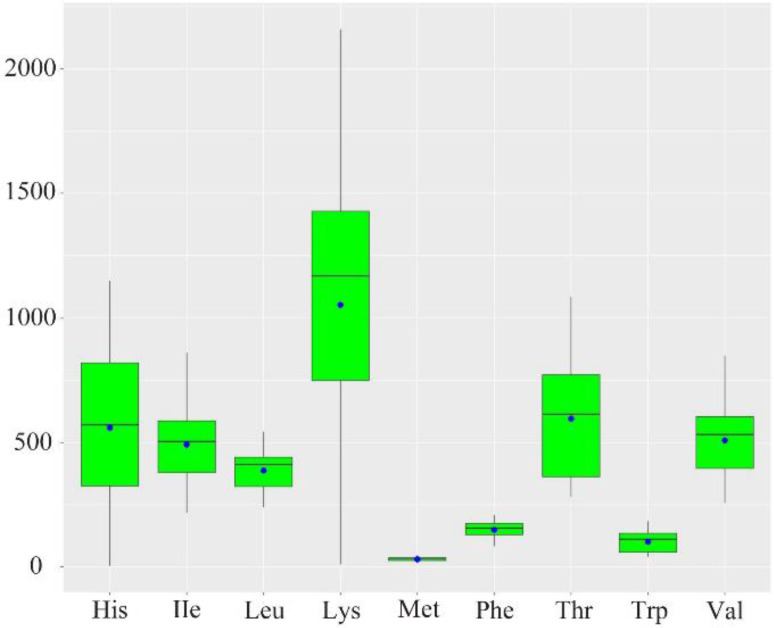
The relative concentrations of all nine EAA, shown in figure 1, were determined by LC-MS/MS. As shown, histidine (His, 4 to 1148 μM) and lysine (Lys, 7.1 to 2157 μM) had the most variation. The EAA Lys was the most abundant AA found among other EAAs, while methionine (Met), tryptophan (Trp), and phenylalanine (Phe) showed the least variation.
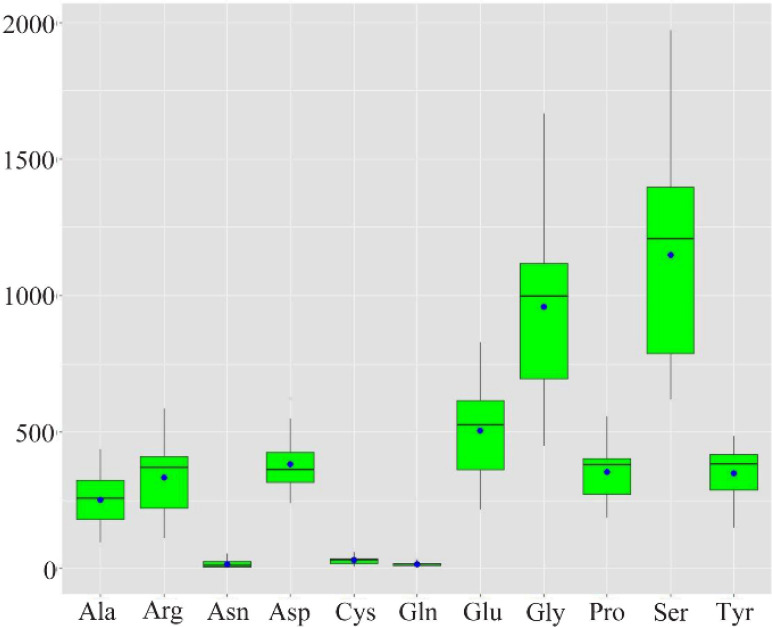
The relative concentrations of eleven NEAA found in SP were analyzed. As shown in figure 2, the most abundant NEAAs with the most variation were serine (Ser, 617 to 1970 μM) and glycine (Gly, 450 to 1666 μM). The rest of the NEAAs including alanine, arginine, asparagine, cysteine, glutamine, glycine, proline, serine, and tyrosine showed stable concentrations with a small variation.
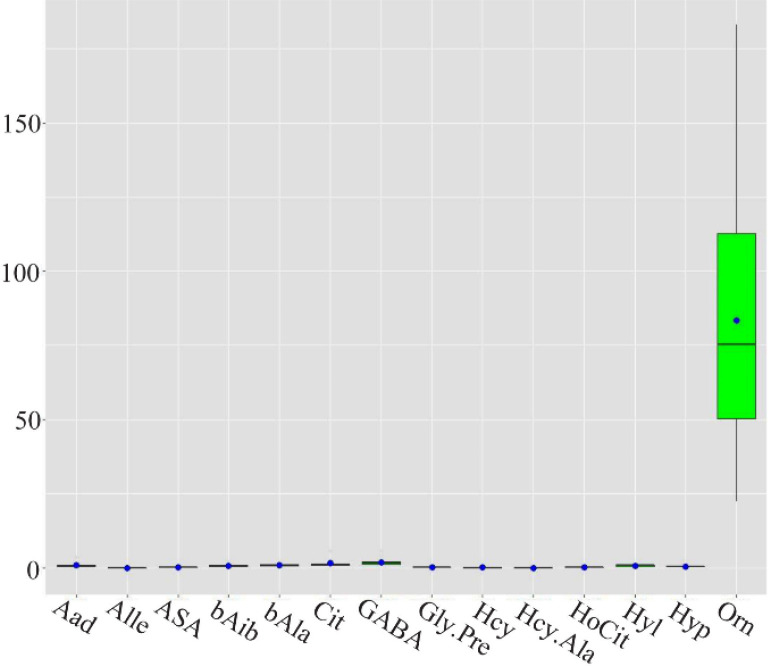
Fourteen NPAAs (alpha-aminoadipic acid [Aad], allo-isoleucine [AIle], arginosuccinate [ASA], beta-aminoisobutyric acid [bAib], citrulline [Cit], gamma-amino-butyric acid [GABA], glycylproline [Gly.Pro], homocysteine [Hcy], homocysteine alanine [Hcy. Ala], homo-citrulline [HoCit], hydroxylysine [Hyl], hydroxyproline [Hyp], and ornithine [Orn]) were subjected to relative concentration measurement using LC-MS/MS. However, as shown in figure 3, only ornithine (Orn) concentration showed the significant relative contribution in SP (22 to 183 μM). The rest of NPAAs did not contribute significantly to the AA profile of SP. Therefore, it was decided to exclude them from further analysis.
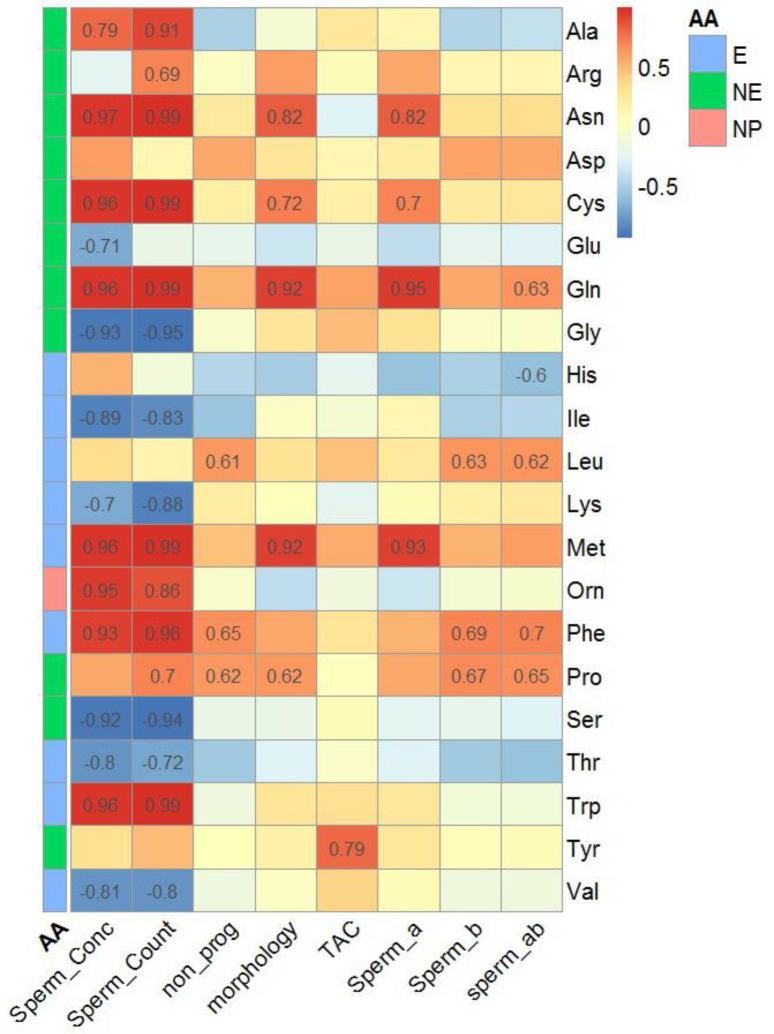
A heatmap shows a correlation of the relative concentration of AA in the SP samples with the spermiogram parameters and TAC (Figure 4). In an overall view, there are significant positive and negative correlations between the concentrations of AAs and sperm parameters. A significant positive correlation has been found between selected amino acids including methionine, rs=0.92; glutamine, rs=0.92; cysteine, rs=0.72; and asparagine, rs=0.82 (p<0.0001) with the motility. Furthermore, normal sperm morphology showed significant positive correlations with methionine (rs=0.92, p=0.0004), cysteine (rs=0.72, p=0.007), glutamine (rs=0.92, p= 0.007), and asparagine (rs=0.82, p=0.008). Sperm concentration showed significant positive correlations with aspargine, cystine, glycine, methionine, ornithine, tryptophan, and phenylalanine (p< 0.0001) (Supplementary 1 and 2). In contrast, several AAs, including glycylproline, serine, and isoleucine showed negative correlations with sperm concentration (rs=−0.93, rs=−0.92, and rs= 0.89, respectively). The total p-value of correlation of heatmap can be found in supplementary table 3 and supplementary table 4.
Metabolomics is a rapidly emerging field within the “omics” domain, currently experiencing rapid development. Metabolomics opens a new horizon in male infertility knowledge and diagnostics. During the last decade, several studies have been published regarding male infertility using metabolomics technology (5, 8, 9). To the best of our knowledge, only one study has focused on the spermiogram parameters and metabolomic profile of fertile men (19). The existing procedure for distinguishing fertile men from infertile individuals currently lacks the necessary precision, sensitivity, selectivity, and accuracy. Therefore, the need for a better diagnostic test is undeniable. To obtain this, a thorough study of spermiogram parameters of fertile men is needed to be conducted using more precise techniques such as metabolomics. SP is a “golden” biological fluid in the male reproductive system which has been underestimated in the diagnosis of infertile men (6, 7). From 34 AAs identified in SP, only 21 had significant relative concentrations (Figures 1–3). Moreover, the majority of non-proteinogenic AAs showed low levels of relative concentration (Figure 3). Only ornithine showed a high level of relative concentration (Figure 3). This is in agreement with findings of Engel et al. (19). Orn is the main source of non-proteinogenic AA conversion to polyamines such as spermine (20). Polyamines play a very important role in the sperm capacitation and acrosome reaction (21).
The total antioxidant capacity of SP plays an important role in infertility of men (22, 23). It is well-established that infertile men have an imbalanced TAC resulting in oxidative stress which has been linked with male infertility (4, 22) . Our data show that only Tyr (rs=0.79) is positively correlated with TAC (Figure 4). This is in accordance with data by van Overveld et al. which demonstrated Tyr is an important contributor to the anti-oxidant capacity of SP (24).
Normal sperm morphology showed a significant positive correlation with some proteinogenic amino acids in SP (Figure 4). Among the essential amino acids (EAAs), methionine (Met) exhibited a significant positive correlation (rs=0.92) with normal sperm morphology. Furthermore, the synthesis of cysteine (Cys), a non-essential amino acid (NEAA), is interconnected with Met, as evidenced by their positive correlation (rs=0.72). Additionally, glutamine (Gln), a prominent NEAA in seminal plasma, showed a strong positive association with normal sperm morphology. Additionally, Gln transforms to asparagine (Asn) through asparagine synthetase. As shown in figure 4, Asn is positively correlated with sperm morphology (rs=0.82). This observation is novel since Engel et al. were not able to show any association between normal sperm morphology and AAs in SP (19). Furthermore, this data is in agreement with the recently published NMR-based data on teratozoospermia showing that Gln has an important role as a biomarker in teratozoospermia (25). Interestingly, Xu et al. also reported a positive correlation between high abnormal sperm morphology and several metabolites in seminal plasma. Specifically, high abnormal sperm morphology was found to be positively correlated with carnitine, prostaglandin E3, leucylproline, valine, glutamyl arginine, and hypoxanthine. On the other hand, a negative correlation was observed between morphology and six other metabolites, namely butoconazole, 2-phosphoglyceric acid, prolylphenylalanine, glutamyl-se-methylselenocysteine, isopentenyl pyrophosphate, and creatine riboside (26).
Sperm motility is an important factor in the evaluation of male infertility. As illustrated in figure 4, four AAs showed a high positive correlation with rapid progressive sperm motility (a grade). Methionine (Met) and glutamine (Gln) demonstrate the highest positive correlation with sperm_a. This observation is not surprising considering that the synthesis pathways of Met and Gln culminate in cysteine (Cys) and asparagine (Asn), respectively.Thus, these two AAs also show a positive correlation with sperm_a (rs=0.72 and rs=0.82, respectively). Additionally, this data is in accordance with Zhang et al.’s findings who reported that Met and Gln, as biomarkers, play an important role in SP of asthenozoospermia patients (27). Other AAs, including proline, phenylalanine, and leucine show positive correlations with other sperm motility parameters such as slow progressive sperm motility (b grade) though the correlation coefficient was relatively low (Figure 4). Furthermore, Engel et al. did not observe any correlation between sperm motility and seminal plasma AAs (19). In order to evaluate whether these AAs make a major contribution in sperm motility, a further study, specifically including asthenozoospermic patients, is needed. The table showing total correlations can be found in supplementary table 2.
Some of the proteinogenic AAs, including tryptophan, phenylalanine, and alanine show positive correlations with sperm concentration (Figure 4). This is in agreement with Engel et al.’s and Qiao et al.’s findings (19, 28). Nevertheless, several AAs, including glycine, serine, isoleucine, had negative associations with sperm concentration. This data is in accordance with Qiao et al.’s report about a negative association of some amino acids with sperm concentration using gas chromatography–mass spectrometry (GC-MS) (28). Among the NPAA, Orn showed a high positive correlation with sperm concentration (rs=0.95). At the same time, it can be observed that Met and Cys have a high positive correlations with sperm concentration (rs=0.96 and rs=0.96, respectively) (Figure 4). These three AAs are interconnected in biochemical pathways (20). Additionally, it is not surprising since Orn converts into several polyamines which are important for sperm capacitation and acrosome reaction (21). Murgia et al. performed an untargeted metabolic analysis of SP from oligozoospermic patients (29). However, they were not able to see significant AA changes in SP from these patients.
Recognizing seminal metabolic signature and determining the cut-off levels of some notable metabolic compositions in fertile men with normal semen parameters may help to understand the underpinning mechanisms of male infertility (30).
In this study, a correlation analysis was conducted between the amino acid (AA) profile of seminal plasma (SP) and spermiogram parameters obtained from fertile men. The strong positive/negative correlations between seminal metabolic signature and sperm concentration, motility, and morphology demonstrate the significance of determining metabolite concentration levels under normal conditions. Combining the metabolome with clinical characteristics of semen enables clinicians to look beyond biomarkers toward the clinical interpretation of seminal parameters to explain the biological basis of sperm pathology.
We would like to acknowledge the contribution of Avicenna Research institute for providing the grant that supported this study (Grant No. 940103-004).
