
Reproductive tract infections play a significant role in the development of male and female infertility. Among male infertility factors, 13–15% are related to infections (1). Chlamydia trachomatis (CT) is one of the most prevalent sexually transmitted infections worldwide and a common cause of pathology in both men and women, causing several genital tract infections, ectopic pregnancies, and infertility (2, 3). Defensins are cationic antibacterial and antiviral peptides classified as α-defensin, β-defensins, and hdefensins. Humans have only α-defensins and β-defensins. In addition to their direct antimicrobial functions, defensins have immunomodulatory functions and are involved in many physiological processes (4). Studies have shown that defensins are widely distributed in both the female reproductive tract (FRT) and male reproductive tract (MRT), playing a dual role in host defense and fertility protection. Moreover, a high expression level of β-defensins is found in MRT (4–6). It is highly expressed in the epididymal caput and corpus, indicating that defensins play an important role in sperm maturation. The expression of defensins in MRT varies with androgen levels, age (7–9), and the status of microbial invasion (10–12). They protect the male reproductive system from bacterial infections by neutralizing lipopolysaccharide (LPS) (13) and downregulating proinflammatory cytokines (14). In addition to sperm maturation, animal and clinical studies have shown that defensins play an important role in sperm motility and fertilization (15). As a broad-spectrum antimicrobial peptide without drug resistance, defensin has great potential for the development of new natural antimicrobial treatments for reproductive tract infections (4). However, increasing evidence has shown that defensins can not only inhibit microbial invasion but also promote the invasion and adhesion of some microorganisms in certain biological environments (16).
DEFB126 is a secretory glycoprotein, rich in cysteine, that is secreted by the principal epididymal epithelial cells and covers the entire surface of spermatozoa (5, 17). DEFB126 is present in ejaculated spermatozoa and is essential for them to pass through the female reproductive tract. This ability is related to terminal sialic residues that have negative charges, as the removal of these residues from DEFB126 results in a decrease in the number of spermatozoa that can successfully transit through the cervical mucus (18, 19). The DEFB126 glycoprotein plays a multifaceted role in various reproductive events. It is involved in crucial functions such as the storage of sperm in the tail of the epididymis, facilitating sperm movement through cervical mucus, protecting spermatozoa from the female immune system, as well as shielding them from enzymatic and microbial attacks. Additionally, it contributes to sperm capacitation, binds to the oviduct epithelium, and aids in the formation of a reservoir of spermatozoa within the oviduct (20, 21). Upon capacitation, DEFB126 is released from the sperm surface, which appears to be important for facilitating binding to the zona pellucida (5, 19). Sperm cells that are not covered by DEFB126 show reduced ability to reach the egg, which consequently leads to reduced fertility (6, 21). Human DEFB126 is located on the subtelomeric region of chromosome 20p13 and does not contain copy number variations (22). Several studies have demonstrated that a two-nucleotide deletion in DEFB126 gene on both chromosomes (del/del) results in a frameshift mutation and produces a non-stop mRNA that is prone to degradation due to nonsense-mediated mRNA decay (6, 23, 24). Protein expression in males with the del/del genotype was significantly lower compared to the other genotypes.
DEFB126 is secreted by the principal epididymal epithelial cells and covers the entire surface of spermatozoa (5, 17). In addition to facilitating sperm movement in cervical mucus and capacitation, it is also involved in the protection of spermatozoa against the female immune system as well as against enzymatic and microbial attacks (20, 21). Several studies have demonstrated that homozygous 2-nt deletion of the DEFB126 gene (rs11467417) impairs DEFB126 protein synthesis (6, 25, 26). Protein expression in males with del/del genotype exhibited significantly lower levels compared to individuals with other genotypes (25). Considering the above-mentioned facts, the purpose of the current study was to investigate whether there is any association between the 2-nt deletion of the DEFB126 gene and CT infection in infertile Iranian males referred to Royan Institute.
Semen collection and Chlamydia trachomatis (CT) infection analysis: In this pilot case-control study, semen samples of 1080 subfertile males (aged 26–55 years) from the Infertility Clinic of Royan Institute were investigated between 2015 to 2017. Initially, the participants were divided into two primary groups based on their semen analysis results:
Patients with a history of antibiotic consumption in the last two months, positive for HIV, HBsAg, HCV Ab, varicocele, azoospermia, and history of epididymitis or epididymoorchitis were excluded from this study.
Semen samples were collected by masturbation after three days of abstinence. Sperm concentration, motility, and morphology were assessed according to World Health Organization guidelines (2). Serological testing for CT and molecular methods for detecting ctDNA in semen samples have been described in detail in our previously published article (27). Samples that were positive by molecular and serological testing were included as CT-positive samples.
The individuals in the case group who were CT-positive and had an abnormal spermogram with high WBC (>1000 per/ml), low sperm count, low normal morphology, and low sperm motility were considered as symptomatic positive group. The portion of the main control group that exhibited no particular semen abnormalities but tested positive for CT was categorized as the third group, referred to as the infected asymptomatic group. The study was approved by the Ethical Review Board of the Royan Institute, following the principles outlined in the Helsinki Declaration (reference number: IR.ACECR.ROYAN.REC.1394.27). After obtaining informed consent from all patients enrolled, semen samples were collected for the study.
DEFB126 genotyping: In this pilot case-control study, among patients who had CT-positive results, sperm DNA from 50 symptomatic and 50 asymptomatic patients were collected for DEFB126 genotype analysis. Additionally, a control group comprising 100 DNA samples from individuals with normal spermogram and testing negative for CT was included in the study. Specific primers which were used to detect ctDNA as well as the primers amplifying the region of 2-nt deletion of the DEFB126 gene are shown in table 1.
Table 1 DEFB126 primers of the study
| Primer name | Primer sequence (5’-3’) | Product size |
|---|---|---|
| CT1-F | GGACAAATCGTATCTCGG | 320 |
| CT1-R | GAAACCAACTCTACGCTG | 320 |
| CT2-F | ATCCATTGCGTAGATCTCCG | 517 |
| CT2-R | GCCATGTCTATAGCTAAAGC | 517 |
| DEF-F | AAGAATGGTTGGGCAATGTGC | 256 |
| DEF-R | CCACCATGCTTTAATGAGTCGGG | 256 |
The PCR-sequencing technique was performed to detect the 2-nt deletion of the second exon of the DEFB126 gene [NM_030931.4:c.317_318del, NP_112193.1:p.Pro106fs] according to the detailed protocol described previously by Boroujeni et al. (25). Briefly, after performing the PCR with specific primers on sperm DNA, PCR products were sent to Fazabiotech Company (Tehran, Iran) for being sequenced. The sequencing analysis was conducted in accordance with the Sanger sequencing standards, utilizing the ABI 3730XL Capillary Sequencer (ThermoFisher, US). The obtained results were then compared to the wild-type DEFB-126 gene sequence sourced from NCBI (https://www.ncbi.nlm.nih.gov). The extracted data were analyzed with BLAST (https://blast.ncbi.nlm.nih.gov/Blast.cgi) and Finch TV (https://digitalworld-biology.com/FinchTV). The sequences corresponding to the second exon of the DEFB126 gene in all of the CT-positive (case group) and the CT-negative (control group) infertile males were compared with the reference sequence (NC_000020.10) available on the NCBI-Gene site.
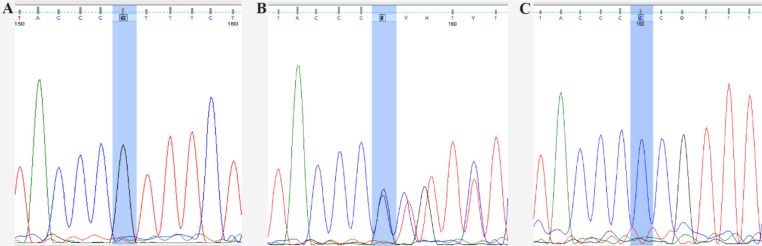
The wt/wt genotype refers to patients who do not have any deletions and exhibit a normal homozygous genotype (Figure 1A). In the wt/del genotype, the Finch TV analysis revealed the presence of two peak series in the corresponding regions. One peak represented the normal allele, while the other peak represented the mutant allele with a deletion of two cytosines, indicating a heterozygous genotype (Figure 1B). Patients with the del/del genotype demonstrated 2-nt deletion in both alleles in exon 2, indicating a homozygous genotype (Figure 1C).
Statistical analysis: Statistical analyses were carried out using SPSS version 22.0 (SPSS Inc., USA). Chi-squared test was used to determine the significance of the difference between DEFB126 mutation carriers and CT infection. A P-value of ≤0.05 was considered statistically significant.
To determine the association between the DEFB-126 gene variant and CT infection, the presence of two cytosine deletions in exon 2 of the DEFB126 gene was evaluated in 100 CT-positive and 100 CT-negative infertile men.
Out of the 100 CT-positive males, 36% had a homozygous genotype for the wild-type allele, 37% had a heterozygous genotype with the deletion, and 27% had a homozygous genotype with the deletion. Among the control group, 41% exhibited a homozygous wild-type genotype, 48% had a heterozygous genotype, and 11% had a homozygous genotype with the deletion (Table 2). The Chi-squared test comparing all three groups revealed no significant differences across the different genotypes (p=0.074). Moreover, based on the statistical data, no significant difference between the two CT-positive groups (symptomatic vs. asymptomatic) was seen (p=0.307).
Table 2 Genotype distribution between CT-positive (symptomatic and asymptomatic) patients and controls
| CT-positive patients 100 | CT-positive patients 100 | Controls 100 | p-value | |||||||||
|---|---|---|---|---|---|---|---|---|---|---|---|---|
|
| ||||||||||||
| Symptomatic 50 | Asymptomatic 50 | |||||||||||
| Genotype | ||||||||||||
|
| ||||||||||||
| At least one normal allele | No deletion | 73 (73%) * | 37 (74%) ** | 15 (30%) | 36 (72%) ** | 21 (42%) | 89 (89%) * , ** | 41 (41%) | * p=0.021 | ** p=0.046 | ||
|
|
|
|
| |||||||||
| Hetero | 22 (44%) | 15 (30%) | 48 (48%) | |||||||||
|
| ||||||||||||
| -No wildtype allele | Homo | 27 (27%) * , ** | 13 (26%) | 14 (28%) | 11 (11%) * , ** | * p=0.021 | ** p=0.046 | |||||
Significant difference when comparing CT-positive patients and controls in terms of the presence of at least one normal allele (p≤0.05)
Significant differences when comparing all three groups of samples with respect to the presence of at least one normal allele (p≤0.05)
However, statistical analysis of CT-positive patients and controls demonstrated significant differences in the frequencies of homozygous del/del genotypes (p=0.042) (Table 2).
Based on the results of DEFB126 protein analysis (25), it was previously revealed that heterozygous wt/del individuals retain DEFB126 protein on their sperm surface. Therefore, by summing the frequencies of individuals with at least one normal allele (wt/del and wt/wt individuals), a significant difference was observed between the number of individuals with a wild-type allele (73%) and those without a copy of the wild-type allele (homozygous for the deletion, 27%) in infertile versus fertile men (p=0.013) (Table 2). As shown in table 2 and based on the Chi-squared test results, homozygote deletion was seen in 26% and 28% of symptomatic and asymptomatic CT-positive patients, respectively; which were significantly higher than that observed in the controls (11%) (p=0.046).
Evaluation of CT infection in men is important because they can remain asymptomatic and transfer the infection to their female partners (28). This infection can persist for up to several years within couples and affect their fertility (29). Accordingly, CT infection may be one of the reasons for male infertility in those patients with idiopathic infertility (30). Previous studies demonstrated that a decrease in sperm count, sperm motility and progression, as well as an increase in the number of dead sperm and teratozoospermia index were all significantly associated with the presence of CT infection in infertile men (31, 32). Moreover, Vigil et al. suggested that another possible effect of CT on male fertility might be due to its transmission to female partners, and consequently, the inflammatory processes that promote the generation of anti-sperm antibodies in the female reproductive tract (33).
Defensins, which are cationic proteins, are primarily expressed by neutrophils and epithelial cells. They play a significant role in the innate immune response at mucosal surfaces, acting as crucial components in combating infectious pathogens (34). The protective role of β-defensins against CT infections in FRT has been widely discussed (35–40). However, there is only one study on the role of defensins in preventing CT infections in MRT (41). To the best of our knowledge, this publication does not specifically focus on β-defensins.
The results of this study showed a significant difference between the frequencies of homozygous del/del genotype in CT-positive patients and controls. Interestingly, when there was only one normal allele (heterozygote), CT-positive patients and controls did not show a significant difference. Conversely, the frequency of individuals homozygous for the deletion in both symptomatic and asymptomatic CT-positive patients was higher when compared to the control group. Based on our results, the antimicrobial role of DEFB126 was suggested for the first time. Since it was previously discovered that the sperm surface of heterozygous wt/del individuals is still covered by the DEFB126 protein (25), it can be concluded that DEFB126 may play an important role in the effectiveness of immune response against CT infection. These results are in agreement with those of the previous studies. According to Yenugu et al., DEFB118, which is similar to DEFB126 and has the characteristics of other β-defensins, contributes to epididymal innate immunity and protects the sperm against attack by microorganisms in the male and female reproductive tracts (8). Moreover, recombinant β-defensin 22, the rat homolog of DEFB126, has been previously characterized as an effective antimicrobial peptide against E. coli, S. aureus, and C. albicans (42, 43). It is suggested that the pathogenicity of gram-negative bacteria, such as E. coli and CT, is usually associated with the lipopolysaccharide (LPS) layer, which is the main component of their cell walls. In humans, LPS can provoke an innate immune response (44) and induce defensin expression in the reproductive tract. On the other hand, defensins can regulate the immune response of macrophages against gram-negative bacterial infection by neutralizing LPS (13). In cases where defensin expression is absent, such as in individuals with a homozygous del/del genotype in DEFB-126, this process of immune defense may be compromised.
This study did not show any differences between symptomatic and asymptomatic CT-positive patients regarding the DEFB126 genotypes. In addition, 11% of the CT-negative infertile patients with normal spermogram showed homozygosity for this deletion (del/del). Based on the available information, it can be inferred that the 2-nt deletion had no detrimental impact on the parameters considered as “symptoms” in the patients’ spermogram, including sperm count, motility, and morphology. Although He et al. in 2022 suggested an association between this variant and unstable defensin protein on the sperm surface and idiopathic asthenozoospermia (45), Tollner et al. considered this variant as a common mutation that causes impaired sperm “function” and subfertility in idiopathic infertile men with normal spermogram. It has been observed that sperm from individuals with the del/del genotype appears normal when assessed using conventional measures of male fertility potential, including sperm count, motility, and the percentage of sperm with normal morphology (5, 6). These data are also in agreement with our previous study on the role of this variant in idiopathic male infertility (25). However, based on the results of Aram et al., the proportion of DEFB126-positive sperm was positively correlated with sperm motility and normal morphology. Based on their findings, full-length DEFB126 can increase sperm motility in vitro. However, no genotype analysis was performed in this study (46).
The higher prevalence of the 2-nt deletion in the DEFB126 gene among CT-positive patients suggests a potential association between mutations in the DEFB126 gene and a compromised antimicrobial function of the DEFB126 protein. This compromise in the antimicrobial function of the DEFB126 protein may increase susceptibility to infections such as Chlamydia trachomatis (CT). Our results suggest that DEFB126 plays a significant role in the innate immune response against infectious pathogens. Like other genetic factors influencing individuals’ immune defense mechanisms, DEFB126 emerges as a noteworthy contributor to the modulation of Chlamydial infection pathogenesis and its potential impact on male fertility.
We are thankful to the participants of the study and personnel of the Genetic Laboratory of Royan Institute for their technical help and services. The authors would like to gratefully thank Dr. Salman Yazdi and Mrs. Mona Ahmadipanah for their support.
Funding: This study was funded by a grant from Royan Institute, Tehran, Iran (Grant number: 91000673).
