
The human genetic blueprint comprises 22 pairs of autosomes and two sex chromosomes, forming the foundation of human inheritance. During the formation of a zygote, genetic material is contributed equally by both parents through the sperm and oocyte, resulting in a blend of genetic information. However, the journey from conception to birth is not without its challenges, and genetic errors may occur during the myriad cell divisions that occur on this path. In some instances, mosaic embryos, characterized by the presence of genetically different cells, including some that may have chromosomal abnormalities or gene mutations, can develop into seemingly healthy individuals. Such individuals can have a subpopulation of genetically abnormal cells either in somatic tissues or within their germline (gametes). The latter holds significance in predisposing individuals to abnormal conceptions and, in some cases, children affected by cytogenetic abnormalities of monogenic disease.
Detecting mosaicism, especially in the germline, presents challenges owing to the subtlety of the phenomenon and the frequent lack of a phenotype. Confirming aneuploid mosaicism in an individual across different cell types can offer insight into the embryonic stage at which the abnormality occurred. Crucially, it must be recognized that aneuploidies originating from mitotic errors in oogonia may not manifest in postnatal karyotype analyses of somatic tissues, which could lead to underestimations of germline-associated mosaicism rates (1).
The genetic make-up of an individual may be seemingly normal from a phenotypic perspective. Balanced structural chromosomal rearrangements rarely disrupt genes and do not involve loss or duplication of genetic material. Consequently, aneuploidies may remain hidden, only being revealed when the individual attempts to conceive and begins to experience fertility problems, such as recurrent miscarriages or genetically abnormal pregnancies/births. The reported incidence of structural chromosome alterations in first-trimester miscarriages ranges from 1.2% to 4.4% (2). In the general population, the most common type of structural chromosomal rearrangements is the Robertsonian translocation (RT), arising from fusion between the long arms of two of the acrocentric chromosomes (13–15, 21, 22), near their centromeric regions. RT can occur between nonhomologous or homologous chromosomes, with the latter being extremely rare. This rarity is partly due to the fact that rearrangements cannot be propagated through generations of a family (3). Carriers of homologous RT tend to be infertile and suffer from recurrent miscarriages, due to an inability to produce chromosomally balanced gametes. In fact, nearly 100% of their gametes will be either nullisomic or disomic for the translocated chromosome (3). The only way for such a patient to produce a karyotypically normal embryo is when uniparental disomy (UPD) affects the translocated chromosomes, an extremely rare event that carries its own problems associated with abnormal expression of imprinted genes. Considering that the incidence of RT is approximately one in 1000 individuals and that one in 100 couples with recurrent pregnancy loss will be carriers, it is important to delve deeper into the genetic basis of miscarriages resulting from such chromosomal rearrangements (4). Advances in genetic testing, coupled with assisted reproductive technologies, have revolutionized the landscape of genetic risk assessment in humans. Preimplantation genetic testing for aneuploidy (PGT-A) has emerged as an approach for identifying embryos with chromosomal abnormalities before implantation, hence reducing the risk of miscarriages, abnormal pregnancies, and birth defects. In this context, the purpose of the current report was to contribute to the growing body of knowledge surrounding germline mosaicism involving structural chromosome rearrangements. The findings described offer valuable insights into genetic risk assessment in the context of germline mosaicism and fertility.
A 33-year-old woman sought fertility treatment at Aria Fertility in London in May 2021, following four years of attempting to conceive. Written consent from the patient was obtained for this report. The couple experienced a series of recurrent miscarriages (n=6), most of which occurred within 4–5 weeks of gestation, with the most recent one dated February 2022. A product of conception (POC) analysis was performed via karyotyping, revealing an abnormal chromosome complement (der(14;14) (q10;q10)). Consequently, the couple underwent karyotyping of peripheral blood lymphocytes, which yielded normal results twice. The genetic laboratory determined that the RT detected in the recent miscarriage was most likely to have occurred de novo, rather than resulting from missegregation of a parental rearrangement (Figure 1). For this reason, the risk of recurrence was predicted to be low.
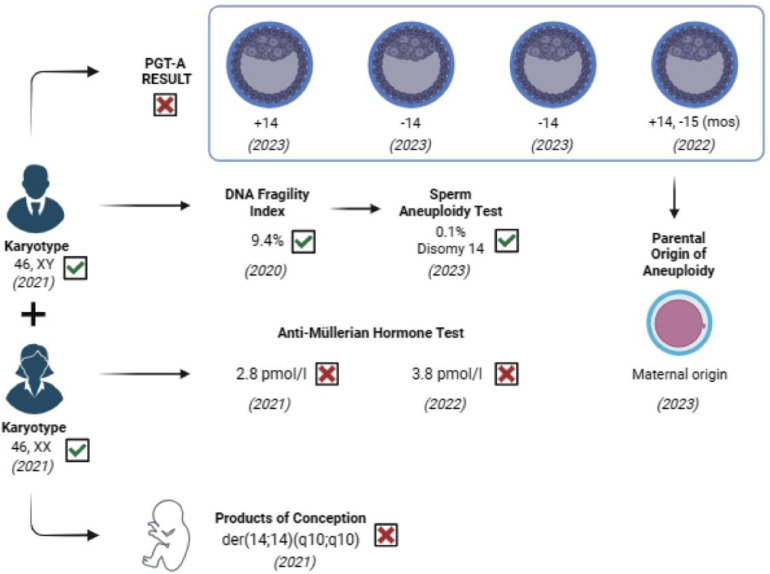
Fertility investigations disclosed an anti-Mullerian hormone (AMH) level of 2.6 pmol/L in 2021 and 3.86 pmol/L in 2022, which were both outside the normal range (4.1–58 pmol/L). In 2023, the semen analysis conducted for the male partner indicated normal values, including a sperm count of 102 M/ml, 71% progressive sperm, and 7% normal forms. Sperm DNA fragmentation testing done in 2020 showed a DNA fragmentation index of 9.4% (normal).
During treatment at the patient’s initial clinic in April 2022, a total of 7 mature oocytes were obtained. Among them, 5 successfully fertilized, leading to the transfer of a single blastocyst, while two additional embryos were vitrified. Unfortunately, both the initial cycle and a subsequent frozen single embryo transfer yielded negative results on urine pregnancy tests. Endometrial receptivity analysis (ERA; Igenomix, UK) indicated normal receptivity, and hysteroscopy and dilation and curettage (D&C) procedures showed normal findings. The remaining embryo was transferred to Aria Fertility Laboratories.
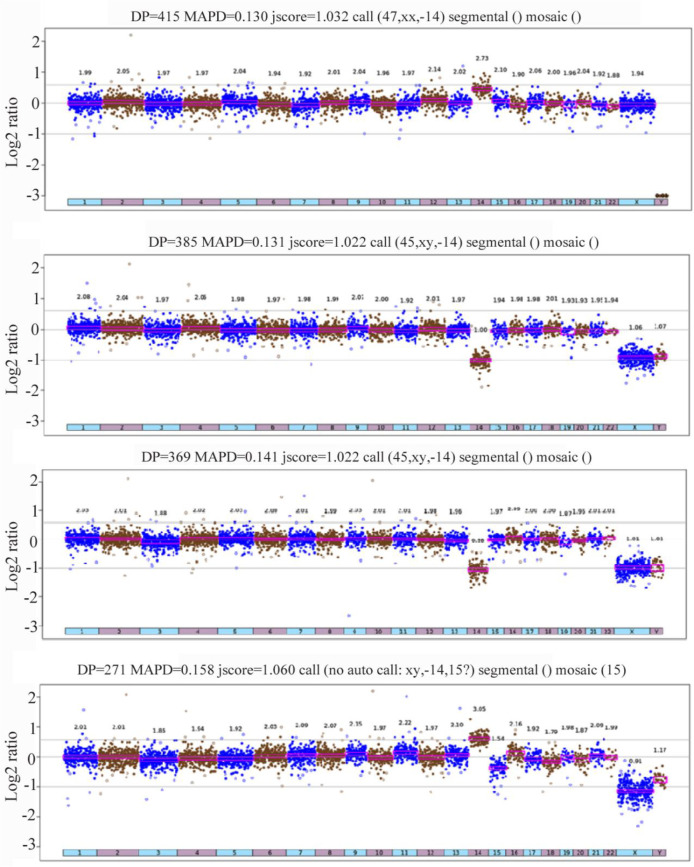
In April 2023, the patient underwent another cycle of IVF at Aria Fertility including PGT-A. The PGT-A method employed was PGTseq (Juno Genetics, USA), which is a custom targeted amplification-based approach. This method is widely recognized as one of the most validated and accurate techniques for PGT-A currently available (5–6). The IVF cycle resulted in 5 oocytes, all of which fertilized successfully, with 3 embryos reaching the blastocyst stage. The three blastocysts from the fresh cycle and the cryopreserved embryo from the previous cycle underwent trophectoderm biopsy, involving approximately 5 cells, followed by PGT-A analysis. The results showed that two of the blastocysts were monosomic for chromosome 14, one was trisomic for the same chromosome, and the remaining embryo exhibited trisomy 14 along with a mosaic loss of chromosome 15 (Supplementary Figure I).
Sperm aneuploidy test (ERA; Igenomix, UK) was performed to determine if the elevated aneuploidy rate for chromosome 14 could have a paternal origin. SAT is a cytogenetic test used to assess male infertility by measuring the percentage of spermatozoa with specific abnormalities involving loss or gain of the tested chromosome(s). SAT employs fluorescence in situ hybridization (FISH) and can be applied to ejaculated, epididymal, and testicular sperm. The details on the probes used are as follows: triple FISH includes a centromeric probe for chromosome 18p11.1-q11.1 (D18Z1) in blue, a centromeric probe for chromosome Xp11.1-q11.1 (DXZ1) in green, and a centromeric probe for chromosome Yp11.1-q11.1 (DYZ3) in orange (Cytocell Ltd., UK). Dual FISH involves a locus-specific probe for chromosome 13q14.2 in green and a locus-specific probe for chromosome 21q22.13 in orange (Cytocell Ltd., UK). Dual FISH utilizes a locus-specific probe for chromosome 14q32.33 in green and a locus-specific probe for chromosome 18q21.33 in red (Cytocell Ltd., UK). A normal SAT result is considered when the sample shows similar percentage of abnormal sperm compared to an internal control population of 44 fertile males with normal sperm parameters (evaluated using a Chi-square test or Fisher exact test; p<0.05). A total of 6175 sperm were analyzed, resulting in a normal SAT outcome for the analyzed chromosomes (13, 14, 18, 21, and sex chromosomes). The percentage of disomy for chromosome 14 was 0.10, compared to 0.13 in the control group (7). This outcome indicated that there was no elevated risk of sperm chromosomal abnormalities and therefore chromosome 14 aneuploidies observed in the embryos were unlikely to have had a paternal origin.
In order to determine the parental origin of chromosome 14 aneuploidies in the embryo biopsies, a genotype analysis was conducted using DNA samples obtained from the maternal and paternal blood samples. Juno Genetics employs PGTseq platform for their regular PGT-A procedures, incorporating chromosomal copy number analysis alongside a genotyping method that encompasses roughly 5,000 single nucleotide polymorphisms (SNPs) distributed across the entire genome. The SNPs located on chromosome 14 were analyzed in the parental samples as well as the embryos tested by PGT-A to investigate the parental origin of aneuploidy. The analysis confirmed that all the four chromosome 14 abnormalities detected in embryos were associated with errors of maternal (oocyte) origin.
The results are indicative of a maternal 14;14 RT affecting some or all of the female partner’s oocytes. This inference is supported by the following observations: 1) the patient had experienced multiple miscarriages, and one of the miscarriages was found to carry a 14;14 RT; 2) during IVF cycles, there was an unusually high incidence of chromosome 14 abnormalities in the produced embryos, which is expected if one of the parents carries a 14;14 RT; 3) the abnormalities in chromosome 14 copy number seen in the embryos were determined to be of maternal origin; and 4) analysis of a sperm sample from the father did not reveal an elevated frequency of abnormalities of chromosome 14. Considering that the analysis of blood samples from the two parents had previously failed to detect a translocation, it seems likely that the female patient is mosaic, with the translocation restricted to a subpopulation of her cells. Oocytes carrying a 14;14 RT have a significantly low probability of developing into viable embryo. It is uncertain whether all of the patient’s oocytes carry the translocation or if there are oocytes with a normal karyotype. However, the history of miscarriages and prevalence of chromosome 14 aneuploidies observed in the embryos suggest that abnormalities associated with the translocation will probably be present in the majority of oocytes produced. Although no evidence of oocytes lacking the translocation was seen during the PGT-A analysis, the number of embryos tested was limited, and consequently the possibility that there could be some oocytes of normal karyotype cannot be excluded.
Following the first case report of a homologous RT involving chromosome 14 (8), several publications have documented both female and male carriers (9–11). Cinar et al. in 2011 presented a 36-year-old female and a 56-year-old male with a history of two unsuccessful IVF attempts (12). The male had two healthy children from his previous relationship, during which his former partner had experienced six spontaneous abortions. The semen analysis showed that the sample was oligoasthenoteratozoospermic and cytogenetic analysis performed on a peripheral blood sample revealed a pure 45,XY,t(14;14)(q10;q10) karyotype for the male (the female partner had a normal karyotype). Interestingly, sperm FISH analysis for chromosome 14 revealed that 13% of sperm cells were normal. The presence of two healthy children from male partner excludes the possibility of these embryos resulting from uniparental disomy (UPD), since paternal UPD for chromosome 14 is associated with mental retardation and dysmorphism due to abnormal expression of imprinted genes (13). Although this study showed a case where the male gamete was the likely cause of increased genetic abnormalities, it highlights the intricacy of predicted germline mosaicism.
It is important to acknowledge the emotional strain, grief, and loss resulting from recurrent miscarriages and the complexities associated with the couple’s unique case. Providing emotional support and equipping the couple with various coping resources for infertility and recurrent pregnancy loss is important. Taking a comprehensive and holistic approach to genetic counselling can be immensely beneficial, aiding the couple in making well-informed decisions while navigating the intricate landscape of their reproductive journey throughout their fertility experience.
Although PGT-A was performed on embryos, the mosaic nature of the translocation may prompt consideration of a broader range of reproductive options, including the use of donor eggs or embryo adoption. This wider perspective on reproductive choices can offer the couple alternatives to increase their chances of a successful pregnancy and provide clarity and closure regarding their initial expectations about their desired family dynamic.
