
Polycystic ovary syndrome (PCOS) is a major public health concern that mainly affects the female reproductive system and is characterized by anovulation or oligo-ovulation, hyperandrogenism, and polycystic ovaries. The prevalence of PCOS is estimated to be 5–18%, making it the most common cause of anovulatory infertility (1–3).
From a therapeutic standpoint, the treatment options of PCOS depend primarily on the desired clinical outcome, such as reducing hyperandrogenism symptoms and the treatment of infertility (4). However, currently available treatments are unable to completely resolve the adverse consequences of PCOS, which is attributed to the lack of comprehensive understanding of the pathophysiology of this disease (5).
That is why investigating the pathophysiology of PCOS and identifying new drug targets remains a hot topic of scientific research. Nevertheless, the findings of many studies show that oxidative stress plays a key role in the occurrence and development of PCOS (6–8). Oxidative stress refers to the imbalance between the intracellular production of oxidants and the activity of the cellular antioxidant system. In therefore, the accumulation of oxidants causes protein and deoxyribonucleic acid (DNA) damage and lipid peroxidation, which ultimately leads to cell dysfunction (9). However, understanding the vital role of oxidative stress in PCOS alone is insufficient. To achieve a more effective treatment of the disease, it is crucial to explore the origin of oxidative stress in PCOS patients.
Hydrogen sulfide (H2S), recently recognized as the third gasotransmitter after nitric oxide (NO) and carbon monoxide (CO), is endogenously produced by cystathionine β-synthase (CBS), cystathionine γ-lyase (CSE), and 3-mercaptopyruvate sulfurtransferase (3-MST), which have different expressions in different mammalian tissues (10, 11). For example, evidence has shown that CBS and CSE play major roles in the female reproductive system (12). The importance of H2S produced by these two enzymes in female reproduction became more apparent when reports of changes in the H2S signaling pathway in female reproductive diseases such as PCOS were published (13). Given the potent antioxidant role of H2S (14), the purpose of this study was to investigate the potential link between decreased activity of H2S-producing enzymes, CBS and CSE, and oxidative stress in PCOS. The objective was to assess whether administration of sodium hydrosulfide (NaSH) as an H2S donor can alleviate PCOS symptoms by restoring H2S levels and mitigating oxidative stress. The second goal was to evaluate the impact of NaSH on enzymatic activity, histological changes in the ovaries, and oxidative stress markers in a rat model of PCOS. The findings may contribute to understanding the role of H2S in PCOS pathology and offer insights into potential therapeutic strategies.
Experimental design: For this study, a total of 18 adult female Wistar rats weighing 180–200 g were obtained from the Department of Physiology of Tehran University of Medical Sciences. Animal care and the general protocols for animal use were approved by the Experimental Animal Committee of Tehran University of Medical Sciences.
All animals were kept at a constant temperature of 20–22°C and a 12 hr light-dark cycle with free access to standard laboratory chow and tap water. Six days before the start of the experiment, the animals were checked for regular estrous cycles by vaginal sampling and then randomly divided into three groups (n=6). The control group received a single intramuscular dose of 0.2 ml of sesame oil. The PCOS group was given a single intramuscular dose of 4 mg/kg of estradiol valerate (Aburaihan Pharmaceutical Co, Iran) dissolved in 0.2 ml of sesame oil (15). The PCOS+ NaSH group was treated with 30 μmol/L of NaSH (Sigma Aldrich, USA) in drinking water for 27 days, starting on the third day after PCOS induction (16). At the end of the procedure, the rats were anesthetized with intraperitoneal injections of ketamine (100 mg/kg) and xylazine (10 mg/kg), and their abdomens were opened. Then, the ovaries were resected and washed in cold saline on ice. For biochemical and oxidative stress measurement, the tissues of the left ovary were quickly frozen in liquid nitrogen and the samples were stored at −70°C until further study. The right ovary tissues were fixed in 10% formalin for histological evaluation.
Determination of the estrous cycle: The estrous cycle was determined by collecting a vaginal smear, whereby 100 μl of sterile saline was gently introduced into the vagina and then aspirated from the tip of the sampler. This allowed for the assessment of vaginal epithelial cells. The procedure was repeated 3 to 4 times. The liquid containing a few drops of cell suspension was poured onto a glass slide, air-dried, and stained using 0.1% crystal violet. Then, the stained slides were observed under a light microscope at 200× magnification (17).
Measurement of ovarian oxidative stress indices: MDA levels in the ovarian tissue were determined according to the method of Esterbauer and Cheeseman. MDA reacts with thiobarbituric acid and produces a pink pigment with a maximum absorption of 532 nm (18).
Enzyme-linked immunosorbent assay (ELISA) kit (Nasdox; Navand Salamat, Iran) was used to measure SOD activity. Briefly, 100 mg of the ovarian tissue was homogenized with 500 μl of lysis buffer and centrifuged at 12,000 rpm for 5 min at 4°C. Next, 50 μl of the obtained supernatant was added to the wells of the microtiter plate, followed by addition of 200 μl of reagent 1 and 50 μl of reagent 2. After 5 min of incubation at room temperature and darkness, the absorbance of the samples was measured using an ELISA reader at 405 nm (19).
Measurement of ovarian H2S levels: In total, 50 mg of the ovarian tissue were homogenized in 500 μl of phosphate-buffered saline and incubated with L-cysteine, pyridoxal phosphate, and normal saline for 30 min at 37°C. Then, trichloroacetic acid and zinc acetate were added to them. After 15 min, N, N-dimethyl-p-phenylenediamine sulfate and ferric chloride were introduced, and the light absorption of the samples was read using a microplate reader at a wavelength of 660 nm (20).
Assessment of ovarian CBS and CSE activity: The activity of CBS and CSE in the ovarian tissue was evaluated with a commercially available ELISA kit (Abbexa, United Kingdom). Next, 100 μl of reagent was added to 100 μl of ovarian tissue supernatant and incubated for 2 hr. In the next step, 90 μl of 3,3',5,5'-tetramethylbenzidine (TMB) solution was added to each well, and the optical density of each well was immediately measured by an ELISA reader at a wavelength of 450 nm.
Evaluation of ovarian histopathology: The ovarian tissues fixed in formalin were embedded in paraffin blocks and cut into 5 μm sections. The tissue sections were then stained with hematoxylin and eosin and observed with a light microscope at 400× magnification (21).
Statistical analysis: The data is presented as the mean±standard error of the mean (SEM). Comparisons between groups were conducted by oneway analysis of variance (ANOVA) followed by Tukey’s post hoc test. The level of significance was set at p<0.05.
Ovarian oxidative stress: PCOS resulted in a significant increase in ovarian MDA levels compared to the control group (4.90±0.69 vs. 0.81±0.09) (Figure 1A, p<0.0001). NaSH administration decreased ovarian MDA levels compared to the PCOS group (1.17±0.19 vs. 4.90±0.69) (Figure 1A, p<0.0001).
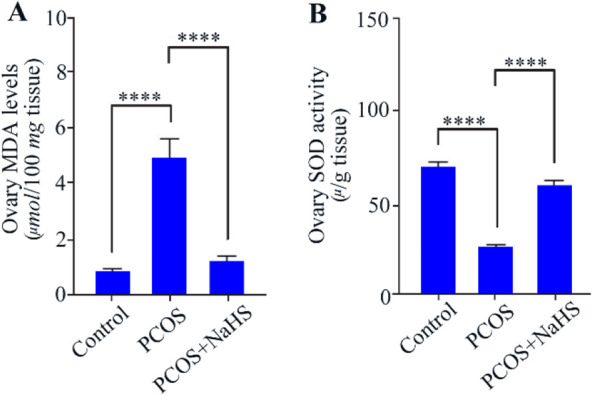
PCOS also resulted in a significant decrease in ovarian SOD activity compared to the control group (25.03±1.63 vs. 68.72±2.71) (Figure 1B, p<0.0001). NaSH administration increased ovarian SOD activity compared to the PCOS group (58.62 ±2.87 vs. 25.03±1.63) (Figure 1B, p< 0.0001).
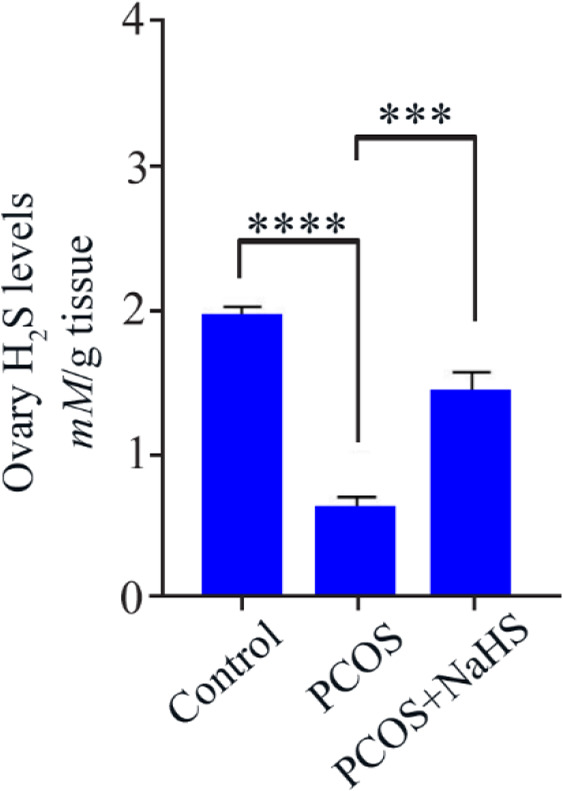
Ovarian H2S levels: PCOS resulted in a significant decrease in ovarian H2S levels compared to the control group (0.62±0.07 vs. 1.95±0.06) (Figure 2, p< 0.0001). NaSH administration increased ovarian H2S levels compared to the PCOS group (1.42± 0.14 vs. 0.62±0.07) (Figure 2, p<0.0001).
Ovarian CBS and CSE activity: PCOS resulted in a significant decrease in ovarian CBS activity compared to the control group (13.68±0.95 vs. 28.30±1.51) (Figure 3A, p<0.0001). NaSH administration increased ovarian CBS activity compared to the PCOS group (20.85±1.16 vs. 13.68±0.95) (Figure 3A, p<001).
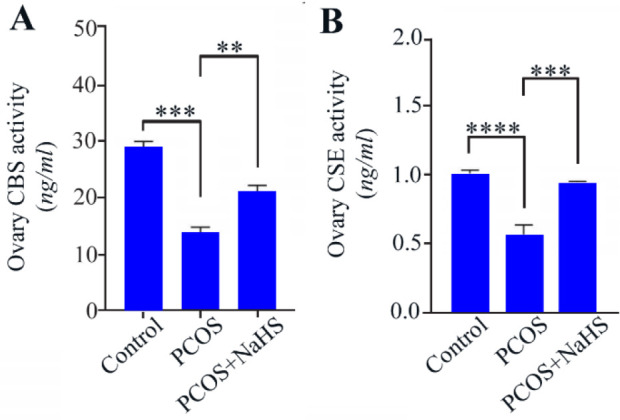
PCOS also resulted in a significant decrease in ovarian CSE activity compared to the control group (0.54±0.07 vs. 0.98±0.03) (Figure 3B, p<0.0001). NaSH administration increased ovarian CSE activity compared to the PCOS group (0.92±0.01 vs. 0.54±0.07) (Figure 3B, p<0.001).
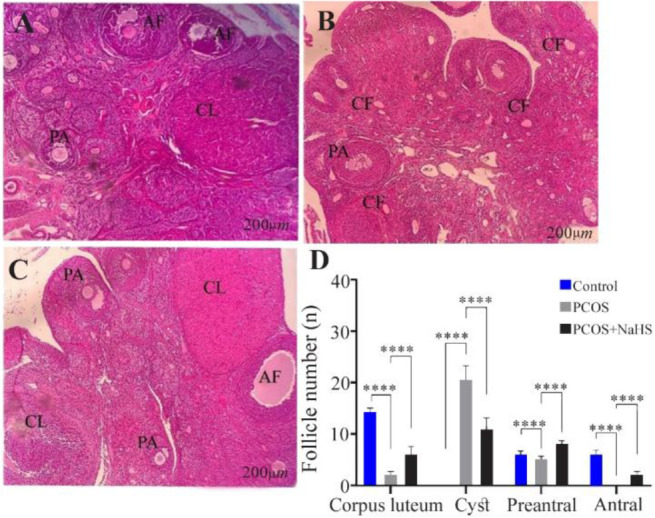
Ovarian Histological changes: There were no detectable cysts in the ovarian tissue of the control group (Figure 4A). In contrast, the ovarian tissue of the PCOS group exhibited signific ant histological alterations, characterized by the presence of cystic follicles (CF), corpus luteum (CL), preantral follicles (PA), and antral follicles (AF), when compared to the control group (Figure 4B). NaSH administration significantly reduced these histological changes (Figure 4C).
In the present study, the induction of PCOS in the rats resulted in oxidative stress in the ovary, decreased ovarian H2S levels, decreased ovarian CBS and CSE activity, and led to significant histological changes in the ovary. However, the administration of NaSH significantly reversed all these parameters, restoring them towards normal levels.
An important consequence following various pathological insults is the overproduction of free radicals, which exceeds the body's antioxidant capacity, resulting in oxidative stress. In this condition, protein and DNA degradation, as well as membrane lipid peroxidation leads to extensive tissue damage (9). Considering the important role of oxidative stress in the pathogenesis of PCOS, MDA levels were assessed as a valuable parameter of lipid peroxidation in the first step, and the activity of SOD as a major endogenous antioxidant in the ovarian tissues was evaluated in the second step (18, 22). In this study, MDA levels in the ovarian tissues were significantly higher in the PCOS group compared to the control group. The presence of oxidative stress in PCOS negatively affects oocyte maturation and the development of embryos (23). Previous studies have also suggested a direct relationship between MDA levels and the prevalence of PCOS (24). Also, SOD activity in rats with PCOS decreased significantly compared to the control group. SOD plays an essential role in protecting ovarian cells against reactive oxygen species (ROS), while SOD depletion leads to corpus luteum apoptosis and deterioration. In addition, our histological results showed a decrease in the number of corpora lutea in the PCOS group. One of the hallmarks of PCOS is the occurrence of follicular atresia, which arises as a result of abnormal ovulation caused by increased ROS levels (25).
In the next step, ovarian H2S levels were examined in PCOS rats as a potential source of oxidative stress. H2S is recognized as a potent antioxidant due to its ability to scavenge free radicals and enhance the activity of other free radical scavengers, such as glutathione. Moreover, changes in the signaling pathway of H2S have been reported in female reproductive diseases such as PCOS (13, 26). Our finding showed a significant reduction in ovarian H2S levels in PCOS rats.
Subsequently, the activity of two enzymes, CBS and CSE, were evaluated which are key players in the production of ovarian H2S. Moreover, the underlying cause of the decreased ovarian H2S levels was assessed in our study. The results indicated decreased activity of ovarian CBS and CSE in PCOS rats. Similarly, Bries et al. stated that letrozole-induced PCOS decreased CBS expression levels and thus its activity in rat ovaries (27). Furthermore, CBS plays an important role in the production of cystathionine from homocysteine, and therefore, decreased CBS activity leads to hyperhomocysteinemia, which has been reported to be a major risk factor for reproductive disorders such as PCOS (28). In addition, while both CBS and CSE enzymes produce H2S, CSE uniquely converts cystathionine to cysteine, which subsequently produces H2S. Importantly, cysteine deficiency has been shown to induce oxidative stress, mitochondrial dysfunction, and apoptosis in ovarian cells (29).
PCOS is a common endocrine and metabolic disorder associated with adipose dysfunction, chronic low-grade inflammation, high prevalence of obesity, and insulin resistance (30, 31). Common treatments for PCOS include a range of approaches including administration of metformin, combined oral contraceptive pills (COCPs), spironolactone, and topical treatments for managing hirsutism and acne (32). Because PCOS is a chronic disease and long-term use of these treatments is associated with various complications such as gastrointestinal disorders and hyperkalemia, research continues to find appropriate treatment strategies with few side effects (33, 34). Considering the significant role of oxidative stress in the development of PCOS, and the findings indicating the involvement of H2S and its producing enzymes in the induction of oxidative stress during PCOS, a final investigation was conducted to assess whether NaSH, as a H2S donor, could mitigate this disease and its underlying pathological mechanisms in rats. It is important to note that the induction of PCOS led to the arrest of follicles in the pre-ovulatory stage, which is considered a diagnostic hallmark of PCOS. In contrast, the administration of NaSH caused normal follicular and oocyte maturation, a decrease in the number of cysts, and an increase in the number of preantral and antral follicles. Based on the results of this study, it seems that NaSH has exerted these positive effects through increasing ovarian CBS and CSE activity and increasing ovarian H2S levels and thus improving oxidative stress status in the ovary.
The findings of the present study suggest that the decrease in ovarian H2S levels, attributed to decreased activity of the enzymes CBS and CSE, may contribute to oxidative stress in PCOS. NaSH administration appears to ameliorate the ovarian activity of CBS and CSE, leading to increased H2S levels. Therefore, this intervention may be considered as a promising therapeutic strategy for PCOS patients.
The authors would like to express their gratitude to Tehran University of Medical Sciences for financial support of the thesis from which this article originated.
Funding: This research was supported by a grant (no=1400-2-372-53181) from Tehran University of Medical Sciences.
