
In the old times, day and night were recognized at conscious organismal level by the appearance and disappearance of light, respectively (1). In a similar vein, body processes and functions were capable of discerning the distinction between day and night. This tendency is attributable to the existence of functional light sensitive retinohypothalamic pathway (2). The pathway extends from non-vision related intrinsically photosensitive retinal ganglion cells to the circadian pacemaker neural structure, known as the suprachiasmatic nucleus (3). Suprachiasmatic nucleus has thousands of circadian oscillators which are capable of being reset by photic signals (4). Emerging from the suprachiasmatic nucleus is an efferent signal that travels to the pineal gland, a differentiated photoreceptor organ that controls secretion of a chronobiotic known as melatonin. Melatonin exerts its modulatory influences by decreasing cyclic adenosine monophosphate via melatonin receptors MT1 and MT2 (5). Hence, metabolic rates are reduced in virtually all body tissues. Muscle tone in levator palpebrae superioris becomes low and the palpebral orbicularis contracts involuntarily, causing the eyelids to close. This prevents the entry of noxious agents but does not block the light (6).
The advent of public lighting has heralded drastic swing in how much and how long human beings should be exposed to light, an electromagnetic radiation. Reliable evidence indicates that over 60 percent of the world is exposed to light outside of sunlight owing to the proliferation of artificial light sources (7). Among the most common adversities occasioned by exposure to artificial light are irritability, headache, fatigue (8), reduced work productivity (9), and melatonin suppression (10). Since melatonin is a hormone secreted by pineal gland in darkness and dim light, the presence of artificial light tends to suppress its production (11). Light emitting diode (LED) generates blue light which is known to exert the greatest suppression of melatonin secretion (12). Since melatonin is an antioxidant and anti-metastatic agent, exposure to artificial light increases the risk of oxidative stress (13, 14) and carcinogenesis.
Besides suppression of melatonin, another impact of artificial light is desynchronization. Melatonin plays a key role in blending internal biological rhythms with solar cycle or natural light/dark cycle. Hence, persistent suppression of melatonin through prolonged exposure to artificial light results in shift in circadian phase (2). Circadian phase shift manifests as insomnia and sleep deprivation, alteration in the timing of LH surge, delayed conception, follicular phase elongation, increased reproductive cycle length, change in body temperature rhythm, changes in blood pressure cycles, increased estrogen to progesterone ratio, decreased ovarian PER1 expression, and increased risk of diabetes mellitus (13, 15).
In the past decade, there has been an undeniable increase in electrification and access to public lightning from diverse sources in Nigeria. In a similar vein, demographic surveys in Nigeria carried out between 1982 and 2018 and published by Cambridge University Press in 2020 indicate a decrease in age of menarche onset from 15.02 years for girls who were born in 1933 to 13.78 years for those who were born in 2003 (16). Besides the decline in age of menarche onset, shift work disorders are also becoming increasingly prevalent. However, there is no scientific evidence to buttress the possible connection between increased access to artificial lighting and advancement in menarcheal age. This review examined the potential connection between increased access to artificial light and advancement in menarcheal age in Nigeria, with emphasis on the pathophysiologic mechanisms of how artificial light may impair reproductive hormones.
A literature search was done using Web-based databases like Pubmed, Scopus, Google Scholar, and Web of Science. The search was conducted using a variety of terms and text words such as light at night, light pollution, reproductive hormones, menarche, and circadian disruption as seen in table 1. Inclusion and exclusion criteria were set to filter relevant jri_articles. Given the historical context of the subject, it was decided not to exclude jri_articles published in the last few decades from the review. jri_articles that were not directly related to the topic were excluded. Each of the screened article titles and abstracts underwent scrutiny, and subsequently, two authors conducted a thorough review of the full manuscripts, with a third party involved in case of any disagreements.
Table 1. Search strategy
| Search strategy and criteria | |
|---|---|
| MeSH terms used to guide search strategy |
|
| Sources of evidence searched | PubMed, CINAHL, Scopus, Google Scholar, and Web of Science |
| Inclusion criteria |
|
| Exclusion criteria |
|
Homeostatic loop consists of control center and peripheral structures (17). As far as reproductive system is concerned, the hypothalamic-pituitary-ovarian (HPO) axis represents a reproductive homeostasis system consisting of hypothalamus and pituitary gland as the control center, and the ovary as the peripheral structure (18–20). The axis contains neurons that release the gonadotropin releasing hormone into the portal capillary system and it is transported to the anterior pituitary gland, located just below the base of the brain in sella turcica. GnRH binds to its receptors on the gonadotropes and induces the release of the gonadotropins, luteinizing hormone and follicle-stimulating hormone.
The gonadotropins combine with their receptors on the gonads and induce the release of steroid hormones (estrogens, progesterone, and androgens in both females and males) (17). These hormones are transported via the systemic circulatory system. As part of their activities, they provide feedback to the pituitary and hypothalamus, thereby inhibiting the release of GnRH and LH and thus completing a negative feedback circuit. During the late prenatal and early postnatal periods, the hypothalamic-pituitary-ovarian axis is hyperactive in a sexually dimorphic manner, contributing to sexual differentiation of the brain. Later in postnatal life period, this hyperactivity declines, and the axis enters a quiescent period during which GnRH release decreases, resulting in a decline of gonadotropin and steroid hormone levels.
The arm known as hypothalamus-pituitary-gonadal axis regulates the reproductive activities of the ovary and reproductive cycles through gonadotropins (follicle stimulating hormone and luteinizing hormone) (17). Follicle stimulating hormone increases during early pre-ovulatory phase. This increase brings about formation of graafian follicle. As follicle develops, it secretes estrogen (17, 21). In other reproductive structures, the high level of estrogen orchestrates profound changes. During the pre-ovulatory phase of the menstrual cycle, several physiological changes occur in the female reproductive system. In the uterus, the endometrium proliferates. The vaginal epithelial lining becomes cornified. There is also development of the mammary ducts. Towards ovulation, the cervical mucus becomes the thinnest and most stretchy (known as spinnbarkeit). At periovulatory period of reproductive cycle, critical level of estradiol in plasma elicits a surge in luteinizing hormone secretion, which serves as the trigger for ovulation (17, 21). After ovulation, the remnant of the ruptured graafian follicle, known as the corpus luteum, secretes large amounts of progesterone. This progesterone then inhibits the hypothalamus-pituitary-ovarian axis of the reproductive system (21, 22).
Work, urbanization, modernization, and the quest for fortune have stimulated human preference for ambient system characterized by chronic light exposure, altered natural photoperiod, and light pollution (1). Nowadays, conscious and unconscious exposures to light at night are the most common form of light pollution (23). Among the risk factors for light at night are night work and insomnia. The genesis of light pollution can be traced back to the invention of electric bulb by the renowned American inventor Thomas Alva Edison who developed a deep vacuum incandescent lamp with a carbon cotton filament (12). In Nigeria, the onset of artificial lighting can be dated back perhaps to 1886 in Lagos when generators were used to generate 60 Kw. Nowadays, due to rapid electricity proliferation, electric lighting has replaced most traditional lighting sources, making the human population virtually independent of the natural 12-hr light/12-hr dark photoperiodic cycle. As a matter of fact, over one third of the world population is estimated to live under light polluted areas.
Excess exposure to anthropogenic light in the nighttime environment is termed light pollution or photopollution (24). The International Dark-Sky Association (IDA) defines light pollution as the inappropriate or excessive use of artificial lighting (25). Light pollution is also defined as inappropriate use of artificial lighting which may interfere with people’s health and comfort or harm the ecological system (25). The effects of light pollution are of two types, image forming effects and photoperiodic effects. While the former is characterized by discomfort and disability glare (10), the latter is characterized by disruption of circadian rhythm, the internal clock that regulates physiological functions (26, 27).
A major impact of exposure to light at night is inhibition of melatonin production and thus a disruption of the entire circadian cycle (11). Blue light has been shown to be most effective in the suppression of melatonin secretion (12). Light induced suppression of melatonin is due to reduction in postganglionic noradrenergic neural discharge to pineal glands. In fact, melatonin rhythm is an efferent mechanism that synchronizes exogenous light/dark cycle with endogenous circadian cycle.
Suppressed nocturnal melatonin secretion represents impairment in synchronization. The desynchronization of the circadian rhythm leads to many clinical conditions. For example, studies have shown the link between exposure to artificial light at night and fatigue, reduced work productivity (25), higher risk of diabetes mellitus (15), various forms of cancer (25), and disruption of female reproductive functions (28, 29).
According to a report published by Statista in 2023 (30), the level of urbanization in Nigeria has increased, reaching 53.52% in 2022. On the basis of population and infrastructural amenities, settlements can be categorized as either urban or rural. When compared with typical rural areas, urban areas exhibit high population and infrastructural facilities. Among the infrastructural facilities are electric grids, satellites, streetlights, and a barrage of illuminating gadgets, some of which emit melatonin suppressing blue light. Even though urban areas in Nigeria are more illuminated with light from diverse sources when compared with rural areas, lighting pattern in urban areas differs across states and regions. A study by Wizor and Anthony-Leo using a questionnaire reported that selected areas of Port Harcourt in Rivers State, South-South Region of Nigeria, exhibited street-lights, with the majority (68%) being functional lighting (31).
Ogoro et al. reported the spatial trend of light pollution across Obio/Akpor Local Government Area of Rivers State using the Global Positioning System data and a structured questionnaire (32). Respondents reported that the stray light from neighboring security lights and traffic lights caused them remarkable discomfort and disturbance during their outdoor relaxation activities. Another study by Gilbert and Shi in Lagos, South-West Region of Nigeria, indicated that nighttime light coverage increased to 631.16 km2 from 175.53 km2 over a period of 20 years (between 2000 and 2020); the study also found strong association between light at night and horizontal urban development (33).
In North Central Region of Nigeria, a study involving1637 residential households in six cities reported average electricity supply rate of 10 hours per day and 5 days per week. Lighting was the major purpose of electricity utilization, and the predominant electric lighting source was the 60 W and 100 W incandescent bulbs, with a smaller fraction using florescent bulbs (34). Yet the study was unable to indicate the proportion of the electricity supply available at nighttime. The authors stated that kerosene lamps and low power generators were used as alternative sources for lighting in the absence of public electricity supply. It is also worthy to note that utilization of alternative light sources such as streetlights, light emitting diode (LED) gadgets, rechargeable and battery powered gadgets, kerosene lamps, solar lights, florescent bulbs, incandescent bulbs, and illuminated public spaces is higher in Nigerian cities when compared to rural areas.
Nigeria is the most populous African country with three major ethnic groups and six geopolitical zones (Figure 1). The Nigerian population consists of roughly equal proportions of males and females. In Nigeria, there are many sources of artificial light, including electronic gadgets, mobile phones and computers, light emitting diode devices, touch lights, cooking appliances, satellites, and streetlights. These light sources are powered by batteries, electricity, and generators. Hence, the use of artificial lighting can be dated back perhaps to 1886 in Lagos when generators were used to generate 60 kW of power (35). Between 1886 and 1945, the power output corresponding to artificial lighting was majorly directed to industrialized and commercial Nigerian cities, such as Lagos, Jos, and Enugu (36). Proliferation of electric power generators in the decades following the advent of the Fourth Nigerian Republic has improved frequency of artificial lighting in homes, schools, religious centers, recreational centers, workplaces, and streets.

Despite the growth in electricity supply and popularity of artificial lighting in Nigeria over time, there are factors that have marred its uniform availability in Nigeria. Insecurity in Northern region, for instance, has for long impaired availability of social amenities in the affected areas. It has also impoverished socio-economic prowess of many states with North-Eastern states most affected. Secondly, poverty has contributed to restricted access to light-emitting gadgets and electric power generators (37, 38). Radical illiteracy is another factor. Illiterates are vulnerable to poverty and socio-economic wreckage. All these cumulatively reduce access to electricity and light producing gadgets, which may have a presumed effect on the age of menarche onset.
As Nigeria has undergone tremendous improvements in technology, electrification, and public lightings over time, there has also been a corresponding decline in age of menarche onset between 1930s and 2020s. At least according to information retrieved from demographic surveys in Nigeria carried out between the year 1982 and 2018 and published by Cambridge University Press in 2020, there was a decrease from 15.02 years for girls who were born in 1933 to 13.78 years for those who were born in 2003.
Moreover, artificial light at night is a well-known conspicuous hallmark of urbanization (40, 41). There is available evidence about the role of urbanity in menarcheal onset in Nigeria. Since electrification and access to artificial lighting are more prevalent in urban communities than rural areas, these may exert profound influence on the onset of menarche. A 2012 study published in the Annals of African Medicine, which compared the mean age of menarche onset for 228 rural and 480 urban girls in Sokoto, showed that the average ages were 15.32 years for rural girls and 15.20 years for urban girls (37). In a similar vein, girls from rural areas regardless of ethnicity were shown to exhibit delayed onset of menarche than those from urban areas in Nigeria. A study by Nwankwo et al. indicated an average menarcheal age of 13.83±0.95 years and 13.48±0.86 years for Hausa girls from rural and urban areas, respectively (42). Igbo girls from rural and urban communities exhibited menarcheal age of 13.52±0.87 years and 13.35±0.88 years. A study by Adienbo and Erigbali on menarcheal age in Niger Delta region, South-South zone of Nigeria, indicated that age of menarche was the lowest in girls from urban cities (11.62±0.13) than those from coastal rural (11.69±0.04) and upland rural (13.24±0.1) areas, respectively (43). In Delta State, South-South zone of Nigeria, the mean age of menarche in urban areas was 12 years while it was 13 years in rural areas (44). Of 859 secondary school girls selected from Rivers State, South-South zone of Nigeria, Ikaraoha et al. reported mean menarcheal ages of 13.19±1.32 years and 14.22±1.47 years for girls from urban and rural areas, respectively (45).
In a 2022 study published in the Nigeria Journal of Medicine, the mean age at menarche was estimated as 12.4±1.5 years among 711 subjects in Abeokuta, an urban city in the South-West zone of Nigeria (46). The age of menarche onset was 13.66±1.82 years, which was reported in an urban study that involved 542 female participants of the University of Ibadan and Ladoke Akintola University of Technology (LAUTECH) (47).
According to another urban study by Diorgu and Diorgu, conducted in Port Harcourt, South-South zone of Nigeria, and published in 2020, 648 girls were investigated and the mean age of menarche was found as 12.8±1.6 years with 61% of the subjects having menarche between years 12 and 14 (48). In urbanized South-East zone of Nigeria, a study published in 2020 indicated that the mean age at menarche in 450 girls between ages 10 and 20 was estimated as 13±1.0 years (49). In Northern Nigeria, an earlier study by Rehan had revealed a menarche onset age of 13 years and 5 months in Hausa girls of Northern Nigeria (50). A study was designed by Sulayman et al. to establish the age of menarche in 535 girls in Zaria, an urban city in Kaduna, North–Western Nigeria. The mean age was found to be 12.53±1.33 years (51).
Puberty onset is a complex process and the role of ambient lighting and melatonin regulation cannot be underestimated. Melatonin, a hormone produced by pineal gland, is capable of inhibiting the onset of puberty (52). In a previous study, thirty-three males with delayed puberty were shown to exhibit elevated levels of serum melatonin (53). Light is known to regulate melatonin production through the retinohypothalamic pathway (54, 55). Ambient light enters through the photoreceptors into the intrinsically photosensitive retinal ganglion cells which are not involved in vision. Mesopic signals from these cells project to the suprachiasmatic nucleus of the anterior hypothalamus and then to the pineal glands through the superior cervical ganglion causing suppression of arylalkylamine N-acetyltransferase, an enzyme involved in melatonin production.
At puberty, the hypothalamic-pituitary-gonadal axis becomes active through kisspeptin signaling, resulting in an increase in the pulse frequency of gonadotropin-releasing hormone and a rise in the secretions of luteinizing hormone and follicle-stimulating hormone (21). The gonadotropins orchestrate a rise in testosterone secretion with development of secondary sexual characteristics (21). Melatonin has been shown to reduce KiSS1 expression in the hypothalamus (56), indicating the importance of melatonin regulation for the onset of puberty. Moreover, there is increasing evidence that kisspeptin secretion occurs in proportion to duration of light exposure (57). In a previous study, mice exposed to light showed higher KiSS1 expression compared to blind mice. This increase in hypothalamic kisspeptin occurs during puberty. Kisspeptin produced from ante-roventral periventricular nucleus of hypothalamus is known to enhance high pulse frequency gonadotropin releasing hormone, which is necessary for ovulation (58, 59).
Biological rhythms are periodic variations in biological functions. Examples are sleep/wakefulness, metabolic activities, LH surge, reproductive cycle, blood pressure, heart rate, respiratory rate, bronchial tone, and hormone secretions among others (23). When periodic variations in biological events and processes occur in 24 hr, they are known as circadian rhythms. The circadian rhythms work through a set of genes located in the suprachiasmatic nucleus (master clock) which regulate peripheral clocks in other body tissues including gonads (60). Generally, the circadian genes consist of “period (PER)”, “cryptochrome (CRY)”, “brain and muscle Arnt like protein (BMAL)”, and “circadian locomotor output cycles kaput (CLOCK)”. PER1 transcription is controlled by protein interactions with its five E-box and a D-box elements in its promoter region. PER1 interacts with other PER proteins as well as the E-box regulated, clock controlled proteins CRY1 and CRY2 to create a heterodimer which enters into the nucleus. Then, the heterodimer inhibits CLOCK-BMAL-1 activation (60). CLOCK/BMAL1 heterodimer stimulates E-box elements present in the PER1 promoter and activates the E-box promoters of other components of the molecular clock such as PER2, CRY1, and CRY2 (23).
The body’s biological rhythms are programmed to function in consonance with natural rhythms most especially light/dark cycle (12). The light energy from the environment resets biological cycles through the suprachiasmatic nucleus of the hypothalamus, increasing the expression of PER proteins. This results in the suppression of pineal melatonin secretion and activation of reticular activating fibers, leading to an increase in metabolic activities (23). The reverse occurs during the dark phase. Hence, alteration in natural light/dark pattern leads to alteration in biological cycle causing insomnia, daytime somnolence, alterations in normal rhythms of hormones including reproductive hormones and alterations in normal reproductive events such as folliculogenesis and ovulation, which can lead to infertility (11). Alteration in photoperiod brings about adverse health and reproductive effects since circadian clocks are en-trained by light duration. For example, shift duty, an employment practice meant to provide service around the clock (61) that is characterized by altered photoperiod and desynchronization of circadian clock, results in health and reproductive problems (62). Nurses are one of the risk groups for artificial light exposure due to the shift patterns of their job. Among 422 nursing staff in South-West region of Nigeria, Idowu et al. indicated that insomnia exhibited a prevalence of 52.4% (63). Bakare and Omiwale investigated the effects of work shift on the health status of women in Ile-Ife, Nigeria (64). Lack of quality sleep is one of the most prevalent complaints of the subjects. Although there is no specific report indicating the effect of artificial light exposure on fertility in Nigeria, the general consensus is that work arrangements allowing regular exposure to artificial light can have a significant impact on circadian synchronization and entrainment, impairing reproductive hormone rhythm and fertility (12). Continuous illumination was shown to modulate normal nocturnal decrease in FSH secretion in women (65, 66). A study by Defelice et al. indicated that 96% of females that were exposed to artificial light demonstrated abnormal length of follicular phase, while 64% and 58% exhibited deranged ovulation and luteal function, respectively. Artificial light exposure has been associated with increased subfertility tendencies and lengthened period to achieve pregnancy (23, 67). In animal studies, when female rats were kept under continuous lighting regime for a period of 8 months, there was persistence of estrus and vaginal cornification owing to high estradiol-progesterone ratio (68). Furthermore, there was persistent estrus phases in 8-week-old Wistar rats maintained under continuous illumination, as well as prolonged estrous cycle length in animals exposed to long lighting period (69, 70).
Apart from the perturbation of FSH, LH, and gonadal hormones, mechanisms through which artificial light impairs reproductive rhythms can be classified into central and peripheral mechanisms. Central mechanisms may include oxidative stress and depletion of antiperoxidative activities in the anterior hypothalamic nucleus. Peripherally, decreased gonadal PER1 expression and increased gonadal oxidative stress may be implicated as mechanisms by which artificial light impairs reproductive rhythms (71, 72).
Besides suppression of melatonin, the endocrine disruptions that characterize artificial light-induced reproductive problems might be related to increased prolactin secretion (14). The perturbing influence of prolactin on hypothalamic kisspeptin production has been documented. Araujo-Lopes et al. showed that the suppressive effect of prolactin on luteinizing hormone, a trigger of ovulation, was due to the tendency of prolactin to control kisspeptin secreted by the arcuate nucleus of the hypothalamus (73). This effect perhaps can be termed as negative feedback since kisspeptin is known to act on lactotropes and orchestrates prolactin secretions. It is widely known that few months after parturition, some lactating women who are on exclusive breastfeeding may resume menstruation. The best way to describe this phenomenon might be central prolactin resistance, an inability of prolactin to exert significant regulatory effect on kisspeptin production. Empirical studies will be required to test this hypothesis.
Apart from prolactin, cortisol is another stress hormone which is known to reduce kisspeptin production. Luo et al. reported that there was reduction in the quantity of KiSS 1mRNa and KiSS 1 cells that co-expressed cFos in mice implanted with corticosterone (74). Cortisol is a product of hypothalamic-pituitary-adrenal axis and it represents the long-term response to stress, in contrast to the sympathoadrenal axis, which is the short-term response to stress. In a study conducted by Fadeyi et al. that involved 44 nurse shift workers in Nigeria, there was an increase in salivary cortisol. The increased level of salivary cortisol is an indication of on-going stress (75). Indices such as cortisol, catecholamine, blood pressure change, heart rate response, temperature change, increased gluconeogenic enzyme activity, and decreased plasma proteins have been used to describe the physiological response to stress (76–79).
Body weight is a downward force exerted by body on the earth. Body weight has for long been known to play a major role in puberty and reproduction. At least, the reproductive roles of leptin have been documented (80). Leptin is an adipokine that induces kisspeptin production by hypothalamic reproductive hormones and its concentration correlates positively with the size of adipose tissue. There are two important lines of evidence to support the significance of body weight for puberty and reproduction. Obese and overweight children exhibit a higher likelihood of achieving puberty earlier (81). Secondly, female athletes experience what is known as female athlete triad, characterized by menstrual dysfunction, low bone mineral density, and energy imbalance (82). Hence, leptin level within a reference limit is required for reproduction.
Melatonin, a hormone suppressed by light is a sleep inducer. Increase in metabolic activity at night occasioned by conscious exposure to artificial light has remarkable effects on body composition. In 60 age-matched Nigerian female students, Adeniyi et al. reported that regular nighttime study increased body weight and body mass index when compared with students with irregular nighttime study (83). A study by Abay and Amare indicated that there was a relationship between intensity of nighttime light intensity and body weight (84). Higher nightlight intensity correlated with obesity and overweight. Light-at-night-induced increase in body weight is attributable to changes in feeding pattern occasioned by stress. Under the influence of stress hormones such as catecholamine, the desire for food decreases, leading to the consumption of high-calorie food when the body is metabolically less active. Under this situation, the body accumulates fats. In a similar vein, cortisol is raised in chronic stress causing stimulation of appetite and weight gain through adipose tissue hypertrophy. Another mechanism is alteration in leptin/ghrelin interplay. Ghrelin, a hunger hormone, is physiologically known to be low at night and high during the day while leptin is high at night and low during the day. Elevated nighttime ghrelin levels have been observed in night shift workers (76). Shahrad et al. demonstrated that there was an inverse association between inadequate sleep and suppressed leptin secretion (85). This hormonal shift causes changes in body weight. Overweight is characterized by an increase in low density lipoprotein and elevated estrone and testosterone secretions (86). Alteration in reproductive hormones has been associated with menstrual cycle irregularities and reproductive abnormalities (87).
Artificial lighting is a conspicuous feature of urban areas and urbanization has increased in Nigeria over the years (30). Sources of artificial light in Nigeria (Figure 2) include electric light, street lights, light emitting diode (LED) gadgets, re-chargeable and battery powered gadgets, kerosene light, solar light, florescent bulbs, incandescent bulbs, and illuminated public places. Even though unrecognized by Nigerians as impactful, the evolution, presence, and utilization of these artificial light sources may have remarkable effects on health status. The review was designed to examine the possible association between decrease in menarcheal age and increase in artificial light and how artificial light may disrupt reproductive hormones.
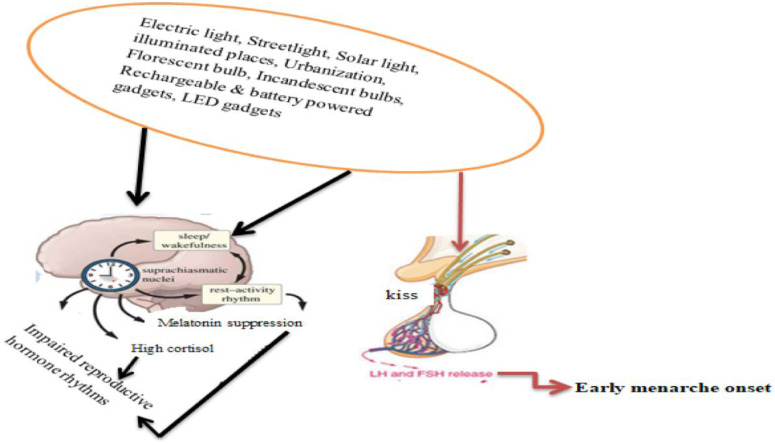
There has been a definite increase in electricity supply, one of the primary sources of lighting in Nigeria, from 1886 till date. While there has been an increase in electricity supply, a factor that contributes to the proliferation of artificial light in Nigerian urban areas, it would be inaccurate to use this as the sole evidence, as rural and remote areas are also experiencing growing electrification. However, besides electricity supply, Nigerian urban areas have more artificial light sources including street lights, well illuminated public places, solar light, and light emitting diode gadgets among others.
Menarche onset was earlier in urban girls than rural girls. Puberty onset is a multifactorial process and the role of environmental factors including ambient light and melatonin regulation cannot be underestimated. Melatonin, a hormone produced by pineal gland is capable of inhibiting the onset of puberty by interfering with kisspeptin signaling (52). Exposure to light, on the other hand, reduces melatonin levels. Light not only suppresses melatonin production but also increases kisspeptin production by anteroventral periventricular nucleus of hypothalamus (57).
Since kisspeptin increases pulse frequency of gonadotropin-releasing hormone neurons, it leads to increased gonadotropin secretions and LH surge (21, 57), ultimately culminating in hastened puberty and the onset of menarche. The important role of kisspeptin in puberty onset has been extensively documented, especially in females. Kisspeptin produced by anteroventral periventricular nucleus of the hypothalamus has been reported to facilitate LH surge (73). While the mechanisms that regulate kisspeptin production from this nucleus are not yet fully understood, sustained increases in circulating estradiol are believed to play vital roles. Evidence from polycystic ovary syndrome induced by obesity clearly indicates elevated circulating estrogen, androgen, and leptin concentrations besides leptin resistance. The presence of leptin resistance is a strong barrier in making an association between leptin and kisspeptin production (57, 58).
Moreover, it is importance to emphasize that an earlier onset of menarche does not necessarily indicate either improved fertility, or improvement in health. Rather, it may increase the proportion of teenage pregnancy, early motherhood, child neglect, child abuse, unfulfilled childhood dreams, reduced productivity, depression, and ill-prepared marriages and families. Early menarche is a basis for early onset of menopause. Public awareness and educations regarding the potential impacts of excess exposure to artificial light on reproduction are required to keep the public informed of environmentally-induced changes that may increase the rate of unwanted and teenage pregnancy, early motherhood, unfulfilled childhood dreams, and ill-prepared marriages and families.
Just as light promotes kisspeptin production for early onset of menarche, prolonged light exposure may be detrimental to kisspeptin production through downregulation of kisspeptin signaling, thereby impairing reproductive processes (57). Reproductive processes are known to be rhythmic and controlled by external cues. For instance, while light/dark cycle influences FSH and LH secretions, FSH and LH secretory patterns determine steroidogenic and gametogenic activities of the gonads. Hence, disruption of external light/dark rhythm is capable of perturbing infradian rhythm of LH surge, as well as the ultradian and circadian secretion of gonadotropin-releasing hormone, luteinizing hormone, and follicle-stimulating hormone. Disruptions in reproductive hormone secretions include prolongation of reproductive cycle length, subfertility, and infertility (14, 54). Artificial light also induces increased secretions of prolactin and cortisol. Interestingly, prolactin and cortisol are independently capable of regulating hypothalamic kisspeptin expression (73).
Melatonin, a hormone suppressed by light (11, 83), is well-known for its soporific effect. Hence, conscious exposure to artificial light has remarkable effects on body compositions. As metabolic activities increase at night owing to artificial light, ghrelin increases and leptin decreases. Ghrelin stimulates appetite, causing consumption of calories and increasing the risk for obesity. Increase in fat mass in obesity may be characterized by disruption of normal estrogen and androgen and suppression of follicle stimulating hormone secretion (76). Reduction in follicle stimulating hormone impairs recruitment and selection of dominant follicle. Under the influence of luteinizing hormones, the normal development of primordial follicles into graafian follicles does not occur. Instead, the follicles are converted into cysts. This condition is known as polycystic ovary syndrome. Polycystic ovary syndrome is one of the leading causes of anovulation worldwide.
Artificial light has undoubtedly created a flexible round-the-clock work pattern. Although the review was majorly centered on female reproductive axis, indiscriminate exposure to artificial light may potentially cause disruption in reproductive hormones through elevation in prolactin secretion, modulation of kisspeptin, disruption of circadian rhythms, and body composition changes. Thus, this suggests that excess exposure to artificial light is a potential risk factor for anovulation.
Based on the available studies that examined trends of menarche over decades, growth in electrification, and public lighting, it was found that artificial light exposure is related to early onset of menarche and disruption in reproductive hormones. Artificial light utilization was most prevalent in urban areas and the age of menarche onset was earlier in urban girls. Furthermore, artificial light exposure can disrupt reproductive hormones through several mechanisms, including circadian rhythm disruption, increased stress hormone levels leading to altered kisspeptin secretion, and weight gain.
As the World continues to dwell on the euphoria of the advent of artificial light sources, it is important to know that there are a number of adverse reproductive outcomes including breast cancer risk that are associated with utilization and dependence on light at night. Efforts towards enactments of laws guiding utilization and exposure to artificial light and light at night are needed. Voluntary efforts are required to reduce exposure to light at night, particularly blue light. Sleep hygiene practices, such as turning off the lights before bedtime, are strongly recommended.
Given that fertility involves both males and females, further empirical studies are required to clarify whether and how indiscriminate exposure to artificial light may affect indices of male fertility and male puberty in the indigenous population.
None.
