
Intrauterine devices (IUDs) are a frequently used reversible form of contraception (1). It was used by approximately 14% of women due to its efficacy, safety, and low cost (2). IUD is usually placed without any significant complication. However, as with any medical foreign object, there are several possible drawbacks. Hemorrhage, infection, device migration, uterine rupture, dislocation, and expulsion are reported as complications of IUD. Of these potential complications, uterine perforation tends to receive the most attention.
Uterine perforation can occur during the initial placement of an IUD. Over time, erosion of the uterine wall can also lead to perforation. This condition is reported to occur in 0.5–1 cases per 1,000 IUD insertions (3).
Following the uterine rupture, an IUD may potentially migrate to the pelvic or intra-abdominal cavity, which causes several problems. There are numerous reports in the literature documenting cases of IUD migration away from the intended placement site within the uterus.
A literature review covering 18 years until 1999 identified 165 reported cases of IUD migration, indicating that migration to the bladder is relatively uncommon and has only been reported in 31 cases (4). In this study, a patient who was referred to our hospital with a migrated IUD in the bladder was reported.
The patient was a 41-year-old woman who was referred to Imam Reza Hospital for IUD removal in September 2022. The IUD was inserted after the birth of her third child, approximately 12 years ago in 2010. However, the patient became pregnant unintentionally 3 months after inserting the IUD. When examined in the clinic, the IUD string was not visible. Investigations and ultrasounds failed to locate the IUD, leading the patient and physician to believe that it was spontaneously expelled. The patient delivered her baby without any complications. One year following the birth, the patient tried to use the IUD again as a contraception.
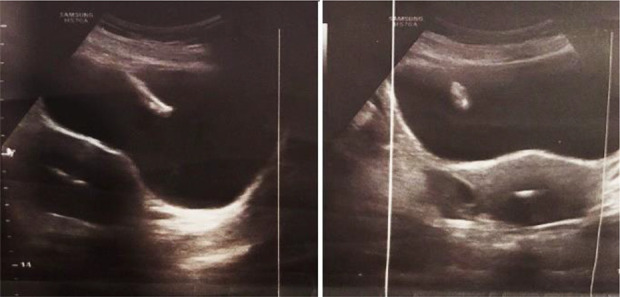
Eight years after the second IUD was placed (October 2022), the patient underwent a pelvic ultrasound following routine tests and the discovery of pyuria in the urine test. The findings of the patient’s ultrasound are as follows; the ultrasound revealed an echogenic linear structure measuring 28 mm protruding from the anterior wall of the bladder into the lumen, suggestive of a foreign body or a bladder wall septum secondary to lobulation (Figure 1).
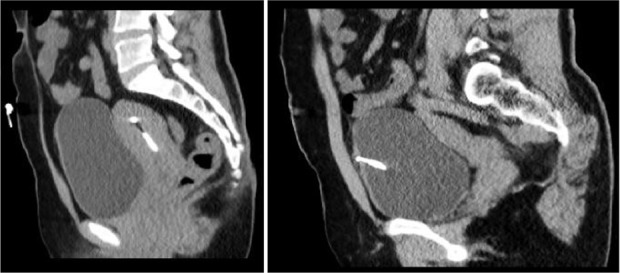
The patient did not complain of dysuria, hematuria, or pelvic pain. Ultrasound findings were also confirmed by computed tomography scans (CT scan) (Figure 2).
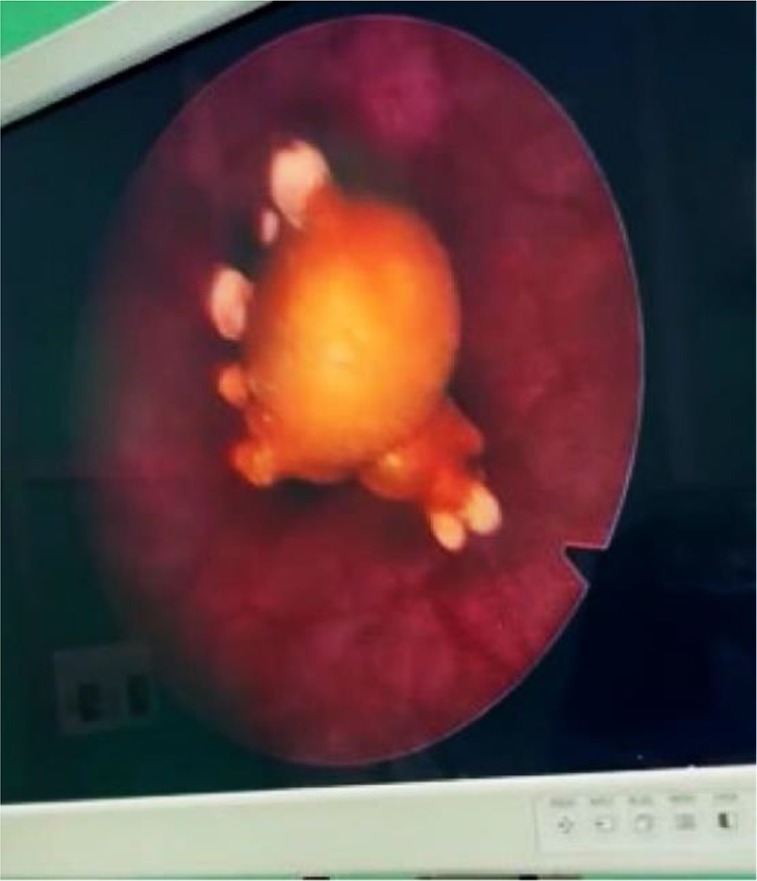
Cystoscopy was performed at Imam Reza University Hospital under general anesthesia using the Olympus system with a 2.9 mm lens and a 30 degree angle. The IUD was observed adhering to the bladder wall, with a stone deposit visible on it. The IUD was easily removed with a cystoscope grasper. No evidence of fistula or additional stones was found on the repeat cystoscopy (Figure 3).
In hysteroscopy, a second IUD was observed inside the uterus, which was removed with a grasper, and the uterine cavity appeared normal. Six hours after the operation, the patient was discharged. During the 1-month and 3-month follow-up visits, the patient had no symptoms or complaints.
An intrauterine device is a common widely used form of mechanical contraception. More than 150 million women use IUDs, predominately in developing countries (1). Uterine perforation, malignant transition, and migration into neighboring structures are the most serious complications of an IUD insertion (5).
Potential mechanisms behind IUD migration include uterine perforation at the time of insertion, uterus/bladder contractions, gastrointestinal peristalsis, and peritoneal fluid movement. Important risk factors for uterine perforation include insertion by inexperienced persons, uterine size and position, inherent anatomic variation, and recent abortion or pregnancy (6). Uterine perforation by an IUD may basically occur via two mechanisms. First, perforation can happen at the time of placement, primarily due to misplacement, which may present with bleeding, acute pelvic pain, or loss of the IUD’s thread. The experience of the IUD insertion provider and placement by specialists are extremely important factors in preventing misplacement, as supported by numerous authors. The second mechanism is gradual and spontaneous perforation of the uterine wall over time after IUD insertion, known as uterine migration. This can lead to the development of late-onset symptoms or may be entirely asymptomatic (7).
The design and structural characteristics of the IUD, as well as the nature and rigidity or plasticity of the device, are considered IUD-related factors that may contribute to perforation (6). Uterine perforation related to IUD placement can occur shortly after the procedure or as a delayed event. It is widely recommended that IUDs be inserted following proper patient selection and by trained clinicians (5).
Uterine perforation may be asymptomatic or cause pain, abnormal bleeding, bowel or bladder perforation, or fistula formation (13). Possible sites of IUD migration include the bladder (intravesical), peritoneum, omentum, rectosigmoid, appendix, small bowel, colon, adnexa, and iliac vein (8). Intravesical migrated IUDs may result in bladder perforation, stone formation, or malignant transition (9). Uterine examination, a transvaginal ultrasound, abdominal ultrasound, a kidney, ureter, and bladder (KUB) X-ray, and pelvic CT are useful for determining the location of a migrated IUD. In particular, CT is useful for diagnosing whether the IUD is penetrating surrounding organs (10).
The World Health Organization (WHO) recommends removing the migrated device in the a timely manner (11). It is suggested that surgical removal should be considered even in asymptomatic patients once it has migrated out of the uterus. The recommendation is to use minimally invasive methods if possible, including hysteroscopy, cystoscopy, colonoscopy, or laparoscopy, depending on where the IUD is located. If the device is embedded in an organ such as the bladder or bowel, it is not recommended to remove it using minimally invasive methods. Instead, an exploratory laparotomy should be performed (12). In the case of this patient, the use of cystoscopy was sufficient to diagnose and remove the migrated IUD.
Regular follow-up visits and examinations immediately after IUD insertion and periodic checkups, could help prevent IUD misplacement, migration, and other complications.
If the IUD string is not visible during the pelvic examination, further investigation with imaging methods such as an abdominal x-ray (AP view) and ultrasound is recommended. In such cases, it is advisable for the radiologist to examine the uterus and explore the adjacent organs such as the bladder, intestine, and pelvis to assess for potential uterine perforation and migration of the IUD to these areas.
