
One of the primary focuses in in-vitro fertilization (IVF) clinics is to optimize culture conditions, which encompasses both the selection of proper culture media and the configuration of incubator system. Notably, environmental factors such as the type of media (1, 2), temperature (2), and gas concentration (3) remarkably influence the in vitro development of embryos. Two different types of incubators, conventional and time-lapse, are widely implemented in IVF laboratories worldwide. Although conventional incubator is commonly utilized, it has certain limitations. Specifically, embryologists encounter the necessity to periodically remove the embryo from the incubator for microscopic evaluation at specified intervals to monitor the progression of embryo development. Also, there is a possibility that the embryologist misses the important and dynamic changes in embryo morphology (4).
Considering the current limitation, TL systems have been developed for embryo incubation allowing embryologists to continuously monitor embryo development and obtain high-quality real-time images of developing embryos (5). This is accomplished by integrating an internal camera within the system. The TL incubator system is anticipated to represent the safest and the most stable environment for embryo culture. The advancement aims to revolutionize continuous monitoring and documentation of embryo development (6). Consequently, this approach reduces the frequency of observing embryos outside of the incubator, potentially leading to a higher yield of improved top-quality embryos on both day 3 and day 5 (7), as well as heightened rates of implantation and clinical pregnancy (8).
In addition, this system offers various information concerning embryo development and also provides a non-invasive approach to embryo quality assessment. It not only provides a detailed evaluation based on morphological parameters but also presents real-time non-invasive markers such as kinetic values, blastomere multinucleation, irregular divisions, and the occurrence of reverse cleavage (9, 10). Selecting the embryo based on the aforementioned non-invasive markers is expected to improve embryo quality and pregnancy success rates.
Several randomized controlled trials, as well as systematic and meta-analyses, have investigated the impact of uninterrupted embryo culture using TL system on the IVF outcome within a closed culture system (4, 11). Additionally, these studies have explored the integration of this system with embryo selection tools based on morphokinetic markers (12–14). These studies have found limited evidence supporting the superiority of the TL system over CI, regardless of whether morphokinetic assessment was used for embryo selection (12–14). In contrast, others have reported that TL system outperforms CI as a culture and monitoring system without benefiting from the application of morphokinetic markers (15). Additionally, TL has been shown to be effective when morphokinetics are utilized for embryo selection (16). Therefore, further clinical evidence is needed to assess the potential benefit of implementing the TL system using larger, real-world clinical datasets. Further investigations are needed specifically to compare the clinical use of the TL system to CI, focusing on TL as a closed culture system in the clinical setting of IVF. In fact, this assessment should encompass the evaluation of both laboratory and clinical outcomes as well as analyzing the population based on female prognosis to accurately reveal the impact of the culture system.
This multicenter, retrospective, cross-sectional observational study was conducted at the private Morula IVF clinics in Jakarta and Surabaya, Indonesia. The institutional ethics committee of the Faculty of Medicine, University of Indonesia approved the study protocol (Number of ethics approval: KET-1057/UN2.F1/ETIK/PPM00.02/2023). Data was extracted from the online Windows-based application database of the Morula IVF clinics in Jakarta and Surabaya, accessible only to credentialed personnel. A total of 4,769 female subjects who underwent IVF between January 2015 and August 2022 met the eligibility criteria. A purposive sampling method based on specific inclusion and exclusion criteria was implemented. The inclusion criteria consisted of infertile couples undergoing the IVF program. Exclusion criteria comprised patients with a natural menstrual cycle, no oocyte retrieval, no fertilization, those undergoing embryo transfer on day 3 or a frozen cycle on either day 3 or day 5, as well as incomplete documentation of pertinent data for this study. Based on their history of culture system, participants were assigned to the MIRI TL group and the CI benchtop incubator group (MIRI® Multiroom incubator; Esco Medical, Lithuania). Patients were categorized into good and poor prognosis group based on female evaluation using several criteria; good prognosis was defined as age ≤38 years, antral follicle count (AFC) ≥7, and anti-Müllerian hormone (AMH) ≥1.1 ng/ml. Poor prognosis was assigned to women aged >38 years, with AFC <7, and AMH <1.1 ng/ml. A schematic representation of the study is illustrated in figure 1.
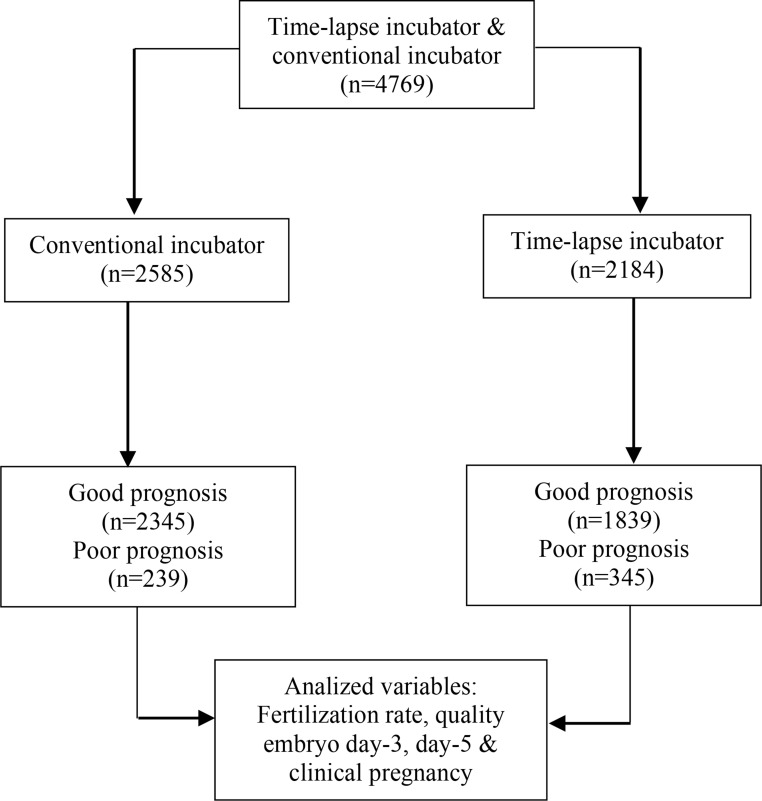
The majority of the studied participants underwent ovarian stimulation with antagonist protocol. Patients received gonadotropin injections on day 2 or 3 of their menstrual cycle. Gonadotropins used for stimulation included Gonal-F (Merck Serono, Germany), Pergoveris (Merck Serono, Germany), Menopur (Ferring Pharmaceuticals, Sweden), and Rekovelle (Ferring Pharmaceuticals, Sweden). Initial doses ranged from 150 to 375 IU, or an equivalent dose for Rekovelle, depending on the patient’s characteristics and clinical assessment by the clinicians. Cetrotide (Merck KGaA, Germany) injection, at a dose of 0.25 mg, was administered daily starting on day 5 or 6 of stimulation. Recombinant hCG (Ovidrel; Merck Serono, Germany) at a dose of 6,500 IU was injected once after at least three follicles had reached an 18-mm size. Ovum pick-up (OPU) was performed 36 hr post-hCG injection.
The majority of sperm samples were obtained via masturbation. The sperm sources included fresh ejaculates, frozen-thawed ejaculates, sperm collected through percutaneous epididymal sperm aspiration, and biopsy procedures. On the collection day, each semen sample was assessed for sperm concentration and motility, but no morphological assessment was conducted. Sperm morphology values were obtained from sperm analysis reports conducted at least six months prior to the initiation of IVF. The sperm preparation method included swim-up, gradient centrifugation, and simple washing using SpermRinse medium (Vitrolife, Sweden), depending on sperm quality. The simple washing method was employed when the sperm count was less than 5 million/ml. Meanwhile, the density gradient centrifugation was used when the sperm count ranged between 5 and 15 million/ml and motility was below 20%. For semen samples with concentration exceeding 15 million/ml and motility greater than 20%, a swim-up procedure was employed.
Oocyte collection and fertilization procedure were conducted as previously described (17). Injected oocytes were then cultured in either G-TL (Vitro-life, Sweden) or Sage medium (Origio, Denmark) at 37°C, 6% CO2, and 5% O2. Individual culture was implemented in all cycles for both CI and TL incubators (The MIRI® TL Multiroom IVF incubator; Esco Medical, Lithuania). In the CI, embryos were placed in micro-drops of 30 μl culture media using a 60 mm Falcon petri dish. In the TL incubator, a CultureCoin® dish was used, with each coin/hole containing 25 μl of culture media. For the CI, the embryologist opened the incubator at least three times for evaluation of fertilization, cleavage, and blastocyst quality and changing the culture media if necessary. Fertilization observations were conducted around 17±1 hr post insemination. Day 3 cleavage assessment occurred at 68±1 hr post-insemination while day 5 blastocysts assessment took place at 116±2 hr post-insemination. The expected time for embryo observation in the CI was approximately 5–10 min per patient, depending on the number of evaluated embryos. In the TL incubator, fertilization and embryo quality examination were conducted through a TL monitor without opening the incubator or changing the media. The assessment of embryo quality at both cleavage and blastocyst stages was detailed in our previous study, which utilized standard morphological evaluation and did not employ morphokinetic markers for embryo selection (17). Clinical pregnancy was defined as the presence of a gestational sac or detection of a fetal heartbeat via ultrasound. To minimize confounding effects associated with embryo vitrification and variations in endometrial preparation for frozen cycles, clinical pregnancy was measured only in patients who underwent fresh embryo transfer cycles.
Baseline and clinical characteristics of the studied participants were outlined using descriptive statistics. Categorical variables were displayed as the number of participants and percentage (n (%)), while the numerical variables were presented as median and interquartile range (Q1 and Q3). Comparison of categorical data between the two groups was conducted using the chi-square test, while numerical data were evaluated using the Mann–Whitney U test. Data analyses were performed using SPSS software version 26 (IBM, USA) at a 95% confidence level.
The baseline and clinical characteristics of the studied participants are presented in table 1. In the context of baseline characteristics, the median age of women was 33, with a significant proportion of women aged ≤35 compared to those aged over 35 years. There were notable differences in the proportion of young (≤35 years) and older participants (>35 years) between the conventional and TL groups (p<0.001). This trend was also observed in the proportion of couples with primary and secondary infertility between the two groups (p=0.01). Other baseline characteristics, including BMI and infertility duration, exhibited significant differences between the groups (p=0,002). Several clinical characteristics also exhibited differences between the two groups, including basal FSH, basal progesterone, AFC, AMH, history of miscarriage, and number of IVF cycles. In contrast, the levels of basal estradiol and those measured on the hCG trigger day were similar between the groups (p=0.905 and p=0.984, respectively). Among all male participants, the median age was 36 years old. While sperm concentration was comparable between the two groups, sperm motility and semen volume exhibited significant differences (Table 1).
Table 1. Baseline and clinical characteristics between the two groups
| Parameters | Overall participants (4.769) | Conventional incubator (n=2.585) | Time-lapse incubator (n=2.184) | p-value |
|---|---|---|---|---|
| Baseline characteristics of female | ||||
| Age (years) a | 33 (30–36) | 33 (30–36) | 34 (31–37) | <0.001 * |
| >35 years (n (%)) b | 1510 (31.7) | 725 (28) | 825 (35.9) | <0.001 * |
| ≤35 years (n (%)) b | 3259 (68.3) | 1.860 (72) | 1399 (64.1) | |
| BMI (kg/m2) a | 23.49 (21.23–25.69) | 23.31 (21.01–25.55) | 23.83 (21.51–25.81) | 0.002 * |
| Type of infertility (n (%)) b | ||||
| Primary infertility | 4036 (84.6) | 2220 (85.9) | 1816 (83.2) | 0.010 * |
| Secondary infertility | 733 (15.4) | 365 (14.1) | 368 (16.8) | |
| Infertility duration (years) a | 5 (3–8) | 5 (3–8) | 5 (3–8) | 0.002 * |
| Clinical characteristics | ||||
| Basal E2 (pg/ml) a | 36 (28–46) | 36 (27.58–46.58) | 36 (28.89–45) | 0.905 |
| Basal FSH (mIU/ml) a | 6.6 (5.6–7.9) | 6.7 (5.6–8) | 6.6 (5.6–7.7) | 0.027 * |
| Basal progesterone (ng/ml) a | 0.23 (0.13–0.37) | 0.26 (0.17–0.44) | 0.20 (0.11–0.28) | <0.001 * |
| AFC a | 12 (9–16) | 11 (8–15) | 11 ( 8–15 ) | <0.001 * |
| AMH (ng/ml) a | 3.22 (1.91–5.17) | 3.52 (2.16–5.66) | 2.89 (1.62–4.7) | <0.001 * |
| E2 on the day of hCG (pg/ml) | 2882 (1951–4327) | 2882 (1974–4288) | 2882 (1918–4360) | 0.984 |
| History of miscarriage (n (%)) b | 782 (16.4) | 476 (18.4) | 306 (14) | <0.001 * |
| Number of IVF cycles a | 1 (1–1) | 1 (1–1) | 1 (1–1) | <0.001 * |
| Number of oocytes retrieved a | 11 (7–16) | 12 (8–17) | 10 (6–15) | <0.001 * |
| Number of MII oocytes following insemination a | 9 (5–12) | 9 (6–13) | 8 (5–12) | <0.001 * |
| Baseline characteristics of male | ||||
| Age a | 36 (33–40) | 35 (32–39) | 36 (33–40) | <0.001 * |
| Semen volume (ml) a | 2.5 (2–3.5) | 3 (2–4) | 2.5 (1.5–3.5) | <0.001 * |
| Concentration (×106) a | 35.5 (18–62) | 35.5 (17–65) | 35.5 (19–58) | 0.145 |
| Motility (%) a | 31 (17–43) | 25 (15–40) | 37 (23–47) | <0.001 |
Data are presented as median (Q1–Q3),
Data are presented as the number of subjects and percentage (n (%))
p-value <0.05
Further statistical analysis revealed the superiority of several laboratory outcomes of the TL over the CI group. Notable differences emerged, particularly in terms of fertilization rate and the attainment of top-quality embryos on day 5 (p< 0.001) (Table 2). The clinical pregnancy rate appeared to be unaffected by the type of culture system. Although the rate was higher in the TL (45.7%) than in the conventional group (41.1%), this difference did not reach statistical significance (p=0.169, OR 1.22, 95%CI 0.94–1.50).
Table 2. Comparison of embryology laboratory outcomes between the two groups
| Outcomes | Conventional incubator (n=2.585) a | TL incubator (n=2.184) a | p-value |
|---|---|---|---|
| Fertilization rate (%) | 76.92 (63.64, 88.89) | 80 (66.67, 100) | <0.001 * |
| Top-quality embryos on day 3 (%) | 57.10 (37.5, 75) | 50 (30, 75) | <0.001 * |
| Top-quality embryos on day 5 (%) | 33.33 (20, 50) | 38.46 (20, 57.14) | <0.001 * |
| Clinical pregnancy rate (n (%)) | 431/1036 (41.1) | 180/394 (45.7) | 0.169 |
Data are presented as median (Q1, Q3)
p-value <0.05. Clinical pregnancy was calculated based on the fresh embryo transfer cycle
Sub-group analysis was conducted to decipher the effect of the culture system on IVF outcomes based on female prognosis, particularly concerning clinical pregnancy. Similar to the overall group analysis, a corresponding trend was identified within the good prognosis group regarding fertilization and the production of top-quality embryos on day 5 (p<0.001). Conversely, top-quality embryos on day 3 and 5 were comparable (p>0.05) in the poor prognosis group. The evaluation of clinical pregnancy within sub-group analysis based on female prognosis consistently yielded similar results to those observed in the overall group. No statistically significant differences in clinical pregnancy rates were noted between the TL and conventional groups, both in cases of good prognosis (p=0.155) and poor prognosis (p=0.420) (Table 3).
Table 3. Laboratory outcome in sub-group analysis based on female prognosis
| Primary outcome | Good prognosis | Poor prognosis | ||||
|---|---|---|---|---|---|---|
|
| ||||||
| Conventional incubator (n=2345) | TL (n=1839) | p-value | Conventional incubator (n=239) | TL (n=345) | p-value | |
| Fertilization rate a | 76.33 (63.64, 87.50) | 80 (66.67, 91.91) | <0.001 * | 100 (50, 100) | 100 (75, 100) | <0.001 * |
| The rate of top-quality embryos on day 3 a | 57.1 (40, 75) | 50 (33.3, 73.3) | <0.001 * | 50 (0, 100) | 50 (0, 100) | 0.077 |
| The rate of top-quality embryos on day 5 a | 35.71 (21.43, 50) | 40 (25, 57.14) | <0.001 * | 0 (0, 50) | 20 (0, 60) | 0.075 |
| Clinical pregnancy rate | 42.9 (421/982) | 47.2 (171/362) | 0.155 | 18.5 (10/54) | 28.1 (9/32) | 0.420 |
Data are presented as median (Q1, Q3)
p-value <0.05. Clinical pregnancy was calculated based on the fresh embryo transfer cycle
This study compared two different culture systems, specifically examining the IVF outcomes associated with the TL over the CI system, with a focus on their respective roles. Overall, our study indicated that the TL system yielded higher fertilization rates and increased production of top- quality blastocysts. However, there was no significant improvement in the clinical pregnancy rate compared to the CI system, both in the overall and sub-group analyses based on women’s prognosis. The good prognosis group’s results were consistent with the overall analysis for all measured outcomes. In contrast, the poor prognosis group showed a comparable top-quality embryo rate between the two groups on both day 3 and day 5.
The present study demonstrated a significantly higher fertilization rate in the TL incubator in comparison to a CI system. The theoretical benefit of TL as a closed system over CI was typically measured over a culture period of at least 48 hr, as previously shown by Park et al. (4). In our cases, it was presumed that the pronucleus might have been overlooked in the CI group, leading to lower fertilization rates due to single time point measurements. Our results seem to support previous findings that 0 PN and 1 PN stages are more prevalent in conventional culture systems, with reported frequencies ranging from 11.3% to 20% (18). Our results differ from those of Park et al. (4), who found a similar fertilization rate between the TL (mean 4.7) and CI (mean 4.73) culture systems. Several factors may account for these discrepancies. For instance, the majority of participants in that study were administered an agonist protocol, whereas the majority of our participants in the study underwent an antagonist protocol. Additionally, the type of TL system was different in the studies. In the current study, Miri TL was utilized, while an Embryoscope system was employed in the previous study. This may account for variations, including the use of different types of Petri dishes.
The assessment of embryo quality between the two systems emerges as a prominent parameter in discerning the efficacy of distinct culture systems. Our data revealed a noteworthy disparity, indicating a higher quality of the embryo in the blastocyst stage in the TL incubator than in the CI group, emphasizing the results reported by other researchers (19). According to Meseguer et al. (8), utilization of a TL incubator can minimize embryos handling, reducing their exposure to external environmental conditions outside the incubator and thereby decreasing the induced stress. In addition, an uninterrupted TL culture establishes an embryotrophic microenvironment by generating autocrine and paracrine substances. In contrast, CI observation process requires the removal of embryos from the incubator for measurement, which could potentially disrupt the pH, oxygen level, and temperature of the culture environment. This variability is attributed to the CI different recovery times following the opening of the incubator door (20). Given the potential exposure to stress during early development (21), such interference may hinder recovery and subsequent embryonic development, potentially contributing to a reduced embryo development rate from the cleavage to the blastocyst stage in conventional culture systems. Our study revealed no statistically significant differences in the rate of top-quality cleavage and blastocyst formation between the two types of incubator culture systems within the poor prognosis group. This is consistent with a previous study that demonstrated no differences between the TL system and CI in terms of cleavage quality, implantation, and clinical pregnancy outcomes in the poor prognosis group (22). It is suspected that the inherent quality of the gametes in this specific group may be the primary contributing factor.
In the context of clinical pregnancy, our study demonstrated a comparable clinical pregnancy rate between the two groups. These findings remained consistent across all participants and also in both sub-group analyses of good and poor prognosis. Our finding, however, did not align with the results reported by Guo et al. (15), which demonstrated the significant benefit of TL as a culture system, independent of morphokinetic parameters, over CI in terms of clinical pregnancy rates and overall birth weights (15). However, our results support previous findings (13, 14), suggesting that the clinical pregnancy rates between the TL and conventional incubation are comparable. Given that successful implantation relies not only on blastocyst quality but also on a receptive endometrium (23), it can be hypothesized that receptivity of the endometrium could be a contributing factor to the challenge of deciphering the effect of the two culture systems in relation to clinical pregnancy.
The strength of this study lies in the large number of IVF cycles analyzed, enabling a clear comparison between two distinct culture systems and, ultimately, their impact on embryo quality. Additionally, the sub-group analysis was conducted to better comprehend whether women’s prognosis affects the investigation of these two culture systems. Based on our center’s experience, the utilization of this TL incubator proves advantageous for both embryologists and patients, especially throughout the IVF process. Patients are able to observe the detailed development of the embryo in real-time, from fertilization through cleavage and ultimately to the formation of the blastocyst. Moreover, when dealing with unfavorable results, couples are more likely to accept an embryo-logist’s explanation when presented with real-time recorded videos. This study has several limitations primarily due to its retrospective design. Additionally, clinical pregnancy rates were calculated exclusively for patients under-going fresh embryo transfer, which may have limited the ability to detect significant differences due to the relatively small sample size within this specific sub-group.
Based on the findings of this study, it can be concluded that TL incubator system can offer an optimal environment for embryo culture, yielding superior top-quality blastocysts in comparison to a CI system.
The authors would like to express their gratitude to Nuraieni Yusup for her support with statistical analysis, and to the embryologists at Morula IVF clinics in Jakarta and Surabaya for their contributions.
Funding: The authors received no specific funding to conduct the study.
