
In ART, fresh embryo transfer (ET) cycles involve transferring embryos into the uterus shortly after oocyte retrieval, aiming to maximize implantation success during the optimal period of endometrial receptivity. One of the key factors influencing implantation and pregnancy outcomes is serum progesterone level, which plays a crucial role in endometrial receptivity (1). Variations from optimal progesterone levels can disrupt the synchronization of endometrial receptivity and impair implantation (2, 3).
Most prior research has focused on progesterone levels on the day of ovulation induction (hCG administration), showing that elevated progesterone level on the trigger day is associated with decreased pregnancy rates due to premature endometrial maturation (3, 4). However, serum progesterone levels on the day of oocyte retrieval have received less attention, despite their potential role in predicting pregnancy outcomes in fresh ET cycles.
Emerging evidence suggests that progesterone levels on the day of oocyte retrieval may be associated with pregnancy success. Some studies indicate that higher progesterone levels on oocyte retrieval day correlate with improved implantation rates, while others suggest that excessive progesterone at this stage may negatively impact pregnancy outcomes (5, 6). Additionally, recent research has explored the rate of progesterone change between the trigger day and oocyte retrieval day, suggesting that dynamic fluctuations in progesterone may influence embryo implantation (7). Despite these insights, there is no consensus on the optimal progesterone threshold level on the day of oocyte retrieval, and its predictive value remains uncertain (8). Also, heterogeneity in reporting progesterone threshold levels and their impact on ART outcomes are evident across different studies (9, 10).
There is insufficient evidence regarding the association between progesterone levels and ART outcomes in fresh ET cycles. The purpose of the current study was to determine whether serum progesterone level on the day of oocyte retrieval in fresh embryo transfer cycles differs between successful and failed cycles, and whether it can predict pregnancy outcomes; in fact, this investigation would address the gap in prior research which focused primarily on trigger-day progesterone levels.
This prospective cross-sectional study was conducted at the infertility clinic of Akbarabadi Women’s Hospital, affiliated with Iran University of Medical Sciences, from February 2024 to July 2024. The clinic serves a diverse population of patients seeking ARTs.
The study included women aged 18–40 years with a BMI between 18 and 30 kg/m2, regular menstrual cycles (25–32 days), euthyroid sick syndrome, normal prolactin levels, and a confirmed diagnosis of infertility. All women were undergoing assisted fertility treatment for the first time. Women with serum progesterone level exceeding 1.5 ng/ml on the trigger day were excluded from the study. Other exclusion criteria were women with PCOS, adenomyosis, leiomyoma, uterine abnormalities, endometriosis, and visible hydrosalpinx in transvaginal ultrasound as well as male partners with azoospermia or severe oligospermia.
The study was approved by the Ethics Committee of Iran University of Medical Sciences with the code IR.IUMS.FMD.REC.1402.416. Written informed consent was obtained from all participants, and the study was conducted in accordance with the Declaration of Helsinki.
The primary exposure variable was the serum progesterone level on the day of oocyte retrieval. The primary outcomes were clinical pregnancy, defined as a positive fetal heart rate on ultrasound at 6 weeks of gestation, and chemical pregnancy, which was confirmed by a positive serum β-hCG (>25 mIU/ml) 14 days after embryo transfer. Secondary outcomes included association between baseline hormone levels with clinical and chemical pregnancy rates. Baseline serum levels of E2, FSH, LH, and AMH were measured on the second or third day of the menstrual cycle. Demographic variables such as age, BMI, and duration of infertility were also recorded.
Patients in this study underwent ovarian stimulation using a long protocol with GnRH agonists or antagonist protocol. Pituitary suppression in long agonist protocol was initiated with GnRH agonists, 7 days prior to the expected onset of menstruation. The antagonist was initiated when 2–3 follicles reached a size of 12 mm, following a “flexible protocol”. Ovarian stimulation was carried out using recombinant FSH (Gonal-F) or human menopausal gonadotropin (HMG) with dosages adjusted based on each patient’s age and ovarian reserve.
Ovarian response was closely monitored through serial transvaginal ultrasounds and serum estradiol measurements. When at least two follicles reached a diameter of ≥18 mm, an hCG injection or a GnRH agonist was administered to trigger final oocyte maturation.
Embryo quality was assessed using international consensus criteria, which included evaluations of blastomere symmetry and fragmentation rates. Based on these assessments, embryos were classified into three categories: Class A (excellent, with 1–10% fragmentation and full symmetry), Class B (moderate, with 11–25% fragmentation and moderate asymmetry), and Class C (poor, with >25% fragmentation and significant asymmetry).
Embryo transfer was conducted under ultrasound guidance on days 3–5, following oocyte retrieval. According to current recommendations, 1 to 2 embryos were transferred for each patient, irrespective of their progesterone levels on day of oocyte retrieval. However, it was essential for progesterone levels on the day of trigger to be ≤1.5 ng/ml and the endometrium had to demonstrate a triple-layer appearance with a thickness greater than 7.5 mm. All women received 400 mg of progesterone every 12 hr through vaginal or rectal routes from the day of oocyte retrieval. This regimen continued till the 12th week of gestation, provided that the implantation was successful. If the serum level of progesterone was lower than 10 ng/ml on the retrieval day, additional intramuscular progesterone was administered to the treatment regimen.
Blood samples were collected using BD Vacutainer systems (Becton Dickinson, USA) and centrifuged immediately. Serum levels of E2, P4, FSH, LH, and AMH were measured using standardized laboratory methods. AMH was measured using an enzyme-linked immunosorbent assay (ELISA), while FSH, LH, E2, and P4 levels were analyzed using a chemiluminescent immunoassay.
Baseline characteristics and hormone levels were summarized using means and standard deviations for normally distributed variables, and medians with interquartile ranges for non-normally distributed variables. The primary comparison of serum progesterone levels between the two groups (positive vs. negative embryo transfer outcomes) was conducted using the t-test for normally distributed data or the Mann-Whitney U test for non-normally distributed data. Logistic regression analysis was employed to adjust for potential confounding variables, including age, BMI, and baseline hormone levels. The results were expressed as odds ratios (OR) with corresponding 95% confidence intervals (CI). ROC curve was used to evaluate the predictive value of progesterone levels on the day of oocyte retrieval for embryo transfer outcomes. The area under the curve (AUC) was calculated, and a cutoff value of 1.5 ng/ml was used for classifications. All analyses were performed using SPSS software version 24 (IBM, USA).
The sample size for the study was determined based on the predictive value of progesterone levels. Pass software version 2021 (NCSS LLC, USA) was utilized, with type 1 and type 2 error rates set at 0.05 and 0.2, respectively, to achieve AUC of 0.7, with a confidence interval ranging from 0.55 to 0.85. Considering a 10% dropout of patients, a total sample size of 91 participants was calculated.
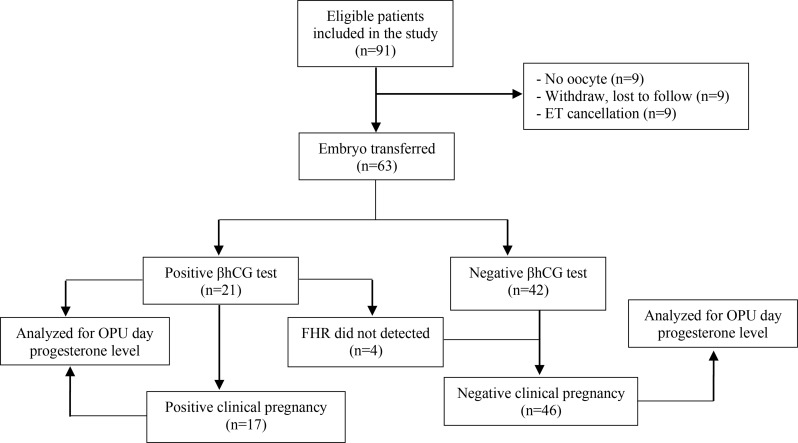
Between February and July 2024, 91 patients were enrolled in the study. The mean age of the patients was 35.56±4.45 years, and the mean BMI was 25.98±2.2. Out of the 91 eligible patients, 63 underwent fresh embryo transfer. Serum β-hCG evaluation revealed that 42 patients had a negative result, while 21 had a positive result. Additionally, fetal heart rate (FHR) was observed in 17 patients during ultrasonography conducted at the 6th week of gestation (Figure 1).
Baseline characteristics were compared between patients with positive and negative β-hCG results. No significant differences were observed between the groups in terms of age, type of infertility, etiology of infertility, ovarian stimulation protocol, trigger medication, hysterosalpingography results, and sperm analysis outcomes (Table 1). However, significant differences were noted in BMI and serum LH levels on the 2nd day of the cycle, with lower BMI (p=0.004) and higher LH levels (p= 0.045) in the positive β-hCG group compared to the negative group.
Table 1. Baseline clinical and paraclinical characteristics of patients with positive and negative serum β-hCG level, 14 days after the embryo transfer
| Variables * | Negative (n=42) | Positive (n=21) | Total (n=63) |
Mann Whitney
p-value | |
|---|---|---|---|---|---|
| Age ** | 36.5 (26–40) | 36 (24–40) | 37 (24–41) | 0.777 | |
| BMI *** | 26.15 (21.7–33.1) | 24.7 (21.9–28.1) | 26 (20.5–33.1) | 0.004 | |
| Duration of infertility * (years) | 3 (1–13) | 3 (1–7) | 3 (1–13) | 0.094 | |
| FSH **** | 5.95 (3.1–9.8) | 6.5 (3.7–7.6) | 6.5 (2.8–9.8) | 0.153 | |
| LH **** | 4.2 (1.1–9) | 4.5 (1.7–5.5) | 4.3 (1.1–9) | 0.045 | |
| TSH **** | 1.55 (0.5–2.5) | 1.4 (0.5–2.1) | 1.5 (0.5–2.5) | 0.318 | |
| PRL **** | 13.85 (4.8–25) | 15.5 (5.7–23.5) | 15.5 (4.8–28) | 0.325 | |
| AMH **** | 2.5 (0.2–5.1) | 2.1 (1.4–3.5) | 2 (0.2–5.1) | 0.343 | |
| Transferred embryos * | 2 (1–2) | 2 (1–2) | 2 (1–2) | 0.06 | |
| FSH | 18 (16–33) | 18 (16–22) | 18 (16–33) | 0.149 | |
| hMG | 9 (2–22) | 9 (2–16) | 9 (2–22) | 0.359 | |
| Duration of cycle | 9 (8–11) | 9 (8–11) | 9 (8–11) | 0.882 | |
| Endometrial thickness | 8 (7–9) | 8 (7–9) | 8 (7–9) | 0.626 | |
| Total oocytes | 8 (2–14) | 9 (6–12) | 8 (1–14) | 0.271 | |
| M2 oocytes | 5 (0–10) | 5 (4–8) | 4 (0–10) | 0.180 | |
| Total embryos | 6 (2–10) | 6 (4–10) | 5 (0–10) | 0.519 | |
| High-quality embryos | 4 (2–7) | 3 (2–6) | 3 (2–7) | 0.517 | |
| Intramuscular progesterone | 12 (28.6%) | 4 (19%) | 16 (25.4%) | 0.4 | |
| Primary infertility δ | 25 (59.5%) | 11 (52.4%) | 36 (57.1%) | 0.59 | |
| Cause of infertility δ | Female | 35 (83.3%) | 17 (81%) | 52 (82.5%) | 0.285 |
| Male | 4 (9.5%) | 4 (19%) | 8 (12.7%) | ||
| Both | 3 (7.1%) | 0 | 3 (4.8) | ||
| Protocol stimulation δ | Antagonist | 33 (78.6%) | 18 (90.5%) | 52 (82.5) | 0.241 |
| Agonist | 9 (21.4%) | 2 (9.5%) | 11 (17.5) | ||
| Protocol of trigger | Agonist | 6 (14.3%) | 2 (9.5) | 8 (12.7) | 0.59 |
| HCG | 36 (85.7%) | 19 (90.5%) | 55 (87.3) | ||
Serum β-hCG concentrations measured 14 days post-embryo transfer
Data are presented as frequency (percentage)
Levels on day 2 of retrieval cycle
All of parameter measured of day 2 of retrieval cycle
Data are presented as median (range)
Progesterone levels on the day of the trigger and the day of oocyte retrieval were compared between the groups. The analysis showed no significant difference in progesterone levels on the day of the trigger between the two groups (p=0.763). However, progesterone levels on the day of retrieval were significantly higher in the positive β-hCG group (median=8.46 ng/ml) compared to the negative group (median=5.95 ng/ml, p=0.005) (Table 2). Similarly, the difference in progesterone levels between the day of trigger and the day of retrieval was significantly greater in the positive β-hCG group (median=8.4 ng/ml vs. 4.07 ng/ml, p=0.002). This suggests that both the progesterone levels on the day of retrieval and the increase from the day of the trigger are important predictors of pregnancy success.
Table 2. Comparison of serum progesterone level in successful and failed embryo transfer based on serum β-hCG level and ultrasonography 14 days and 6 weeks after the embryo transfer
| Variables | Negative * | Positive * |
Mann-Whitney
p-value | |
|---|---|---|---|---|
| Serum β-hCG on the 14th day | ||||
| Serum progesterone on retrieval day | On trigger day ** | 0.76 (0.1–1.38) | 0.79 (0.3–1.3) | 0.763 |
| On retrieval day ** | 5.95 (1.3–24.3) | 8.46 (3–13.3) | 0.005 | |
| Difference ** | 4.07 (0.24–23.3) | 8.4 (2.4–12.6) | 0.002 | |
| Clinical pregnancies (positive FHR on 6-week ultrasound) | ||||
| Serum progesterone on retrieval day | On trigger day** | 0.75 (0.1–1.38) | 0.81 (0.4–1.3) | 0.57 |
| On retrieval day ** | 6.19 (1.3–24.3) | 8.38 (3–13.3) | 0.02 | |
| Difference ** | 4.2 (0.24–23.3) | 8.1 (2.4–12.6) | 0.01 | |
Data are presented as median (range).
(ng/ml)
In the subgroup of patients who achieved clinical pregnancy (positive FHR), progesterone levels on the day of retrieval were also significantly higher compared to those who did not achieve clinical pregnancy (p=0.02). Additionally, the change in progesterone levels between the day of the trigger and the day of retrieval was significantly greater in the clinical pregnancy group (median=8.1 ng/ml vs. 4.2 ng/ml, p=0.01), further supporting the role of progesterone dynamics in predicting pregnancy outcomes.
The serum progesterone difference was calculated as the serum progesterone level on the day of oocyte retrieval minus the serum progesterone level on the day of the trigger.
Given the significant differences or near-significant trends in BMI, LH levels, and the number of embryos transferred between the groups, a logistic regression analysis was performed to adjust for these potential confounders. The adjusted analysis confirmed that higher progesterone levels on the day of retrieval were associated with increased odds of both chemical pregnancy (OR=1.34, 95%CI: 1.08–1.62, p=0.007) and clinical pregnancy (OR=1.28, 95%CI: 1.03–1.58, p=0.024) (Tables 3). These findings suggest that elevated serum progesterone levels on the day of retrieval significantly enhance the likelihood of achieving both chemical and clinical pregnancies, independent of other factors such as BMI, LH levels, and the number of embryos transferred.
Table 3. Logistic regression analysis of the association between progesterone levels on ovarian puncture day and positive serum β-hCG levels 14 day and clinical pregnancy after embryo transfer, adjusted for potential confounders
| Variable | Positive Serum β-hCG | Clinical pregnancy | ||||||
|---|---|---|---|---|---|---|---|---|
|
| ||||||||
| Odds ratio (OR) | 95%CI. for OR | p-value | Odds ratio (OR) | 95%CI. for OR | p-value | |||
|
|
| |||||||
| Lower | Upper | Lower | Upper | |||||
| Progesteron day of OPU (ng/ml) | 1.34 | 1.08 | 1.66 | 0.007 | 1.28 | 1.03 | 1.58 | 0.024 |
| Progesteron day of Trigger (ng/ml) | 0.99 | 0.14 | 7.01 | 0.993 | 1.60 | 0.22 | 11.66 | 0.641 |
| BMI | 0.75 | 0.52 | 1.08 | 0.125 | 0.78 | 0.54 | 1.12 | 0.181 |
| LH d2cycle | 0.60 | 0.36 | 1.01 | 0.053 | 0.58 | 0.33 | 1.02 | 0.060 |
| Number of Embryo Transferred | 20.62 | 1.57 | 271.22 | 0.021 | 9.19 | 0.84 | 100.93 | 0.070 |
| Constant | 2.61 | - | - | - | 4.00 | - | - | - |
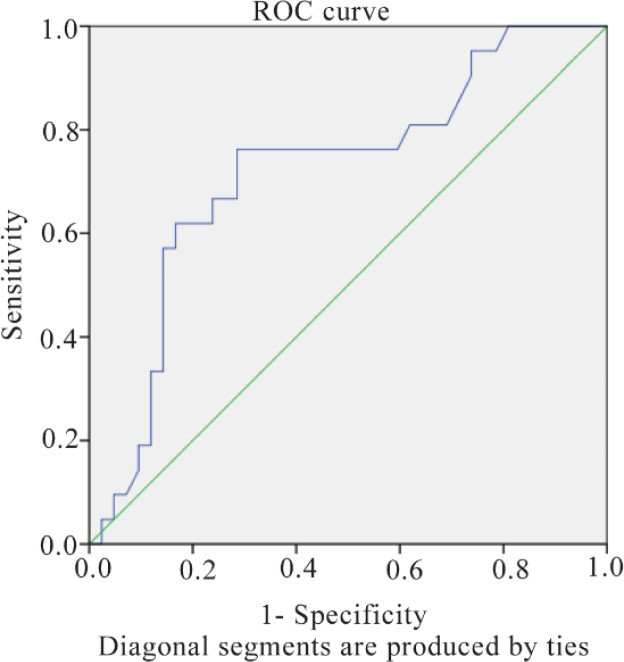
The ROC curve analysis was conducted to assess the predictive value of progesterone levels on the day of retrieval for pregnancy outcomes. The AUC for predicting chemical pregnancy was 0.72 (95%CI: 0.58–0.857), indicating a moderately good predictive value. A progesterone cutoff of 7.1 ng/ml on the day of retrieval predicted chemical pregnancy with a sensitivity of 76.2% and a specificity of 72.1% (Figures 2 and 3). For clinical pregnancy prediction, the AUC was 0.69 (95% CI: 0.54–0.83), with a serum progesterone cutoff of 7.55 ng/ml. This cutoff predicted clinical pregnancy with a sensitivity of 71% and a specificity of 68%.
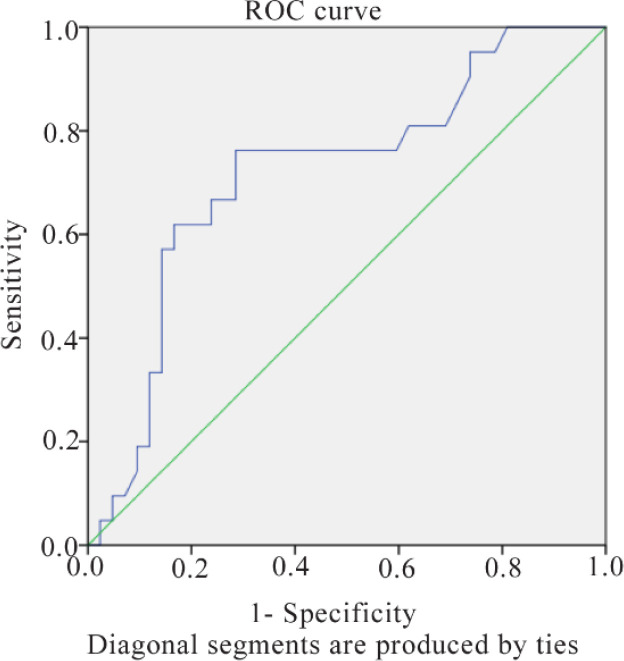
In this study, serum progesterone levels were evaluated on two key days, the day of trigger (hCG administration) and the day of oocyte retrieval, in patients undergoing fresh embryo transfers. Significant differences in progesterone levels were observed only on the day of retrieval, with higher progesterone levels being associated with positive embryo transfer outcomes. The ROC curve analysis yielded an AUC of 0.72 for chemical pregnancy and 0.69 for clinical pregnancy, indicating a moderately strong predictive value of progesterone levels on the day of retrieval in predicting ART outcomes. No significant differences in progesterone levels were observed on the day of hCG administration.
Our findings align with prior studies that emphasize the importance of progesterone levels for predicting successful ART outcomes. For instance, Nayak et al. found that elevated progesterone levels on the day of oocyte retrieval in GnRH antagonist protocols were associated with better pregnancy outcomes (5). However, our study is unique in its focus on defining a lower bound cutoff for progesterone, unlike previous studies that typically focused on upper thresholds. Studies conducted by Bosch et al. and Venetis et al. highlighted the detrimental effects of elevated progesterone levels on ART success, particularly in frozen cycles (2, 3). In contrast, our study suggests that in fresh cycles, maintaining progesterone levels above a certain threshold is more critical for success.
Additionally, studies such as the one conducted by Alyasin et al. reported lower AUC values (0.61) when investigating progesterone’s role in frozen embryo transfers, suggesting that the timing of progesterone measurement and the type of cycle may significantly impact the predictive value (11). Kofinas et al. also reported lower AUC values (0.60) for elevated progesterone levels in frozen cycles, further emphasizing the context-specific nature of progesterone thresholds (12).
The research by Uyanik et al. examined progesterone levels after retrieval in fresh blastocyst transfer cycles. Their study found that patients who experienced a decline in progesterone levels between days 3 and 5 had significantly lower ongoing pregnancy rates compared to those who maintained or increased their progesterone levels. This research underscores the significance of maintaining stable or increasing progesterone levels following oocyte retrieval for enhancing the likelihood of successful implantation and pregnancy. However, they did not evaluate the predictive value of progesterone via ROC curve analysis, limiting direct comparison of predictive accuracy across studies. Instead, their focus was on the longitudinal monitoring of progesterone and its impact on ongoing pregnancy rates (7). In our study, despite the absence of decline in progesterone levels, the rate of its increase was significantly lower in the group with negative pregnancy outcome compared to those with positive outcomes. This suggests that not only the level of progesterone but also the magnitude of its increase between the day of trigger and retrieval plays a crucial role in determining pregnancy success. This underscores the significance of progesterone dynamics in predicting outcomes. Uyanik et al. observed a decline in progesterone levels, whereas our study found that a slower increase in progesterone was associated with unsuccessful outcomes.
Our findings are further supported by Tsai et al. who examined the role of progesterone levels at various stages of ART. Their study demonstrated that elevated progesterone levels could be detrimental in certain contexts, emphasizing the significance of precise timing and control (13). Similarly, Xu et al. found that both low and high progesterone levels on the day of hCG administration impacted live birth rates (14). These findings align with our observation that the timing of progesterone evaluation is crucial, with significant predictive value found specifically on the day of retrieval. The identification of a lower bound cutoff reflects the unique needs of our patient population, which may include individuals with reduced ovarian reserves or those undergoing GnRH antagonist protocols. Ensuring that progesterone levels exceed the lower threshold is essential for providing adequate luteal phase support, as suboptimal levels may disrupt the endometrial window of implantation.
The substantial AUC values, with 0.72 for chemical pregnancy and 0.69 for clinical pregnancy, suggest that progesterone level on the day of retrieval serves as a good predictor of ART outcomes in fresh cycles. Higher AUC values, compared to studies involving frozen cycles, may reflect the distinct hormonal dynamics of fresh transfers, where real-time monitoring of progesterone plays a critical role in optimizing endometrial receptivity.
BMI has been shown to impact the success rate of fresh embryo transfers in several studies. Women with a higher BMI (above 25 kg/m2) are generally associated with lower pregnancy rates, potentially due to alterations in endometrial receptivity and hormonal balance (15, 16). In our study, results for BMI and other potential confounders were adjusted.
A major strength of our study is its specific focus on fresh embryo transfers, which contrasts with many previous studies that examined frozen cycles. This provides novel insights into the importance of progesterone levels on the day of retrieval in fresh cycles. Additionally, our study offers practical clinical cutoffs for progesterone levels that can be used to guide luteal phase support in fresh ART cycles.
However, our investigation is subject to certain limitations that may impact its findings. First, the observational design limits our ability to establish causality. Furthermore, although our sample size was adequate for preliminary observations, expanding it would enhance the statistical power and improve the generalizability of the results. Moreover, there was no follow-up on progesterone levels after embryo transfer, which might have provided additional insight into the hormonal dynamics of luteal phase support. Furthermore, progesterone was administered only via vaginal supplementation, which may not fully reflect systemic progesterone levels. These limitations, along with the specific characteristics of the patient population included in the study, suggest the need for further research with larger, more diverse cohorts to validate our findings and the proposed progesterone cutoffs. Additionally, while the number of embryos transferred was controlled in our analysis, this remains a potential confounder that should be considered in future research.
Our findings are particularly relevant to individual patients undergoing fresh embryo transfer cycles. While our study focused on a specific patient population, the concept of identifying a lower bound progesterone cutoff may have broader implications for ART practice in similar populations. In fact, the application of these cutoffs to other ART protocols, such as frozen-thawed embryo transfers, may require additional investigation.
Our study suggests that higher progesterone levels on the day of oocyte retrieval may be associated with improved embryo transfer outcomes in fresh ART cycles. These findings highlight the potential of progesterone level on the day of retrieval as a predictive marker for pregnancy success. Further research is needed to establish optimal cutoff values and validate these results in larger, diverse cohorts to refine ART protocols.
The authors would like to express their gratitude to Shahid Akbarabadi Clinical Research Development Unit (ShACRDU), Tehran, Iran for their collaboration and support throughout the study period.
Funding: This study was financially supported by Iran University of Medical Sciences, Tehran, Iran.
