
For many years, it has been known that male factors contribute to 30–40% of all infertility cases worldwide. Several approaches have been implemented for the treatment of couples with infertility, one of which is ICSI, a technique known to be a breakthrough development for infertile couples, especially those with poor semen quality. Even so, there are still numerous cases of ICSI with poor outcomes, particularly in instances involving low quantity and quality of ejaculates (1). Various attempts have been made to obtain semen samples with good quality. Previous studies have reported that better semen quality can be obtained by using a shorter abstinence time or consecutive ejaculation (2).
Until recently, the World Health Organization (WHO) guidelines, which provide the basis of procedural standardization and reference value for semen analysis, have suggested that the ejaculatory abstinence interval for semen analysis be in a minimum period of 48 hr and no longer than seven days. Meanwhile, a stricter and shorter ejaculatory abstinence interval has been suggested by the European Society of Human Reproduction and Embryology (ESHRE) and the Nordic Association for Andrology (NAFA), which is 3 to 4 days. However, the basis of these suggestions remained unclear, with no supporting scientific references (3, 4).
Human spermatozoa are produced in the seminiferous tubules, and before being ejaculated, they are accumulated in the epididymis. To mature and acquire the capability to fertilize oocytes, sperm have to undergo several physiological and biochemical changes in the epididymis, which last between two to eleven days (5). Sperm transit time through the epididymis can be affected by external factors like sexual stimulation and the frequency of ejaculation, which can raise intraluminal pressure and accelerate the passage of sperm. This accelerated movement may impact sperm maturation. The neutral α-glucosidase, primarily secreted by the cauda epididymis, has been shown to have a positive correlation with sperm motility (6). Since abstinence time has been suggested as one of the many factors influencing semen parameters, it has been reported that prolonged abstinence may have a deleterious effect on semen parameters. A survey on normozoospermic subfertile men showed that longer abstinence was linked to increases in ejaculate volume, sperm concentration, total sperm count, and total motile sperm count (TMSC) (7). However, it may increase sperm exposure to reactive oxygen species (ROS), which have been associated with lipid peroxidation of the sperm plasma membrane, leading to DNA damage, compromising sperm motility and fertilization potential, and contributing to male infertility (8, 9).
Shorter abstinence significantly improved total and progressive sperm motility, as well as sperm viability by protecting it against oxidative stress, increasing the total seminal antioxidant capacity, and limiting sperm exposure towards lipid peroxidation or apoptosis (5, 10, 11). Previous studies have also reported that ejaculate collected after a short interval of abstinence resulted in better sperm motility and morphology with a lower percentage of sperm DNA fragmentation in normozoospermic and oligoasthenozoospermic samples, a higher clinical pregnancy rate, and improved embryo quality (2, 12). A reduction in intracellular ROS levels has been observed in semen samples collected after just one day of abstinence. According to the study, this may be due to the sperm spending a shorter time in the epididymis, allowing them to retain their antioxidant capacity without significant depletion (5).
Shorter periods of ejaculatory abstinence may also improve outcomes in assisted reproductive technology (ART). Good semen parameters are crucial for successful fertilization and high-quality embryo cleavage following ICSI (13). In contrast, impaired semen quality is often linked to genetic abnormalities, implantation failure, and higher miscarriage rates (14). There is still no consensus on how abstinence affects both conventional and functional sperm parameters to date, making the impact of ejaculatory abstinence on sperm characteristics a subject of ongoing debate (15).
Based on these findings, it is considered that an optimal ejaculatory abstinence time is needed to provide a better sperm quality to ensure better outcomes, not only in natural but also in assisted conception. The purpose of the current study was to evaluate sperm quality and fertilization rate, cleavage rate, as well as embryo quality in severe oligoasthenozoospermic samples using the consecutive ejaculate collected within an hour of abstinence.
A prospective study was conducted at Halim Fertility Center, Stella Maris Women’s and Children’s Hospital, Indonesia from August 2020 to April 2022. Male partners who visited the fertility center were screened to determine whether they met all the inclusion criteria stated as follows: 1) sexual abstinence for at least two days and a maximum of seven days, 2) sperm concentration <5×10⁶/ml and total motility <42% based on the previous semen analysis, and 3) undergoing preparation for ICSI. The subjects were excluded if they had one of the following:
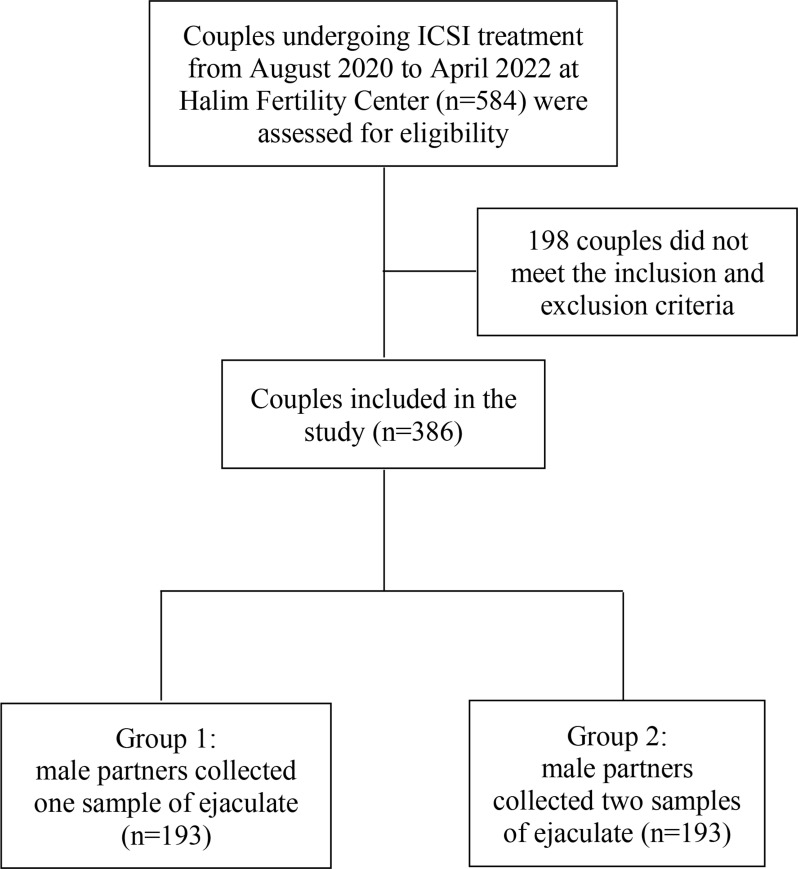
1) a history of infectious diseases including hepatitis B, hepatitis C, and HIV; 2) a history of infection in the sex accessory glands or the reproductive ducts; 3) leukospermia; 4) a history of fever in the past three months; 5) a history of drug consumption that may damage the sperm including chemotherapy agents, anabolic steroid, antibiotics, and psychiatric drugs in the past three months; 6) a history of testicular cancer; 7) retrograde ejaculation; 8) a history of blood clotting disorder; 9) history of smoking; and 10) history of alcohol consumption. The selected male partners were requested to provide their consent to participate in the study. The primary data consisting of the medical record number, name, age, and body mass index (BMI) were recorded. Subsequently, the male partners were randomly divided into two groups. Group 1, or the control group, was asked to collect only one sample, while Group 2, or the case group, was asked to collect two samples where the consecutive ejaculate was taken within an hour of the first (Figure 1).
All female partners involved in the present study had to meet the Bologna criteria for exclusion: 1) advanced maternal age (≥40 years) or any other risk factors; 2) a previous poor ovarian response (canceled cycles or ≤ three oocytes with a conventional protocol); and 3) antral follicle count (AFC) of <5–7 follicles or anti-Müllerian hormone (AMH) levels <0.5–1.1 ng/ml. Confounding variables were controlled through randomization and restrictions on the study participants based on the inclusion and exclusion criteria.
Semen samples were collected by masturbation in the room provided within the fertility center to minimize factors that may alter the semen parameters. All male partners were asked to collect their samples in a sterile, wide-mouth plastic or glass container. Male partners in Group 2 were counseled regarding the possible benefits of collecting consecutive ejaculate. To be included as the study participants, they had to be able to produce an ejaculate 1 hr after the first ejaculate was collected. After being liquefied for 30–60 min at room temperature, all 584 samples were subjected to semen analysis based on 2010 WHO standards to assess sperm concentration and total motility (3). Samples were then prepared for ICSI by a combination of simple washing using G-MOPS™ PLUS (Vitrolife, Sweden) and density gradient methods using Sydney IVF Sperm Gradient (Cook Medical, Australia).
Every patient undergoing stimulation was subjected to follicular aspiration, commonly known as the process of ovum pickup. This procedure was performed 34 to 36 hr after hCG injection. The OPU process was performed using a 17-gauge single-lumen aspiration needle, guided by transvaginal ultrasonography, to aspirate the follicular fluid from the targeted follicle. The aspirated follicular fluid was collected in a sterile 14 ml polypropylene tube, poured into a 60 mm Petri dish, and examined under a stereo microscope to detect the cumulus-oocyte complexes (COCs). The COCs were aspirated using a sterile disposable glass Pasteur pipette and transferred to another Petri dish containing gamete buffer medium. Then, the COCs were stored in a 4-well Petri dish and denudated after two-hour incubation at 37°C, 6% CO2, and 5% O2. The denudation of the COCs was performed to acquire a clearer view of the oocytes using a hyaluronidase solution. Oocytes were considered as mature (metaphase II) if the first polar body (PB) was observed.
An ICSI dish contained 15 μl drops of culture medium and a 10 μl drop of clinical-grade polyvinylpyrrolidone to slow down the movement of the spermatozoa. The ICSI dish was then layered with culture oil and incubated at 37°C until the procedure began. Before ICSI, the injection and holding pipettes were attached to the micromanipulator. The ICSI procedure was carried out by injecting one normal sperm into one mature oocyte obtained from ovum pickup. The semen samples used in ICSI for Group 2 were collected after one hour of abstinence, representing a consecutive ejaculate following an earlier one. Consecutive ejaculates had been shown to contain sperm with improved quality which may increase the chance of successful ICSI. The oocytes were microinjected at a 90°C angle from the first polar body (PB), positioned at 6 or 12 o’clock position. The fertilized oocytes were transferred to a Petri dish containing 30 μl drops of culture medium and incubated at 37°C, 6% CO2, and 5% O2.
The development of the fertilized oocytes was assessed under a light microscope. The fertilization check (PN stage) was assessed 17±1 hr after ICSI, where the appearance of 2 pronuclei (PN) was considered a normal fertilization process. The cleavage stage was assessed on the third day (68±1 hr) after ICSI. In the present study, the day-3 embryos were graded based on the Istanbul Consensus (16). Grade 1 (good) embryos had equal blastomere sizes and fragmentation of less than10%. Grade 2 (fair) embryos had moderate unequal blastomere sizes and fragmentation of 11–25% and Grade 3 (poor) embryos showed severe unequal blastomere sizes and fragmentation greater than 25%. All embryos other than Grade 1, 2, and 3 were classified as Grade 4 (unusable). The fertilization rate, cleavage rate, and embryo grading were first assessed in each study participant and later averaged from the total number of study participants.
In this study, the sperm quality and ICSI outcomes were analyzed in severe oligoasthenozoospermic samples using the consecutive ejaculate collected after an hour of abstinence time. The non-parametric Mann-Whitney test was used to analyze the characteristics of the study participants (age, BMI, AMH, AFC), sperm concentration, sperm total motility, and ICSI outcomes (fertilization rate, embryo cleavage rate, embryo quality) between Group 1 and Group 2. Additionally, the non-parametric Wilcoxon test was used to analyze the sperm concentration and total motility between the first and consecutive ejaculate in Group 2. The statistical analysis was performed using SPSS software version 21.0 (IBM, USA) with a significance level of 0.05.
All male partners participating in the study had consented to the collection of samples. This study received ethical approval from Stella Maris Women’s and Children’s Hospital in Medan, Indonesia, with ethical number 523.2/Dir/RSIA.SM/VIII/2020.
The present study included 386 male partners with severe oligoasthenozoospermia based on prior semen analysis, all of whom were undergoing ICSI. The participants were randomly divided into two groups. The first group was severe oligoasthenozoospermic male partners who were asked to collect only one sample after 2 to 7 days of abstinence, while the second group was severe oligoasthenozoospermic male partners who were asked to collect two samples: the first after 2 to 7 days of abstinence, and the consecutive sample within an hr of abstinence following the first.
There were no significant differences in male partners’ characteristics between Group 1 and Group 2 (mean age: 39.06±6.78 years vs. 37.61±5.64 years; p=0.066 and mean BMI: 26.92±4.14 kg/m2 vs. 27.41±3.91 kg/m2; p=0.308). All female partners in Group 1 and Group 2 (mean age: 34.15±4.26 years vs. 33.62±4.57 years; p=0.363) were subjected to controlled ovarian stimulation with an antagonist protocol. The female partners involved in this study were categorized as normoresponder (mean AMH: 2.39±0.85 ng/ml vs. 2.75±0.92 ng/ml; p<0.001 and mean AFC: 7.78±4.42; vs. 8.98±5.32; p=0.005) (Table 1).
Table 1. Characteristics of the study participants
| Group 1 (n=193) | Group 2 (n=193) | p | |
|---|---|---|---|
| Male | |||
| Age (Mean±SD; years) | 39.06±6.78 | 37.61±5.64 | 0.066 |
| BMI (Mean±SD; kg/m2) | 26.92±4.14 | 27.41±3.91 | 0.308 |
| Female | |||
| Age (Mean±SD; years) | 34.15±4.26 | 33.62±4.57 | 0.363 |
| AMH (Mean±SD; ng/ml) | 2.39±0.85 | 2.75±0.92 | <0.001 |
| AFC (Mean±SD; n) | 7.78±4.42 | 8.98±5.32 | 0.005 |
Mann-Whitney test
Data from samples in the groups are shown in tables 2 and 3. The number of retrieved oocytes and mature oocytes in two groups is indicated in table 2 (oocytes retrieved: 2071 vs. 2589; p=0.005 and mature oocytes: 1497 vs. 1902; p=0.005). The sperm concentration was significantly higher in Group 1 (1.83±1.45×10⁶/ml vs. 1.16±1.24×10⁶/ml; p<0.001). No significant difference was found in sperm concentration between the first and consecutive ejaculate in Group 2 (1.16±1.24×10⁶/ml vs. 1.38±2.15×10⁶/ml; p=0.697). The percentage of sperm total motility did not differ significantly between Group 1 and Group 2 (22.22±9.26 vs. 22.52±8.85; p=0.810) but showed a significant improvement in the consecutive ejaculate compared to the first in Group 2 (31.53±11.73 vs. 22.52±8.85; p<0.001).
Table 2. Characteristics of the oocytes and sperm samples
| Group 1 | Group 2 | p-value | |
|---|---|---|---|
| Oocytes retrieved (n) | 2071 | 2589 | 0.005 |
| Mature oocytes (n) | 1497 | 1902 | 0.005 |
| Sperm concentration (Mean±SD; 106/ml) | |||
| First ejaculate | 1.83±1.45 | 1.16±1.24 | <0.001 a |
| Consecutive ejaculate | - | 1.38±2.15 | 0.697 b |
| Sperm total motility (Mean±SD; %) | |||
| First ejaculate | 22.22±9.26 | 22.52±8.85 | 0.810 c |
| Consecutive ejaculate | - | 31.53±11.73 | <0.001 d |
Mann-Whitney test;
Wilcoxon test
Table 3. Comparison of ICSI outcomes between Group 1 and Group 2
| Group 1 | Group 2 | p-value | |
|---|---|---|---|
| Fertilization rate (Mean±SD; %) | 55.45±31.76 | 61.41±28.04 | 0.081 |
| Cleavage rate (Mean±SD; %) | 81.07±36.34 | 88.10±28.63 | 0.262 |
| Embryo quality (Mean±SD; %) | |||
| Grade 1 (Good) | 9.08±19.22 (12.33) | 6.98±14.86 (10.01) | 0.757 |
| Grade 2 (Fair) | 31.62±34.62 (32.77) | 38.10±34.13 (33.86) | 0.271 |
| Grade 3 (Poor) | 28.28±35.48 (23.10) | 24.55±31.84 (18.45) | 0.757 |
| Grade 4 (Unusable) | 15.48±23.27 (31.80) | 21.57±25.41 (37.68) | 0.105 |
Mann-Whitney test; Bolded texts indicate values in percentages
The ICSI outcomes were analyzed between Group 1 and Group 2. The semen samples used in Group 2 were obtained after 1 hr of abstinence. Fertilization and cleavage rates were higher in Group 2, although they were not significant (fertilization rate: 55.45±31.76% vs. 61.41±28.04%; p= 0.081 and cleavage rate: 81.07±36.34 vs. 88.10±28.63; p=0.262). No significant difference was found in the embryo quality between groups (Grade 1: 9.08±19.22 or 12.33% vs. 6.98±14.86 or 10.01%, p=0.757; Grade 2: 31.62±34.62 or 32.77% vs. 38.10±34.13 or 33.86%, p=0.271; Grade 3: 28.28±35.48 or 23.10% vs. 24.55±31.84 or 18.45%, p=0.757; Grade 4: 15.48±23.27 or 31.80% vs. 21.57±25.41 37.68%, p=0.105). The percentage of each embryo quality grade in both groups was calculated by dividing the total number of embryos of a specific grade by the total number of cleaved embryos.
Infertility poses a significant challenge, impacting one-sixth of all couples in their reproductive years. Traditionally, there was a prevailing belief that the majority of reproductive issues were linked to female partners. However, recent researches indicate that male factors can also contribute to almost half of all infertility cases, affecting one out of every 20 men in the general population (17). Semen parameters may vary intra-individually due to environmental, genetic, and lifestyle factors, such as ejaculatory frequency and abstinence duration. The World Health Organization (WHO) guidelines suggest a minimum of 2 days and no longer than seven days of abstinence period for semen analysis, but recent studies challenge the effects of abstinence on semen quality (1, 3).
Human spermatozoa are more vulnerable to reactive oxygen species (ROS) due to their high polyunsaturated fatty acids (PUFAs) content. An imbalance between oxidative and antioxidant systems in the seminal plasma may negatively affect sperm function (18, 19). Longer abstinence is associated with higher sperm concentration but poorer motility and DNA integrity (20, 21). A low number of motile spermatozoa and high sperm DNA fragmentation are known to be associated with low fertilization rates, poorer embryo quality, implantation failure, and recurrent miscarriages, particularly in men with severe oligozoospermia (21, 22).
A study suggested that shortening the storage time in the epididymis can reduce sperm exposure to factors that inhibit motility, as well as to enzymes released by deteriorating cells in the same environment (23). In men with oligoasthenozoospermia, the sperm transit time through the epididymis is three times longer compared to those who are normozoospermic, making them more vulnerable to oxidative damage (19). Consecutive ejaculates collected within one hour showed improvements in sperm count and motility, despite a decrease in ejaculate volume, thereby benefiting semen quality in men with oligoasthenozoospermia. Shorter abstinence also benefits normozoospermic men, enhancing motility and morphology in consecutive ejaculates (24). In the present study, the sample volume was not recorded because the semen parameters considered more important for ICSI were sperm viability, normal morphology, and DNA fragmentation, which impact fertilization and pregnancy rates (25).
In our study involving 386 male partners, shorter abstinence improved sperm motility, while sperm concentration remained relatively unaffected. These results were similar to the previous study conducted by Sugiyam et al. (13), where the sperm concentration was higher in the consecutive ejaculate compared to the first (11.7±7.3×10⁶/ml vs. 8.9±5.0×10⁶/ml). Sperm motility and motile sperm concentration were significantly improved in the consecutive ejaculate samples (35.2±13.3% vs. 24.3±13.2% and 5.4±7.3×10⁶/ml vs. 2.2±1.8× 10⁶/ml). Azizi et al. (26) also reported that sperm concentration did not differ significantly among groups with 1, 2, 3, 4, 5, 6–10 days of ejaculatory abstinence (1 day: 46±41×106/ml; 2 days: 52±37× 106/ml; 3 days: 49±30×106/ml; 4 days: 50±32× 106/ml; 5 days: 49±30×106/ml; 6–10 days: 61±36× 106/ml; p=0.1). In men with severe oligoasthenoteratozoospermia, 33% initially exhibited a notably low sperm count in their first ejaculate (6.2±8.4 million), followed by significant improvement in the consecutive ejaculate (18.8±24.0 million) (24).
Contrary to our findings, a study involving 16 healthy men showed that sperm concentration was significantly decreased after 4 hr compared to 4 days of abstinence time (36.83±4.5×10⁶/ml vs. 57.4±7.2×10⁶/ml; p=0.018) (27). Another study comparing several groups of oligozoospermic male partners with different abstinence times (<24 hr, 1–2 days, 3–7 days, 8–15 days, and >16 days) also reported that there was a lower sperm concentration in <24 hr group compared to the others (6.07×10⁶/ml, 6.89×10⁶/ml, 6.26×10⁶/ml, 6.22× 10⁶/ml, 7.71×10⁶/ml, respectively) (28). Lower sperm concentration and total sperm count after a shorter abstinence time are possible because, at the time of ejaculation, only 50% of the spermatozoa in the epididymis are ejaculated. They may also result from the limited sperm storage capacity in humans and insufficient time for sperm to travel from the proximal parts of the epididymis to the cauda and vas deferens (29). Although sperm concentration is one of the important indicators of semen quality and a prognostic factor for fertility potential, this parameter is not recommended for accurately measuring spermatogenesis, as it is affected by the volume of secretions from the accessory sex glands (30).
Sperm motility, a key indicator of fertility potential, improves with shorter abstinence due to reduced ROS exposure and less heat damage in the epididymis. Improved motility reflects sperm maturation and enhances their ability to fertilize (11). In the present study, the percentage of sperm total motility was significantly improved in the consecutive ejaculate compared to the first (22.52±8.85 and 31.53±11.73, respectively; p<0.001). This finding is similar to other studies which highlight the positive effects of shorter abstinence on sperm motility. In men with severe oligoasthenozoospermia, one-hr abstinence time resulted in a significant improvement in total and progressive motility compared to the first ejaculate (2). Another study using 30–60 min of abstinence time also reported a significant improvement in sperm quality, particularly the number of sperm with rapid motility and motile sperm concentration (32). Previous studies involving 3506 samples, ranging from mild to severe oligozoospermia, also reported that the peak mean sperm motility could be observed after 24 hr of abstinence time (19). Dupesh et al. (28) conducted a study comparing the sperm progressive motility among groups of oligozoospermic male partners with different abstinence times, showing that the group with <24 hr abstinence time had the highest percentage of progressively motile spermatozoa compared to the 1–2 days, 3–7 days, 8–15 days, and >16 days of abstinence time (26.71; 20.54; 18.52; 17.41; 20.43, respectively). Goss et al. (27) also reported that the percentage of sperm total motility and progressive motility significantly increased after 4 hr of abstinence time compared to 4 days of abstinence time (71.84±3.85 vs. 64.71±13.94; p=0.033 and 58.54±13.38 vs. 47.74±14.33; p=0.001). Ejaculates collected after a shorter period of abstinence time tend to contain a greater number of spontaneously hyperactivated sperm, especially in men with male factor infertility. For this reason, consecutive ejaculates are often recommended to improve IVF-ICSI success rates (29, 32).
The present study analyzed the ICSI outcomes between two groups: one providing a single ejaculate after 2–7 days of abstinence, and another providing a consecutive ejaculate within an hour from the first. Fertilization and cleavage rates were higher in Group 2 compared to Group 1 (61.41±28.04% vs. 55.45±31.76%; p=0.081 and 88.10±28.63% vs. 81.07±36.34%; p=0.262). The results were similar to several studies, stating that shorter abstinence time may improve ICSI outcomes (2, 13, 20). An analysis of the relationship between ejaculatory abstinence and ICSI outcomes revealed that sperm collected after a longer period of abstinence had a lower chance of successful fertilization, leading to fewer viable zygotes. In particular, the likelihood of obtaining 2PN zygotes from inseminated oocytes decreased by 3% for each additional day of abstinence (33). In the present study, a higher percentage of usable embryos (Grade 1, Grade 2, Grade 3) could be seen in Group 1 compared to Group 2 (68.2% vs. 62.32%), though the difference was statistically insignificant. This result was contrary to the previous study, where the number of good-quality embryos was higher in men who provided consecutive ejaculate (20). Barbagallo et al. (2) also reported that consecutive ejaculate increased the number of Grade 1 embryos (72.5% vs. 54.3%).
Our study showed that although the number of oocytes retrieved was significantly higher in Group 2, the number of Viable embryos and Non-viable embryos did not differ significantly compared to Group 1. Studies have shown that the number of retrieved oocytes was associated with live birth rate, because retrieving a greater number of oocytes provides more opportunities for ongoing treatment, thereby increasing the overall cumulative success rates (34, 35). However, as the number of oocytes retrieved increases, so does the likelihood of variability in oocyte quality, leading to a higher chance of encountering oocytes that are either immature or overmature (36). While sperm plays a vital role in ICSI, the primary factor influencing successful fertilization and the progression of embryo development is the oocyte (37). Embryo quality is influenced by the nuclear composition, mitochondrial function, cytoplasmic maturity of the oocyte, selected stimulation protocol, unfavorable conditions in the embryology laboratory, an inadequate response to stimulation, genetic abnormalities in the gametes of either partner, or genetic defects in the embryo itself (38, 39).
Consecutive ejaculate has been applied to increase the success rate of ICSI and intrauterine insemination (IUI) cycles. According to a study conducted by Bahadur et al. (40), male factor issues that hinder successful pregnancies can potentially be addressed by using consecutive ejaculate collected within 30 min from the first. This approach has been linked to enhanced sperm motility, which positively correlates with successful IUI outcomes. Another study assessing ICSI outcomes reported that consecutive ejaculate may result in a higher number of high-quality embryos, as well as improved rates of implantation, biochemical pregnancy, clinical pregnancy, and live birth (2, 41). However, the study had several limitations. The volume of the consecutive ejaculate was not recorded, the number of oocytes retrieved was significantly higher in one of the groups which may increase the risk of bias due to the the possibility of improved oocyte selection, and the DNA fragmentation index of the semen samples was not assessed. Additionally, the quality of embryos was not compared between the oocytes injected with samples retrieved from the first and consecutive ejaculate.
Our study indicates that a consecutive ejaculate obtained within an hour of abstinence from the first may improve sperm total motility, especially in patients with severe oligoasthenozoospermia. This could be beneficial, where good sperm motility is known to be associated with higher fertilization and cleavage rates after ICSI. The study results show that the number of usable and unusable embryos did not differ significantly between the two study groups, possibly due to oocyte quality or embryo development being influenced by factors other than sperm alone. Although there have been numerous studies on the use of consecutive ejaculate for ICSI and IUI, future randomized controlled studies are still needed since there is still ongoing debate about the optimal abstinence period required to achieve the best sperm quality that may enhance ICSI and IUI outcomes.
The authors would like to thank the team at Halim Fertility Center in Medan for their time and support during the data collection and analysis process.
Funding: This study received no specific grant from any funding agency in the public, commercial, or not-for-profit sectors.
