
Menstruation cycle is an essential part of a woman’s reproductive system. During reproductive phase, each woman exhibits her own inherent duration of menstrual cycle. Abnormal cessation or absence of menstruation during reproductive age triggers anxiety and a range of emotional responses, necessitating early diagnosis and intervention due to its impact on women’s physical and mental health (1). Failure or abnormal cessation of menstruation in women during their reproductive age is defined as amenorrhea. Amenorrhea is caused by a variety of factors, including prepubertal development, pregnancy, hormonal imbalance, increased levels of male testosterone as observed in conditions such as congenital adrenal hyperplasia and polycystic ovary syndrome. Other factors include endometriosis, primary ovarian insufficiency, menopause, the absence of uterus and vagina, dysfunction of the hypothalamus or pituitary gland, and vaginal agenesis. Traditionally, amenorrhea is classified as primary, secondary, and oligomenorrhea (2). Absence of menstruation, with or without secondary sexual characteristics by the age of 14, is defined as primary amenorrhea (PA). The main etiologies of PA include hypogonadism, particularly hypergonadotropic hypogonadism, as well as thyroid disorders, adrenal insufficiency, and outflow tract abnormalities. According to various studies, ovarian or gonadal disorders account for half of the total PA cases, and these conditions are frequently associated with sex chromosomal abnormalities (3). Absence of menstruation for 6 months or more than 3 consecutive cycles in a woman who previously had regular menstrual cycle is called secondary amenorrhea (SA). It is mostly caused by endocrine disorders, lifestyle factors, PCOS, and environmental factors. The condition is rarely associated with cytogenetic abnormalities. Infrequent menstruation characterized by longer cycles (typically 35 days or more) and fewer than six to eight menstrual periods per year is classified as oligomenorrhea (OA) (4). Many factors involved in PA or SA can also be responsible for irregular ovulation in woman. PCOS is the leading cause of most cases of oligomenorrhea. However, women who experience infrequent menstruation may also exhibit chromosomal abnormalities. The World Health Organization (WHO) estimates that 15% of the world’s population is infertile, and amenorrhea ranks as the sixth most common cause of female infertility (5). Many investigations have been conducted to determine the prevalence and categories of chromosomal aberrations in amenorrhea cases. However, no cytogenetic investigation has been conducted on amenorrhea patients in Odisha (East India) population. The purpose of the current study was to uncover the categories of chromosomal anomalies and estimate their frequency in women with a clinical history of amenorrhea.
A case series study was implemented to select 231 women with a confirmed diagnosis of amenorrhea who were referred for cytogenetic investigation at inDNA Life Sciences Pvt. Ltd. in Bhubaneswar, India from September 2022 to September 2024. The primary clinical examination and diagnosis were conducted by an expert clinician based on various medical histories, including hormonal profiles, ultrasonography, and physical investigation. In this study, cases were classified into three categories: primary amenorrhea (PA), secondary amenorrhea (SA), and oligomenorrhea (OA). Women diagnosed with amenorrhea based on medical history, clinical information, hormonal profiles, and ultrasonography were included in this survey. Women with autoimmune thyroid diseases or imbalances in prolactin levels, as well as those with infections, exposure to radiation, infertility, or miscarriage were excluded.
The study was designed and performed in accordance with the World Medical Association’s Code of Ethics (Declaration of Helsinki) for human experiments. The study review was conducted by an Independent Ethics Committee at inDNA Life Sciences Pvt. Ltd., Bhubaneswar, Odisha and ethical clearance has been obtained (REF: IND/CYT/09/22/01). Before collecting samples, voluntary informed consent was received from each patient in accordance with the Ethics Committee’s guidelines. Personal information of each patient was kept confidential.
From each patient, 2–3 ml of whole blood sample was collected in sodium heparin vial and thoroughly mixed to prevent the formation of blood clots. A unique laboratory identification number was generated and allotted to each sample.
As per the AGT Cytogenetics Laboratory Manual (4th edition), a 72 hr short-term lymphocyte culture was initiated from the whole blood. In a T25 culture flask, 8 ml of complete RPMI-1640 medium (RPMI-1640, Catalog number 61870036; Thermo Fisher Scientific, USA) was combined with 10–12% fetal bovine serum (Catalog number 10270106; Thermo Fisher Scientific, USA), 1% penicillin–streptomycin solution (A007–100ML; Himedia, Germany), 400 μl of 10 mg/ml phytohemagglutinin (Catalog number 10576-015; Thermo Fisher Scientific, USA). Finally, 500 μl of peripheral blood samples were transferred aseptically.
T-25 culture flasks were uniquely labelled for each sample and kept in a 37°C incubator containing 5% CO2 for 72 hr. At the 71st hr, 10 mg/ml colcemid (Catalog number 15210-040; Thermo Fisher Scientific, USA) was added to each culture flask and incubated at 37°C for 1 hr. After incubation, cell suspensions were transferred to the respective 15 ml centrifuge tube and spun at 1500 rpm for 10 min. Supernatant was aspirated and 0.075 M potassium chloride solution (Merck, Germany) was added drop by drop to the cell pellet while vortexing. Samples were incubated in water bath at 37°C for 45 min and then tubes were spun at 1500 rpm for 10 min. An aliquot of 5–8 ml of freshly prepared pre-chilled Carnoy’s fixative (3:1 ratio of methanol to acetic acid; Merck, Germany) was added dropwise to the cell pellet while continuously mixing on a cyclomixer. Tubes were stored overnight at 4°C. After that, a series of washes with pre-chilled Carnoy’s fixative was performed until a clear cell pellet was obtained.
A white clear cell pellet was gently resuspended by tapping the bottom of the centrifuge tube. Subsequently, 2–3 drops of lymphocyte cell suspension were cast onto a pre-chilled, grease-free microscope slide from an appropriate height, with the slide held at a 45-degree angle.
The casted slides were allowed to dry at 56°C for a few seconds. Next, each slide was labeled with its unique laboratory identification number. The slides were then baked overnight at 60°C. The working trypsin solution was prepared by dissolving 250 mg of trypsin powder (Catalog number 27250018, Thermo Fisher Scientific, USA) in 1x phosphate-buffered saline (PBS) solution (Merck, Germany). The solution was then allowed to equilibrate at room temperature before use. Next, 10% Giemsa stain (HiMedia-S011-100 ML) was prepared in distilled water and filtered using 0.45 μm filter membrane (Merck Millipore, USA). Slides were immersed in trypsin solution for a few seconds, then washed with 1X pre-chilled PBS. After that, the slides were placed in Giemsa solution for 8 min, followed by washing in double-distilled water.
Olympus Bx43 microscope, equipped with aLeica DFC365 FX monochrome digital camera, was used to scan the G-banded slides. Twenty elongated and well-spread metaphases were captured, and the position of each metaphase spread was recorded using the Slide Finder tool.
In case of mosaicism, the count was extended to include up to 50 metaphases. Chromosome meta-phase (approximately 400–500 band level) was karyotyped using CytoVision 4.0 software (Leica Biosystems, Germany). All the abnormal karyo-types were reported according to the International System for Human Cytogenomic Nomenclature (2020).
A total of 231 women were included in this study. According to the clinical history, the women were classified into three groups: Group A consisted of 156 women (67.53%) with primary amenorrhea, Group B included 19 women (8.23%) with secondary amenorrhea, and Group C comprised 56 women (24.24%) with oligomenorrhea. Out of 231 amenorrhea cases, 58 (25.11%) cases exhibited various types of chromosomal abnormalities, while 173 (74.89%) were cytogenetically normal. Out of 231 cases, 43 (18.61%) cases of primary amenorrhea, 1 (0.43%) case of secondary amenorrhea, and 4 (1.73%) cases of oligomenorrhea showed chromosomal abnormalities, while the remaining cases were cytogenetically normal. The incident rates for primary amenorrhea, secondary amenorrhea, and oligomenorrhea with different cytogenetic abnormalities were calculated and are presented in table 1. In this study, numerical chromosomal alterations (10.90%) were observed more frequently than structural aberrations (5.13%) and mosaic chromosomal alternations (3.38%) in PA cases. In contrast, structural aberrations (7.16%) were more prevalent in OA cases. Additionally, a sole chromosomal anomaly, represented by a structural aberration, was found in 5.26% of cases with secondary amenorrhea.
Table 1. Frequency of cytogenetic abnormalities and karyotype details in primary amenorrhea cases
| Types of amenorrhea | Cytogenetic category | Genotype | Frequency (%) |
|---|---|---|---|
| Primary amenorrhea (n=156) | |||
| Normal karyotype (n=113) | 46, XX | 72.43 | |
| Numerical abnormalities (n=17) | 45,X (n=16) | 10.25 10.90 0.64 | |
| 47,XXX (n=01) | |||
| Structural abnormalities (n=088) | 46,X,i(X) (q10) (n=04) | 2.56 | |
| 46,X,t(X;3) (q22.1;p21.1) (n=01) | 0.64 5.13 | ||
| 46,XX,inv(9) (p11q13) (n=01) | 0.64 | ||
| 46,XX,inv(3) (p23q21) (n=01) | 0.64 27.56 | ||
| 46,XX/46,X,del(X)(q26) (n=01) | 0.64 | ||
| Mosaic Turner syndrome with XX constitution (n=03) | 45,X/46,XX (n=03) | 1.92 | |
| Mosaic Turner syndrome with XY constitution (03) | 45,X/46,XY (n=03) | 1.92 | |
| Male karyotype (sex reversal) (n=12) | 46,XY (n=12) | 7.69 | |
| Secondary amenorrhea (n=19) | |||
| Normal karyotype (n=18) | 46, XX | 94.74 | |
| Structural abnormalities (n=01) | 46,X,t(X;4)(q21;q22) (n=01) | 5.26 | |
| Oligomenorrhea (n=56) | |||
| Normal karyotype (n=52) | 46, XX | 92.86 | |
| Numerical abnormalities (n=01) | 45,X | 1.79 | |
| Structural abnormalities (n=03) | 46,X,i(X) (q10) (n=01) | 1.79 | |
| 45,X/46,X,del(X)(pter→p21.1:q21.1→qter) (n=01) | 7.16 1.79 5.37 | ||
| 46,XX,t(5;9)(q32.2;q32) (n=01) | 1.79 | ||
The various spectra of chromosomal abnormalities identified in the present study are illustrated in figure 1.
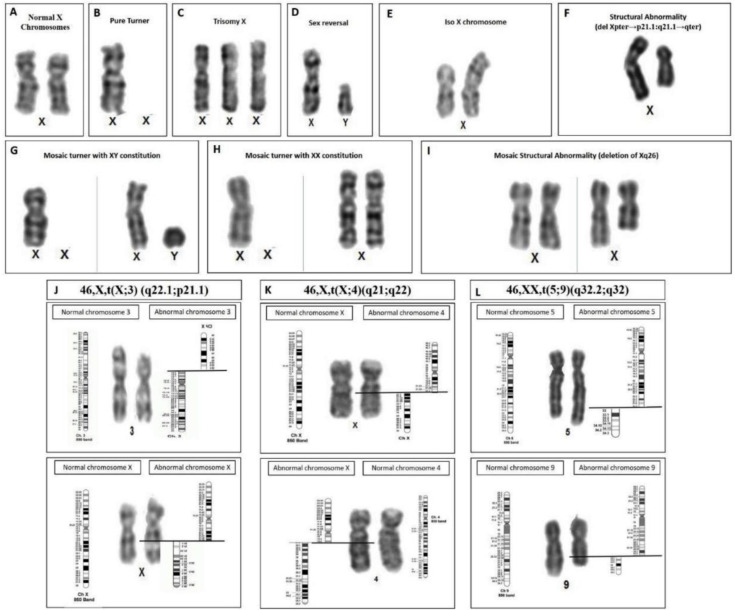
The majority of the PA patients in this study (69.87%) were aged between 13 and 20 years. This age group consisted of 109 patients. Additionally, 42 patients (26.92%) were between the ages of 21 and 25, and 5 patients (3.21%) were older than 25. A significant proportion of SA patients in this study were between the ages of 13 and 20 years, comprising 10 cases (52.63%). Additionally, 4 patients (21.05%) were between the ages of 21 and 25, while 5 patients (26.32%) were older than 25 years. In contrast, the majority of OA patients (62.50%) were over 25 years of age, with 16 patients (24.62%) aged between 21 and 25 years. A total of 5 patients (8.93%) aged 13 to 20 years.
The overall distribution of mean age at manifestation, weight, height, and marital status among PA patients was calculated. Among PA patients and cases with cytogenetic abnormalities, 58.14% were shorter than 150 cm, while 41.86% were 150 cm or taller. Those with the male genotype exhibited greater height, whereas all females with Turner syndrome were below 150 cm in height. Mosaic Turner syndrome patients with XX and XY karyotypes were taller than 150 cm, but all females with structural abnormalities were below 150 cm in height. Females with triple X syndrome were taller than 150 cm. Among Turner syndrome women, 93.75% were unmarried, whereas 6.25% were married. The average age was 17.12±3.20 years and the average weight was 37.5±2.85 kg. Among females with a male karyotype, 83.33% were single, whereas 16.67% were married. The average age was 20.50±4.66 years, and the average weight was 53±7.26 kg. All cases of mosaic Turner syndrome with XY and XX karyotypes were unmarried. The average age for those with an XY constitution was 17.33±1.88 years, while for the XX constitution, it was 21±3.74 years. The average weights were 56±0.82 kg for the XY group and 53±2.17 kg for the XX group. The females with structural abnormalities were unmarried, with an average age of 20.50±4.66 years and weight of 53±7.26 kg. The females with triple X syndrome were unmarried, with an average age of 20.50±4.66 years and weight of 53±7.26 kg.
The distribution of mean age at manifestation, weight, height, and marital status among SA and OA patients was calculated. It was found that one 18-year-old unmarried female with a cytogenetic aberration had a height of more than 150 cm and an average weight of 27 kg. On the other hand, 20% of OA patients with chromosomal abnormalities were shorter than 150 cm, whereas 20% were taller than 150 cm. It was revealed that 66.67% of females with structural anomalies were unmarried, whereas 33.33% were married. The mean age of this cohort was 26.67±1.25 years and the mean weight was 50.25±8.70 kg. The Turner syndrome female was unmarried, with a mean age of 27±00 years and the weight of 45±00 kg. Correlations of cytogenetic abnormality, FSH, and LH levels in PA, SA and OA cases are shown in table 2.
Table 2. Hormonal profile of amenorrhea patients
| Type | Variable | Hormones | |
|---|---|---|---|
|
| |||
| FSH * | LH ** | ||
| Primary amenorrhea | |||
| Cytogenetic finding | Mean±SD | ||
| Turner syndrome (n=16) | 101.51±36.73 | 30.43±9.16 | |
| 47,XXX (n=01) | 31.27±00 | 15.3±00 | |
| 46,XY (n=12) | 89.69±6.49 | 26.88±1.55 | |
| 45,X/46,XX (n=03) | 45.51±6.19 | 15.54±2.87 | |
| 45,X/46,XY (n=03) | 111.03±12.47 | 18.99±3.70 | |
| 46,X,i(X) (q10) (n=04) | 58.31 | 36.12 | |
| 46,X,t(X;3) (q22.1;p21.1) (n=01) | 16.59 | 32.00 | |
| 46,XX,inv(9) (p11q13) (n=01) | 21.22 | 15.41 | |
| 46,XX,inv(3) (p23q21) (n=01) | 5.1 | 18.3 | |
| 46,XX/46,X,del(X)(q26) (n=01) | 35.23±00 | 24.31±00 | |
| Secondary amenorrhea | |||
| Structural abnormality 46,X,t(X;4)(q21;q22)(01) | 138.17±00 | 62.68±00 | |
| Oligomenorrhea | |||
| Turner syndrome (01) | 169.40±00 | 33.10±00 | |
| 46,X,i(X) (q10) (n=01) | 56.17±00 | 40.20±00 | |
| 45,X,46,X,del(X)(pter→p21.1:q21.1→qter) (n=01) | 68.00±00 | 46.00±00 | |
| 46,XX,t(5;9)(q32.2;q32) (n=01) | 15.00±00 | 17.00±00 | |
4.7 to 21.5 mIU/ml,
5 to 25 IU/ml
A correlation analysis was conducted to evaluate the relationship between chromosomal abnormalities and ultrasound results in amenorrhea patients. Ultrasound findings in PA patients indicated that all females with Turner syndrome had hypoplastic/abnormal uterus. Ovaries were not seen in 57.14% of patients, whereas streak/small ovaries were detected in 57.14% of patients with Turner syndrome. The uterus of a female with a male karyotype was found to be hypoplastic or abnormal. In females with male karyotypes, ovaries were not visible in 66.67% of instances, whereas streak/small ovaries were seen in 33.33%. All females with mosaic Turner syndrome exhibiting XX constitution presented with streak/small ovaries as well as a hypoplastic/abnormal uterus. In patients with mosaic Turner syndrome exhibiting an XY constitution, 33.33% had streak/small ovaries and a hypoplastic/abnormal uterus, whereas 66.67% presented with a hypoplastic/abnormal uterus but without any discernible ovarian tissue. Females with triple X syndrome had normal ovaries and uterus. Among females with structural chromosomal defects, 25% had normal ovaries and uterus, compared to 75% with hypoplastic/abnormal uterus, 37.5% with streak/small ovaries, and 37.5% with no ovarian tissue.
In cases of SA, the female exhibiting translocation presented with streak/small ovaries and a hypoplastic uterus. In cases of OA, the female with Turner syndrome had streak/small ovaries and a hypoplastic/abnormal uterus. Among females with structural chromosomal abnormalities, 66.67% of females exhibited streak/small ovaries and a hypoplastic/abnormal uterus (Table 3). Of those with structural chromosomal abnormalities, 33.33% had normal uterus and ovaries.
Table 3. Genotype-phenotype correlation in SA and OA patients
| Type of gonadal dysgenesis | Case ID | Cytogenetic finding | Clinical presentation (phenotypes) | |||||||
|---|---|---|---|---|---|---|---|---|---|---|
|
| ||||||||||
| Breast development | Pubic hair | Axillary hair | Neck | Intellectual ability | Cubitus valgus | Metacarpals | ||||
|
| ||||||||||
| Condition | Genotype | N/UD/A | S/Ab | S/Ab | N/Sh/W | N/C | P/Ab | N/Sh | ||
| Oligomenorrhea | ||||||||||
| OA1 | Turner syndrome | 45,X | UD | S | S | N | N | Ab | Sh | |
| OA2 | 46,X,i(X)(q10) | UD | S | S | N | NA | NA | NA | ||
| OA3 | Structural abnormality (03) | 46,X,delX(pter-p21.1:q12.1-qter | UD | S | S | NA | NA | NA | NA | |
| OA4 | 46,XX,t(5;9) (32.2;32) | N | P | P | N | N | Ab | NA | ||
| Secondary amenorrhea | ||||||||||
| SA1 | Structural anomalies | 46,X,t(4;X)(q21 ;q22) | N | P | P | N | N | Ab | N | |
N: Normal, UD: Under Developed, A: Absent, S: Scanty, Sh: Short, C: Compromised, P: Present, W: Web neck
Prevalence of amenorrhea is reported to be 2–5% among women of childbearing age and is one of the main factors in female infertility (6). The causes of amenorrhea have been divided into many categories and are multifactorial. Women with clinical history of amenorrhea need to be carefully assessed. Step-by-step investigations must be conducted following a thorough history taking and physical examination. These evaluations include hormonal assay, pelvic imaging, assessment of emotional stress level, family history of apparent genetic anomalies, nutritional status, abnormal growth and development, and evaluation of the presence of a normal reproductive tract (7). The available scientific reports suggest that the incidence of genetic anomalies is about 40% which can be due to single gene disorders or chromosomal disorders (6). Global studies on genetics of menstrual disorders over the years have suggested an association between amenorrhea and aberrant karyotypes involving sex chromosomes (8–10). Many studies have been conducted globally to determine the prevalence of sex chromosomal aberrations in women with primary amenorrhea, secondary amenorrhea, or oligo-amenorrhea. Most of these studies revealed a wide variation in the incidence of chromosomal abnormalities (7, 11, 12). Incidence rates reported in the literature range from 4 to 55% with a high prevalence of numerical X chromosome abnormality. In the present study, chromosomal abnormalities were identified in 24.24% (56/231) of women referred for amenorrhea treatment which is comparable to other studies. In women with primary amenorrhea, chromosomal abnormalities have been reported in a range of 13–55%, with an average incidence of approximately 29.78% (13–28). In this study, 27.56% (43/113) of patients with primary amenorrhea had chromosomal abnormalities. Since chromosomal abnormalities in secondary amenorrhea are thought to be rare, only a small number of women with this condition are recommended for cytogenetic investigations. This variation is primarily attributable to the fact that secondary amenorrhea is predominantly caused by cortical or hypothalamic dysfunction, whereas endocrine dysfunction tends to be less pronounced (24). Incidence rate of chromosomal abnormalities in secondary amenorrhea is reported in a range of 0–18%. A sole chromosomal anomaly in the form of a structural aberration was identified in secondary amenorrhea cases, with a frequency of 5.26% for chromosomal aberrations. Very few cytogenetic studies have been conducted in women with oligomenorrhea. According to previous studies, chromosomal anomalies in women with oligomenorrhea are reported in a range of 4–33% (29–33). In the current study, chromosomal abnormalities were identified in 7.14% (4/56) of oligomenorrhea cases.
Various chromosomal abnormalities are commonly observed in patients with amenorrhea, including 45,X mosaicism, structural X chromosome abnormalities (such as Xp/q duplications or deletions), ring chromosomes, isochromosomes, and 46,XY associated with a female phenotype (34). Chromosomal abnormalities observed in this study were complete monosomy X (Turner syndrome), 47,XXX (triple X syndrome), 46,XY (male karyotype), 45,X/46,XY mosaicism, 45,X/46,XX mosaicism, isochromosome Xq, Xp deletion, Xq deletion , X- autosome translocation, and other structural anomalies like inversion 3, inversion 9, and translocation between chromosomes 5 and 9.
In nearly all of the reviewed studies, the most prevalent chromosomal abnormality in amenorrhea patients was X monosomy, followed by a male karyotype. According to the published reports, complete or mosaic monosomy X, often known as Turner syndrome, is the main cause of primary amenorrhea (24); our findings also align with these reports as 10.26% (16/156) of the cases with PA and 1.79% cases (1/56) with OA in our study were found to have Turner syndrome. The findings further emphasized the importance of X chromosome structure in normal female physiology and reproduction. Considering the lack of clinical data in some cases, the karyotype could not be correlated with physical characteristics for all patients. However, poorly developed secondary sexual characteristics and short stature were noticed in most cases of Turner syndrome. Women with medical conditions such as Turner stigmata, primary amenorrhea, premature ovarian failure, and a history of repeated miscarriages are commonly diagnosed with 45,X/46,XX genotype. Mosaics can be classified based on the frequency of 45,X cell clones. When 45,X cells comprise less than 20% of the total cells, mosaicism is classified as low level. In this case, the relatively rare presence of 45,X cells does not significantly influence the observable phenotype. Low-level 45,X/46,XX mosaicism is attributed to premature centromere division, which occurs when the two X chromosomal chromatids separate due to a loss of centromere function (35). While biparental inheritance of X chromosomes has been found in 45,X/46,XX cases with a substantial proportion of X monosomy clones, mosaic aneuploidy may be caused by the loss of an X chromosome during embryonic development in certain cells. However, the exact cause of postzygotic X chromosome loss is unknown (36). In the present study, 1.92% (3/156) of individuals with primary amenorrhea were found to have 45,X/46,XY which was associated with a hypoplastic uterus and streak or absence of ovaries.
Triple X syndrome is a sex chromosomal aberration characterized by a diverse phenotype resulting from the presence of an additional X chromosome. It is the most prevalent female chromosomal abnormality, occurring in around one in every 1,000 female births (37). Although most individuals do not experience serious medical issues, trisomy X might lead to various minor abnormalities. The most prevalent ones are genitourinary anomalies, which range from a single kidney and renal dysplasia to ovarian malformation (38). Pubertal onset and sexual development are often normal in individuals with trisomy X; nonetheless, there have been reports of ovarian or uterine dysgenesis in children and adolescents with this condition (39). Interestingly, in this investigation, a single case (0.64%) of PA with triple X syndrome was detected who had normal ovaries and uterus.
Sex reversed female, also known as Swyer syndrome, is a rare disorder with a female phenotype but a 46, XY karyotype. In our study, 7.69% (12/156) of patients with primary amenorrhea were presented with XY gonadal dysgenesis. The obtained results are consistent with a previous study, which reported that 18% of patients with primary amenorrhea were found to have male karyotype. These individuals frequently have gonadal dysgenesis, normally developed Müllerian ducts, underdeveloped breasts, no uterus or ovaries, and primary amenorrhea (10). The SRY gene, which is located on Y chromosome, may become mutated or deleted, leading to the development of sex-reversed female. A de novo mutation might develop during spermatogenesis, or a deletion could result from an unanticipated crossover of the SRY gene to the X chromosome during the meiotic process of spermatogenesis. Eventually, this leads to the development of sperm that lacks or has a mutant SRY gene on the Y chromosome. This abnormal Y chromosome-bearing sperm produces a sex-reversed female when fertilized with a normal X-bearing ovum. Despite having both the X and Y chromosomes, sex-reversed females lack the SRY gene, which prevents the undifferentiated gonad from developing into a testis. The lack of testosterone and anti-Müllerian hormone (AMH) results in the development of female phenotype (40).
45,X/46,XY mosaicism is an extremely rare sex chromosome disorder and its incidence in the general population ranges from 1.5 to 1.7 per 10,000 individuals (41). Interestingly, in the present study, 1.92% (3/156) of individuals with primary amenorrhea were found to have 45,X/46,XY mosaicism. It has been reported that people with 45,X/46,XY mosaicism experience a 10–20% increased risk of developing gonadoblastoma. Determining the karyotype is essential, as the presence of a Y chromosome indicates the need for gonadectomy to mitigate the risk of malignancy.
In addition to numerical sex chromosomal aberrations and male karyotype, a considerable proportion of the individuals in our research had structural chromosomal aberrations. Many investigations have identified the isochromosome of the long arm of X as a common structural anomaly in amenorrhea patients (12). In the current investigation, 2.56% (4/156) of patients with primary amenorrhea and 1.79% (1/56) with oligomenorrhea were presented with 46,X,i(X)(q10). This phenomenon occurs when chromosomes divide along an axis that is perpendicular to their typical axis of division. This condition is caused by chromosomes being divided transversely rather than longitudinally. The resulting isochromosomes have either two short or two long arms, leading to an imbalanced chromosomal composition, characterized by monosomy for the absent arms and trisomy for the duplicated ones. During mitosis and meiosis, isochromosomes can form as a result of misdivision of centromere or U-type strand exchange. Women with the 46,X,i (Xq) karyotype have been reported to have streak gonads. In these cases, complete and partial ovarian failure have been documented in 9% and 91% of instances, respectively. Furthermore, short stature and Turner syndrome stigmata have been linked to practically total loss of gonadal development in women with 46,X,i (Xq) karyotype (42).
Genes required for proper ovarian development are found on both arms of the X chromosome. An alternation in the number or shape of the X chromosome disrupts the usual process of genetic sex determination, ultimately influencing phenotypic sex (43). Women with an Xq deletion, either due to primary or secondary amenorrhea, exhibit gonadal dysgenesis. In this investigation, 0.64% (1 out of 156) of primary amenorrhea cases exhibited a deletion on the long arm (q arm) of the X chromosome. Additionally, 1.79% (1 out of 56) of ovarian agenesis cases showed deletions on both arms (p and q) of the X chromosome.
X-autosome translocations are rare in individuals with amenorrhea, which is reported to have a prevalence of 1 in 30,000 live births (41). In female carriers of balanced X-autosome translocations, the normal X chromosome is typically inactivated, allowing the derivative X chromosome to remain active. Most individuals with X-autosome translocation appear phenotypically normal. However, female carriers may experience gonadal dysgenesis, and approximately 9% are likely to exhibit multiple congenital anomalies or intellectual disabilities. The presence of two copies of the X chromosome is essential for normal ovarian development and function. Balanced translocations involving the X chromosome, particularly when breakpoints occur in critical regions, may be linked to amenorrhea. These translocations can lead to amenorrhea through several mechanisms; they may disrupt X-linked genes essential for normal ovarian function, such as the XPNPEP2 gene, cause position effects, or induce chromosomal alterations that interfere with X chromosome inactivation or inhibit mitotic pairing. The implications of position effects can be further understood in relation to the POF2 critical region in the long arm of X chromosome, which downregulates the expression of ovary-expressed autosomal genes that have been translocated. This mechanism ensures an equal level of gene expression between the X chromosome and the autosomes. Many patients with amenorrhea who have X-autosome balanced translocations show clustered breakpoints in the POF2 region. In contrast, large interstitial deletions within the POF2 region typically do not correlate with amenorrhea, likely due to the gene-poor nature of this region. The POF2 region is characterized by a highly heterochromatic structure, which may contribute to amenorrhea by altering the epigenetic modifications of autosomal genes as a result of position effects. Additionally, it has been noted that deletions involving the POF1 region are also associated with amenorrhea (44–46). Findings from the current study highlight that 11.8% of individuals have rearrangements involving autosomes and/or sex chromosomes. In the present investigation, X-autosome translocations were identified in 0.64% (1/156) of cases, specifically involving the translocation 46,X,t(X;3)(q22.1;p21.1) in primary amenorrhea. Additionally, 5.26% (1/19) of cases exhibited the translocation 46,X,t(X;4)(q21;q22) in secondary amenorrhea , with breakpoints located within the POF1 critical region.
Autosomal translocations and other chromosomal structural anomalies have been documented in various studies, suggesting that autosomal genes may play a role in proper gonadal development. In this investigation, structural anomalies were identified in 5.36% of the cases (3/56) involving OA. This includes one case of an autosomal translocation (46,XX,t(5;9)(q32.2;q32)), one case of an isochromosome (46,X,i(X)(q10)), and one case of structural anomaly involving both 45,X and 46,X with a deletion (del(X)(pter→ p21. 1:q21.1→qter)). Additionally, inversions of chromosomes 3 and 9 were detected in 1.28% of the cases (2/156) associated with primary amenorrhea.
It is worth noting that the conventional cytogenetics, through karyotyping analysis, has a resolution limit of approximately 4–5 Mb, which prevents it from identifying submicroscopic deletion or duplication. In contrast, CMA analysis can examine the entire genome at a much higher resolution, allowing for identifying genetic abnormalities caused by X chromosomal abnormalities that may not be detected with conventional methods. Although CMA was excluded from this investigation, its integration with cytogenetic studies and other detection techniques can yield a more comprehensive understanding of the genetic landscape associated with cases of amenorrhea.
In conclusion, the current investigation demonstrates that the spectrum of sex chromosomal abnormalities, whether numerical or structural, homogenous or mosaic, constitutes a key etiological component in cases of primary amenorrhea, secondary amenorrhea, and oligomenorrhea.
In this study, 74.98% of suspected cases of amenorrhea were cytogenetically normal. Identifying detailed cytogenetic and molecular cytogenetic changes may facilitate the early and accurate diagnosis of amenorrhea, which could lead to the development of effective treatment strategies for women experiencing this condition. This, in turn, may enable better family planning prior to the onset of amenorrhea. Furthermore, it was emphasized that the application of cytogenetic and molecular screening for confirmation of a specific diagnosis is beneficial in all patients with primary amenorrhea, secondary amenorrhea, or oligomernorrhea. An early and timely diagnosis will facilitate better patient counseling and treatment.
We would like to acknowledge the contribution of the patients for participating in this study; also, the research was funded by the intramural grant from the Department of Research and Innovation in Molecular Diagnostics, inDNA Life Sciences Pvt. Ltd., Bhubaneswar, Odisha, India.
Funding: The research was funded by the intramural grant from the Department of Research and Innovation in Molecular Diagnostics, inDNA Life Sciences Pvt. Ltd., Bhubaneswar, Odisha, India.
