
The World Health Organization (WHO) defines infertility as the disorder of the reproductive system (1). In developing countries, about 25% of couples face the problem of infertility (2) and the live birth rate resulting from IVF is around 40% (3). Studies estimate that about 15% of embryos resulting from assisted reproductive technologies (ARTs) successfully implant following transfer. Failure to achieve pregnancy after 3 high-quality embryo transfers is defined as recurrent implantation failure (RIF) (4). Identifying the pathophysiological causes of RIF may improve implantation success rates and enhance the fertility prospects of affected couples (5). Maternal factors contributing to RIF include uterine abnormalities, hormonal imbalances, and conditions such as polycystic ovary syndrome (PCOS) (6). Proper growth of the endometrium also has a significant effect on implantation. A minimum endometrial thickness of 7 mm at the end of the follicular phase is considered optimal for embryo transfer (6, 7). Disorder in endometrial blood flow resistance can be one of the causes of low uterine receptivity in women with thin endometrium (8). Uterine blood flow is an essential factor for endometrial growth (9). Thin endometrium is associated with high radial artery blood flow resistance, high vascular resistance index, poor epithelial growth, and poor vascular growth (10). Color Doppler ultrasound studies show a high vascular resistance index during the follicular phase in women with RIF (11, 12). In Doppler ultrasound, two indices of uterine artery PI and vascular RI are used to evaluate vascular resistance (13).
Various approaches have been employed to improve thin endometrium, including pharmaceutical estrogen therapy (14), low-dose aspirin (8, 15), vitamin E supplementation (16), vaginal sildenafil administration (17), electroacupuncture (18), and granulocyte colony-stimulating factor (G-CSF) (19). Also, L-arginine is an essential amino acid for the production of nitric oxide (NO) in the body (20). The results of experimental and clinical studies show that arginine is a nutritionally essential amino acid for embryo survival, fetal development, infant growth, as well as maintaining vascular tone, supporting hemodynamics, and enhancing reproductive function (21, 22). According to a meta-analysis, L-arginine supplementation plays a beneficial role in managing fetal growth restriction and preeclampsia (23). L-arginine has also been shown to reduce vascular resistance, making it effective in the treatment of intrauterine growth restriction (IUGR), preeclampsia, and hypertension (24). Given its potential benefits in reducing vascular resistance and the rising prevalence RIF, an attempt was made in this study to investigate the effect of oral L-arginine supplementation on uterine artery resistance in women with RIF undergoing IVF, in order to assess its potential as a safe and therapeutic option.
This randomized, double-blind clinical trial was conducted between 2022 and 2023 at the Infertility Center of Fatemieh Hospital in Hamadan, Iran.
Participants: The study participants included infertile women who were candidates for IVF with a history of at least two implantation failures. The research sample included infertile women aged 18 to 41 years, candidates for IVF with a history of two implantation failures, good-quality embryo transfers, and a suitable endometrium. Participants also required a normal-sized, appropriately shaped uterus, confirmed by ultrasound or hysteroscopy. Participants were also required to be free of chronic diseases, such as severe liver, kidney, or cardiovascular failure, or a history of stroke or myocardial infarction. Eligible participants were non-smokers without stage 3 or 4 endometriosis, and those without known causes of implantation failure, such as hormonal or immunological disorders, thrombophilia, antiphospholipid antibodies, mutations in factor V Leiden or prothrombin, or chromosomal abnormalities.
Exclusion criteria included patients who experienced side effects from L-arginine, those whose treatment cycles were canceled for any reason, and women who were unwilling to continue participating in the study (Figure 1).
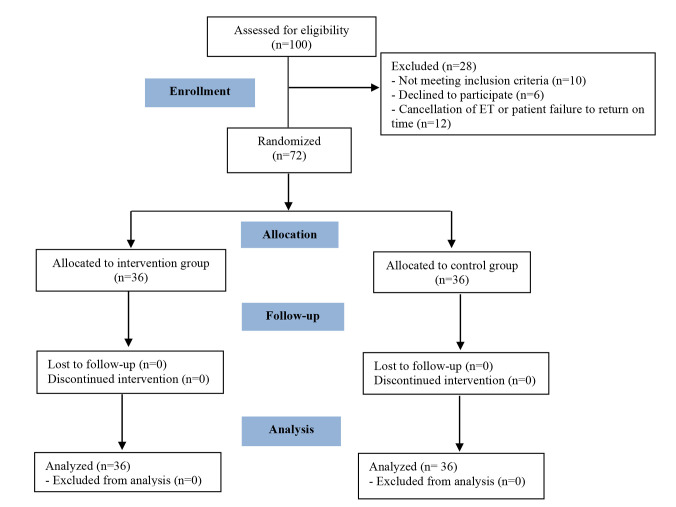
Regarding the study participants, the intervention group consisted of 36 women with RIF undergoing a frozen embryo transfer cycle. After investigation of known causes of implantation failure, all participants were found to have normal results. These women received long GnRH agonist protocol (LONG protocol), which included ovarian suppression and supplements such as folic acid, vitamin D3, B complex, and probiotics. The control group included 36 women with RIF undergoing a frozen embryo transfer cycle. After investigation of known causes of implantation failure, all participants were found to have normal results. In addition to receiving supplements including folic acid, vitamin D3, B complex, and probiotics and the standard long GnRH agonist protocol with suppression medication, they were administered oral L-arginine supplementation (Karen Pharma, Iran) starting from the luteal phase of the previous cycle, at a dosage of 3 grams daily for 20 days.
The primary outcome was the change in pulsatility index and resistance index following L-arginine supplementation. Secondary outcomes included clinical and chemical pregnancy rates. Color Doppler ultrasound was performed by a single perinatologist to prevent observer bias, using a single device to eliminate measurement bias. The ultrasound was conducted on both uterine arteries of infertile women in both the intervention and control groups, starting at the point of the uterine artery connection to the cervix. Four to five waves of the PI were observed. The PI was calculated as the difference between the systolic peak and end-diastolic velocity, divided by the mean velocity during the cardiac cycle, reflecting the variability in blood flow within the uterine artery. The RI was calculated as the difference between the systolic peak and end-diastolic velocity, divided by the maximum systolic velocity, indicating the resistance to uterine perfusion. In addition to receiving the standard drugs and the long protocol with suppression, the intervention group was prescribed an oral L-arginine supplement, starting with the agonist phase, at a dose of 3 grams daily for 20 days. The control group received only standard medications, long GnRH agonist protocol, and suppression medication. Twenty days after the initiation of the GnRH agonist, color doppler ultrasound was repeated by the same perinatologist to assess the uterine arteries, and PI and RI values were recorded. The maximum endometrial thickness was measured at the end of the medication protocol in both groups. Finally, following embryo transfer, clinical and chemical pregnancy rates were evaluated in both the intervention and control groups.
The sample size was calculated using G*Power software, based on a significance level of 5% and a statistical power of 80% (β=20%), according to the parameters reported in a study by Takasaki et al. (25).
The sample size was calculated using the formula for comparing the difference in means between the two groups. Based on an estimated effect size of 0.6, with a significance level (α) of 5% and a statistical power of 80% (β=20%), the minimum required sample size was determined to be 36 participants per group, totaling 72 participants. In the experimental group, the distribution of RIF was as follows: 52.8% of participants had experienced two implantation failures (double RIF), 36.1% had experienced three (triple RIF), and 11.1% had experienced four (quadruple RIF). In the control group, 69.4% of participants had double RIF, 16.7% had triple RIF, and 14% had quadruple RIF.
In this study, 72 infertile women who met the inclusion criteria were randomly assigned to either the intervention group (n=36) or the control group (n=36). Random allocation was performed using the block randomization method. Given the presence of two groups, blocks of four were generated using a table of random numbers. Block randomization was conducted with Stata software, version 14.0, to ensure that an equal number of participants were assigned to the intervention and control groups at consistent intervals throughout the study. This method was employed to maintain balance in group sizes and minimize allocation bias. Both the patients and the outcome assessors were blinded to the treatment allocation in order to minimize bias. This study was registered with the Iranian Registry of Clinical Trials (IRCT 202220317054318N1) and approved by the Research Ethics Committee of Hamadan University of Medical Sciences, Iran (IR.UMSHA.REC. 1401.037). Written informed consent was obtained from all participants prior to their enrollment in the study.
Statistical methods: Data were analyzed using SPSS software, version 26.0 (IBM, USA). Continuous variables were presented as mean±standard deviation (SD) for normally distributed data, and as median with interquartile range (IQR) for non-normally distributed data. Categorical variables were expressed as frequencies and percentages. Mann-Whitney U test was used to compare quantitative variables, such as the resistance index and pulsatility index, between the two groups, as these variables were non-normally distributed. The Wilcoxon signed-rank test was used to compare quantitative values before and after L-arginine supplementation, depending on the normality of the data. Categorical variables were analyzed using the Chi-square test, and Fisher’s exact test was applied when the expected frequency in any cell was less than 5. A p-value of <0.05 was considered statistically significant.
In this study, 72 infertile women who met the inclusion criteria were randomly assigned to either the intervention group (n=36) or the control group (n=36). Random allocation was performed using the block randomization method. Table 1 presents the average values of FSH, LH, and estradiol. Based on the statistical tests performed, no significant difference was observed in any of the variables in the two groups. Endometrial thickness was examined on the day of embryo transfer in both groups, and no significant difference was found. Additionally, the number of previous IVF cycles and embryo transfers was evaluated in both groups, with no significant differences observed.
Table 1 Demographic characteristics and hormonal status in the control and intervention groups
| Variables | Intervention group (n=36) | Control group (n=36) | p-value |
|---|---|---|---|
| Age (year) | 33.58±5.28 (34,6) | 34.38±5.14 (34.5, 10) | 0.51 * |
| BMI (kg/m2) | 24.54±2.96 (24.21, 4.47) | 25.87±2.77 (26.2, 4.57) | 0.054 * |
| FSH (IU/L) | 5.99±2.05 (5.9, 2.72) | 6.62±1.77 (6.60, 2.7) | 0.17 * |
| LH (IU/L) | 6.03±4.05 | 7.53±3.60 | 0.018 ** |
| Estradiol (pg/ml) | 41.33±17.37 (40, 18) | 45.24±18.74 (44, 23.67) | 0.36 * |
| AMH (ng/ml) | 4.27±3.44 | 2.77±1.95 | 0.06 ** |
| Endometrial thickness/mm | 8.46±0.86 | 8.50±0.73 | 0.52 ** |
| Previous ART cycle | 2.25±0.80 (2, 0) | 2.32±0.65 (2, 0.75) | 0.43 * |
| Number of previous embryo transfers | 2.59±0.71 (2, 1) | 2.55±0.98 (2, 1) | 0.33 * |
| The window of embryo transfer | 16.16±2.91 (15.5, 2) | 15.47±2.19 (15.47, 2) | 0.32 * |
Data are presented as mean ±SD (or median, IQR), and analyzed using Mann–Whitney U test
Data are presented as mean ±SD, and analyzed using the student’s t-test
BMI: Body mass index, FSH: Follicle-stimulating hormone, LH: Luteinizing hormone, E2: Estradiol, AMH: Anti-Müllerian hormone
Uterine artery resistance index and pulsatility index were measured on both the right and left sides of the uterine artery, before and after L-arginine administration, in both the control and intervention groups. The data were then analyzed for both groups (Table 2). Uterine artery resistance was significantly different following L-arginine administration in the intervention group (right RI: p=0.006, left RI: p=0.017). Additionally, uterine artery resistance was significantly different between the two groups after the intervention (right RI: p=0.005, left RI: p=0.02).
Table 2 Comparison of uterine artery resistance and pulsatility index between the control and intervention groups
| Variables | Intervention group (n=36) | Control group (n=36) | p-value | ||||||
|---|---|---|---|---|---|---|---|---|---|
|
| |||||||||
| Before | After | Mean diff | p-value | Before | After | Mean diff | p-value | ||
| PIR 1 | 3.33±1.85 | 3.36±2 | 0.025±2.54 | 0.97 ** | 3.57±1.81 | 3.63±1.63 | −0.114±0.61 | 0.60 ** | 0.80 * |
| PIL 2 | 3.55±2.24 | 3.85±2.19 | 0.298±2.59 | 0.17 ** | 3.26±1.77 | 3.23±1.78 | 0.077±0.33 | 0.78 ** | 0.04 * |
| RIR 3 | 0.94±0.20 | 0.84±0.17 | −0.103±0.24 | 0.006 ** | 0.96±0.08 | 0.95±0.09 | 0.012±0.06 | 0.56 ** | 0.005 * |
| RIL 4 | 0.94±0.07 | 0.88±0.12 | −0.061±0.14 | 0.017 ** | 0.95±0.09 | 0.95±0.06 | 0.010±0.09 | 0.84 ** | 0.02 * |
1: Pulsatility index right, 2: Pulsatility index left, 3: Resistance index right, 4: Resistance index left
Data are expressed as the mean ± standard deviation (SD), as well as the mean difference (after-before) ± standard deviation of the mean difference
Mann–Whitney U test
Wilcoxon signed-rank test
The frequency of chemical and clinical pregnancies was also compared between the two groups following the intervention. A statistically significant difference was observed in both clinical pregnancy rates (p=0.006) and chemical pregnancy rates (p=0.003), as shown in table 3.
Table 3 Comparison of clinical and chemical pregnancy rates in the control and intervention groups
| Variables | Intervention group (n=36) | Control group (n=36) | p-value |
|---|---|---|---|
| Chemical pregnancy | 19 (52.7) | 7 (19.44) | 0.003 * |
| Clinical pregnancy | 14 (38.9) | 4 (11.1) | 0.006 ** |
Data are presented as n (%). Fisher’s exact test
Data are presented as n (%). Chi-square tests
The distribution of embryo grades was also analyzed between the two groups, and no statistically significant differences were observed in embryo quality (Table 4).
Table 4 Comparison of embryo grades between the control and intervention groups
| Variables | Intervention group (n=36) | Control group (n=36) |
|---|---|---|
| Merola | 12 (33.33) | 12 (33.33) |
| Blast | 3 (8.34) | 3 (8.34) |
| 8 cells | 21 (58.33) | 21 (58.33) |
Data are presented as n (%)
The primary objective of this study was to evaluate the effect of L-arginine supplementation on uterine artery resistance and, subsequently, its impact on fertility outcomes in women undergoing IVF. According to the results, L-arginine supplementation significantly reduced uterine artery resistance in the intervention group and was associated with improved fertility outcomes, particularly an increase in clinical pregnancy rates.
The objective of the current study was to investigate the effect of oral L-arginine on uterine artery resistance and IVF outcomes in infertile women with RIF. Statistical analysis revealed a significant difference in the resistance index of both the right and left uterine arteries, as well as in clinical pregnancy rates, between the control and intervention groups following L-arginine supplementation. These findings suggest that L-arginine adjunctive therapy may improve uterine perfusion parameters in infertile women with RIF. The observed increase in pulsatility index of uterine artery and decrease in resistance index are particularly noteworthy, as these parameters are critical indicators of improved uterine blood flow, which is essential for successful embryo implantation and pregnancy. An endometrial thickness of approximately 9 mm is considered optimal for achieving pregnancy following IVF and embryo transfer, whereas a thinner endometrial lining is associated with reduced implantation and pregnancy success rates (26, 27). Enhancing endometrial proliferation during IVF through the use of estrogen and/or low-dose aspirin has been associated with improved outcomes in some cases (28). Recent studies have highlighted the role of NO as a key regulator of uterine blood flow (29). NO is synthesized by nitric oxide synthases (NOS) using the amino acid L-arginine as a substrate (20). NO diffuses into adjacent vascular smooth muscle cells and increases the concentration of the cyclic guanosine monophosphate (cGMP) second messenger, thereby leading to relaxation of vascular smooth muscle. In the body, NO is produced by nitric oxide synthases through the conversion of L-arginine to citrulline (30). In addition, NO is also produced via the nitrate-nitrite-NO pathway independent of NOS (31). The nitrate-nitrite-NO pathway is oxygen-independent and is considered to be responsible for ensuring NO production during ischemia or hypoxia (32). Nitrate and nitrite are required for the production of endogenous NO and other bioactive nitrogen oxides, which have protective effects on cardiovascular and metabolic function (33). Inorganic nitrate and nitrite lead to reduced blood pressure, enhancement of endothelial function, platelet aggregation ability, modulation of mitochondrial function, protection against ischemia-reperfusion injury, and improvement of features of metabolic syndrome (34, 35). L-arginine is synthesized from glutamine, glutamate, and proline via the gut-kidney axis in humans and most other mammals, and its degradation occurs through multiple pathways initiated by arginase, nitric oxide synthase, arginine: glycine aminotransferase (AGAT), and arginine decarboxylase (36, 37). These pathways produce glutamate, nitric oxide, polyamines, keratin, proline, and agmatine which are of high biological importance. Studies demonstrate that arginine is an essential nutritional amino acid for spermatogenesis, embryo survival, fetal and neonatal development, as well as maintaining hemodynamics and vascular tone. Additionally, the use of dietary supplements or intravenous administration of arginine has had a very good effect on reproductive, cardiovascular, pulmonary, renal, digestive, hepatic, and immune system functions, and has also facilitated increased insulin sensitivity and tissue preservation. Also, arginine or L-citrulline has been reported to be effective in obesity, diabetes, and metabolic syndrome, which are evident in women with PCOS (38, 39). Among amino acids, arginine has been shown to be unique in treating many developmental and health problems and has been effective in improving the health and well-being of humans and animals (40). L-arginine ameliorates endothelial injury and leads to reduced blood pressure in late pregnancy and a decrease in proteinuria. It has also been reported to increase infant birth weight without altering plasma insulin or serum glucose levels (41). Several studies have explored the impact of L-arginine supplementation on improving outcomes in IUGR by reducing vascular resistance, yielding positive results (23). L-arginine has been shown to reduce vascular resistance in conditions such as IUGR, preeclampsia, and high blood pressure (42). Since high vascular resistance is also linked to lower microvessel density (MVD) and reduced endometrial receptivity in patients with RIF, L-arginine may help improve these conditions. Additionally, ultrasound measurements of endometrial, spiral artery, and uterine artery blood flow are important tools for evaluating endometrial receptivity, playing a key role in predicting pregnancy outcomes in RIF patients after embryo transfer (9, 43). In animal studies, L-arginine has been reported to increase maturation, birth weight, and promote muscle mass development through the mTOR protein pathway (44, 45). L-arginine supplementation has been shown to enhance fetal survival in pigs and improve metabolic homeostasis in sheep by modulating the expression of fetal somatotropic axis genes (46, 47). By increasing antioxidant capacity, it reduces IUGR and promotes fetal-placental growth (48). Through the integration of these factors, L-arginine may play a crucial role in improving pregnancy outcomes in infertile women with RIF via various molecular mechanisms.
Previous human studies have not reported any adverse effects associated with L-arginine supplementation during pregnancy, whether for long-term use (up to 3 months) or with high doses administered acutely (e.g., 20–30 gr in 100 ml saline for one day or one week) (48–50). Therefore, the findings of this study support the potential of oral L-arginine supplementation as a safe and effective treatment option for infertile women with RIF. L-arginine supplementation in women with infertility may be a promising treatment alongside conventional therapies, such as hormone therapy or assisted reproductive techniques.
However, this study also had several limitations. Although confounding factors were adequately controlled and the two groups were well-matched, the presence of unidentified factors in recurrent implantation failure may have led to the omission of certain cases. Future studies with a larger sample size and randomized controlled trials are needed to confirm the findings of this study and further investigate the mechanisms underlying the effects of cervical resistance on infertility in women with RIF.
This study suggests that oral L-arginine supplementation may reduce uterine artery vascular resistance in infertile women with recurrent implantation failure who are candidates for IVF. In this study, a significant difference in pregnancy outcomes following IVF was observed, with L-arginine supplementation associated with an increase in both clinical and biochemical pregnancy rates. These findings support the potential of L-arginine as a safe and effective treatment option for the treatment of female infertility. Further research is required to validate the results and clarify the underlying mechanisms by which L-arginine affects uterine blood flow and enhances frozen embryo implantation. Future research should stratify participants based on their primary diagnosis (such as endometriosis, PCOS, or cases of unknown etiology) that may contribute to recurrent implantation failure. This approach would allow for comparative analysis of the effects of L-arginine supplementation in specific patient populations.
The authors express their gratitude to the patients for their generous consent, which allowed the use of their medical information in this study. The researchers also acknowledge Hamadan University of Medical Sciences and the Fertility and Infertility Research Center for their support in carrying out the project, under IRCT code (IRCT 202220317054318N1) and ethical approval code (IR.UMSHA.REC.1401.037).
