
PCOS, a widespread endocrine disorder, causes infertility due to high androgen levels and decreased ovulation. Additionally, it is related to metabolic disorders, thyroid disorders, cardiovascular risks, hyperinsulinemia, and obesity (1). These phenotypic manifestations are heterogeneous, complicating PCOS treatment (2). Several factors may contribute to PCOS, including genetic instability, lifestyle and environmental variables, and dysregulation in immune response (3). Autophagy, a highly regulated and evolutionarily conserved catabolic process that facilitates the self-digestion of cells, has been linked to obesity, type 2 diabetes, and cardiovascular diseases (4). Oocyte formation, follicle expansion, and atresia depend on autophagy in the ovary. Follicular cells must actively participate in autophagy for optimal growth, differentiation, oocyte production, and reproduction (5).
PCOS primarily affects the ovaries, resulting in compromised ovarian function that disrupts reproductive outcomes. Within the ovary, macroautophagy (a specific type of autophagy) plays a crucial role in orchestrating the sequence of events from oocyte formation to fertilization. Recent evidence underscores the significant involvement of autophagy dysfunction in the pathogenesis of PCOS, with findings demonstrating impaired autophagy in follicular cells at multiple developmental stages (6).
Follicular arrest and cyst development are symptoms of PCOS, a condition characterized by hormonal abnormalities and decreased ovarian function. Certain pathophysiological mechanisms underlying PCOS have been attributed to dysregulated autophagy (5). Oocyte quality and ovulatory function are significantly affected by increased autophagic activity in PCOS, which is commonly associated with chronic inflammation, increased oxidative stress, and insulin resistance (7). Impairments in autophagy expression can exacerbate oxidative stress and cellular damage, thereby aggravating the symptoms and complications associated with PCOS (8).
Beclin-1, a key autophagy regulator, is essential for autophagy initiation, including the formation of the phagophore (a membranous structure) and the subsequent development of autophagic vesicle through its interaction with class III phosphatidylinositol-3-kinase (PI3KC3)/vacuolar protein sorting 34 (Vps34). This interaction facilitates the recruitment of essential autophagy proteins necessary for autophagosome formation (9). Upregulation or dysregulation of Beclin-1 expression is implicated in the pathogenesis of various diseases, including metabolic disorders, neurological disorders, and malignancies (10).
Apoptosis is a programmed cell death process essential in multicellular organisms (11). Programmed cell death 1 (PD-1) plays a critical role in suppressing tumorigenesis, inflammation, and autoimmune diseases (12). Apoptosis is particularly crucial for normal ovarian function and development (13). Individuals with PCOS often exhibit chronic inflammation, and the suppressive signaling molecule, PD-1, appears to hinder T-cell activation (14).
The purpose of the current study was to evaluate the synergistic effects of apoptosis and autophagy activity in PCOS patients from Iraq. The researchers examined serum levels and gene expression of two key factors, Beclin-1 and PD-1, to elucidate their roles in the pathogenesis of PCOS.
Subject collection: The study recruited a total of 132 participants between March 2023 and February 2024. Sixty-eight women diagnosed with PCOS were recruited from Al-Kadhimiya Teaching Hospital and collaborating private clinics and laboratories, while 64 women served as healthy controls.
The inclusion criteria encompassed an age range of 20–45 years, with a confirmed diagnosis of PCOS by a consulting physician based on the Rotterdam criteria (2003), as outlined in the Rotterdam ESHRE/ASRM Consensus of 2004 (15). Age-matched healthy women were enrolled as controls. The diagnosis was made by the physician in accordance with the Rotterdam criteria, which included clinical and/or biochemical hyper-androgenism. The modified Ferriman-Gallwey (mFG) score assesses hirsutism by examining specific body areas such as the upper lip, face, jaw and neck, upper and lower back, upper arm, thigh, chest, upper and lower abdomen, and perineum. A score of 8 or higher out of 36 is considered significant. Furthermore, elevated serum testosterone or luteinizing hormone (LH) levels have been observed, with concentrations exceeding 0.8 ng/ml. The next inclusion criterion was oligo/anovulation, characterized by irregular menstrual cycles (oligomenorrhea) occurring every 35–45 days, or amenorrhea defined as the absence of menstruation for more than 3 months. The final inclusion criterion involved women exhibiting polycystic ovary morphology. A qualified ultrasound specialist conducted a transvaginal ultrasound examination on cycle days 3–4 to assess ovarian morphology (15). Disease history in the family, duration of disease, and menstrual cycle were obtained according to a questionnaire provided by patients. Moreover, patients with thyroid disorders, cardiovascular conditions, autoimmune diseases, diabetes mellitus, hypertension, chronic renal failure, and malignant disorders were excluded from the study. Participants were also excluded if they had taken any additional medications within six months following sample collection, including lipid-lowering agents, ovulation-stimulating drugs, corticosteroids, antidiabetic medications, and antihypertensive drugs.
A group of healthy women between the ages of 20 and 45 who did not have a history of oligomenorrhea, amenorrhea, or hyperandrogenism and whose menstrual cycles were regular (28 to 32 days) made up the control group. Transvaginal ultrasound, conducted on cycle days 3 to 4, confirmed normal ovarian morphology. Blood testosterone levels were below 0.8 ng/ml, and Ferriman-Gallwey (mFG) scores were less than 8. A consulting physician supervised the selection procedure, and a thorough questionnaire was used to verify medical history and family history of the disease. This procedure was conducted to ensure that the comparison group was rigorously matched and to maintain objectivity throughout the study.
Blood collection and processing: Five milliliters of peripheral blood were collected from each participant, including both patients and controls, using a disposable syringe. Following the blood draw, the samples were divided into two aliquots for distinct analyses. Four milliliters were placed in a gel tube for enzyme-linked immunosorbent assay (ELISA) and biochemical studies. Next, the sample was centrifuged to separate the serum into several Eppendorf tubes, thereby preventing repeated freeze-thaw cycles. For molecular analysis, 250 micro-liters (0.25 ml) of whole blood were combined with 0.5 ml of TRIzol reagent in a 1.5 ml Eppendorf tube, and this mixture was stored at −20°C for subsequent molecular analysis.
Assessment of demographics and biochemical profiles: Waist-to-hip ratio (WHR) is a simple anthropometric measure that assesses body fat distribution, specifically assessing the proportion of fat stored centrally (around the waist) in relation to fat stored peripherally (around the hips) (16). It is calculated by dividing waist circumference by hip circumference, with the hips measured at their widest point. In women, a WHR below 0.8 is generally considered desirable. The clinical characteristics of PCOS, including menstrual cycle irregularities, disease duration, and family history of PCOS were gathered from the patients’ data. All hormones including testosterone, prolactin, estrogen, follicle-stimulating hormone (FSH), thyroid stimulating hormone (TSH), and LH were measured by a completely automated analyzer for immunoassay analysis, using unique ElectroChemi-Luminescence (ECL) technology (cobas® e 411 analyzer; Siemens Healthineers, Germany).
The measurement of LH/FSH ratio revealed that the majority of female patients with PCOS demonstrated an abnormal FSH to LH ratio. The serum concentrations of FSH and LH were generally maintained in a balanced 1:1 ratio. In most instances, FSH and LH levels in young fertile women typically ranged from approximately 4 to 8. In women with PCOS, the ratio of LH to FSH was frequently elevated, commonly reaching levels of 2:1 or even 3:1. In healthy women, the LH to FSH ratio generally ranged from 1 to 2. Women with PCOS may exhibit an LH/FSH ratio that can reach as high as 2 or 3 (17).
Enzyme-linked immunosorbent assay (ELISA): Beclin-1 and PD-1 protein levels in serum samples were measured using a commercial double-antibody sandwich ELISA kit (MyBioSource, USA), with category numbers MBS732891 and MBS-2702397, respectively. Target antigens are sequentially bound by particular antibodies in this method. The target antigen from the sample was captured by an antibody immobilized on the ELISA plate. A secondary antibody, conjugated to an enzyme (e.g., horseradish peroxidase), bound to the captured antigen-antibody complex. The enzyme subsequently combined with a chromogenic substrate to produce a colorimetric product. The optical density (OD) of this product was proportional to the sample’s target antigen concentration. Beclin-1 and PD-1 levels were quantified by comparing the optical density values of the samples to a standard curve generated using known antigen concentrations from the ELISA kit. Assay accuracy and consistency were achieved by adhering to the manufacturer’s standards and following the directions for sample and reagent preparation. The primers of real-time polymerase chain reaction (RT-PCR).
Lyophilized primers were BECN1 and PDCD1 genes, and the housekeeping gene used as the control was β-Globin (Macrogen Company, Netherlands) (Table 1). The primers were reconstituted in nuclease-free water to prepare a stock solution of 100 pmol/μl. Next, 10 μl of primer stock solution was diluted with 90 μl of nuclease-free water to reach a final concentration of 10 pmol/μl for working solutions. All dilutions were nuclease-free to reduce primer degradation. For later usage, stock solutions were stored at −20°C.
Table 1 The primers used in RT-PCR
| Primer name | Sequence 5′-3′ | Ta (°C ) | Product size | Reference |
|---|---|---|---|---|
| PDCD1-F | TAGAGAAGTTTCAGGGAAGG | 60 | 77 bp | (18) |
| PDCD1-R | ATGTGTAAAGGTGGAGGG | |||
| BECN1- F | CGCTGAGGGATGGAAGGGTCTAAG | 60 | 163 bp | (19) |
| BECN1 -R | CCTGGGCTGTGGTAAGTAATGGAG | |||
| β-Globin-F | ACACAACTGTGTTCACTAGC | 65 | 110 bp | (20) |
| β-Globin-R | CAACTTCATCCACGTTCACC |
Extraction and determination of RNA: Total RNA was isolated from whole blood samples using the TRIzol™ Reagent protocol (Thermo Fisher Scientific, USA) according to the manufacturer’s instructions. This method relies on a monophasic chloroform extraction to separate RNA from cellular debris, DNA, and proteins. Following isolation, the quality and quantity of the extracted RNA were assessed using a Quantus Fluorometer. This instrument measures the fluorescence intensity of RNA-specific dyes to estimate RNA concentration and purity. High-quality RNA, essential for downstream applications such as RT-PCR, exhibits a high 260/280 nm absorbance ratio, indicating minimal contamination with DNA or protein.
Gene expression: This study utilized a One-Step RT-PCR kit (Promega, USA) to quantify gene expression levels. The reaction mixture consisted of 5 μl of qPCR master mix, 0.25 μl of RT mix for reverse transcription, 0.25 μl of MgCl2 to optimize the reaction, 0.5 μl each of forward and reverse primers, 2.5 μl of nuclease-free water to adjust the volume, and 1 μl of RNA template, resulting in a total volume of 10 μl. For each reaction, 1 μl of the RNA template was combined with 9 μl of the prepared master mix. Real-time PCR was conducted using a three-step thermal cycling protocol. The first step involved reverse transcription at 37°C for 15 min to synthesize complementary DNA (cDNA) from RNA, followed by a preliminary denaturation at 95°C for 5 min to denature the cDNA template. The first phase, denaturation, was conducted at 95°C for 20 s to separate the double-stranded DNA. This was followed by the annealing phase, where the temperature was set at 60°C for Beclin-1 and PD-1 primers, and 65°C for β-Globin primers, each for 20 s, allowing the specific primers to bind to their respective target sequences. Finally, the extension phase occurred at 72°C for 20 s, facilitating the synthesis of new DNA strands. The third step included a melting curve analysis with three cycles ranging from 72°C to 95°C, which ensured the specificity of the amplification by detecting the presence of nonspecific products or primer dimers.
Relative gene expression levels were calculated using 2−ΔΔCT method (21) where ΔCT is determined by the difference between the CT value of the target gene and the housekeeping gene (β-Globin) and ΔΔCT is calculated as the difference between the ΔCT of the experimental sample and the ΔCT of the control group.
The housekeeping gene, β-Globin, was selected as an internal control due to its stable expression across the studied samples. This method allowed accurate quantification of the relative expression levels of BECN1 and PDCD1, ensuring reproducibility and reliability of the results.
The study protocol, approved by the Baghdad Health Directorate, the University of Baghdad Ethics Committee, and Al-Kadhimiya Teaching Hospital, was conducted on November 23, 2022 (approval number 18363), and adhered to the principles outlined in the Declaration of Helsinki. All participants provided their written informed consent before participation in the study, having been fully informed about the nature, purpose, and potential risks and benefits of the research. Participants were assured that they could withdraw from the study at any time without facing any penalties. Information about research participants was kept completely confidential, and data were anonymized before analysis.
Statistical analysis: Statistical analyses were conducted using GraphPad Prism 10, with data normality assessed prior to selecting the appropriate statistical tests. Using normally distributed data, independent t-tests were used to compare PCOS patients with controls. One-way analysis of variance (ANOVA) was employed to compare three or more groups. Subsequently, post-hoc analyses with multiple comparison corrections were conducted to elucidate specific group differences. Mann-Whitney U test for two groups and Kruskal-Wallis test for three or more groups were used to compare non-parametric data. Chi-square tests assessed the associations between categorical variables. Using correlation coefficients such as Pearson’s or Spearman’s rank, the direction and strength of correlations between continuous variables were evaluated. Data are presented as mean± standard error (SE). Statistical significance was determined at a threshold of p<0.05. Receiver operating characteristic (ROC) curve analysis was utilized to evaluate certain aspects related to PCOS diagnosis and screening. The discriminatory ability of the diagnostic test was evaluated by constructing a ROC curve, plotting sensitivity (true positive rate) against 1-specificity (false positive rate) at different cutoff points.
Characteristics of the study participants: Table 2 presents the comparative results of demographic, biochemical, and hormonal data between the PCOS and control groups. The WHR exhibited a significant difference between the two groups (p<0.001). Furthermore, the analysis of hormonal and biochemical indicators, including testosterone, prolactin, estrogen, TSH, LH, and LH/FSH ratio revealed substantial variations between both groups (p<0.001). However, there was no significant difference in FSH levels and age between both groups.
Table 2 Basal characteristics of the control and PCOS groups
| Parameters | Normal value | Control (n=64) (Mean±SE) | PCOS (n=68) (Mean±SE) | p-value |
|---|---|---|---|---|
| Age | 20–45 (years) | 27.6±6.44 | 26.18±5.85 | 0.360 |
| WHR | 0.75–1.15 | 0.925±0.01 | 0.771±0.01 | 0.001 |
| Testosterone | 0.08–0.48 ng/ml | 0.19±0.02 | 0.39±0.02 | <0.001 |
| Prolactin | 4.97–23.30 ng/ml | 14.46±0.84 | 24.03±1.41 | <0.001 |
| Estrogen | 12.5–166 (pg/ml) | 32.93±3.99 | 49.76±4.05 | 0.006 |
| TSH | 0.27–4.2 ulU/ml | 1.60±0.13 | 1.99±0.12 | 0.03 |
| FSH | 3.5–12.5 mlU/ml | 6.57±0.37 | 6.43±0.21 | 0.74 |
| LH | 2.40–12.60 mlU/ml | 7.44±0.48 | 14.64±1.00 | <0.001 |
| LH/FSH ratio | 0–2 | 1.18±0.08 | 2.40±0.18 | <0.001 |
Data are presented as Mean±SE. Statistical significance between control and PCOS groups was determined using independent t-tests for normally distributed data
Assessment of serum level and gene expression of Beclin-1 and PD-1 in PCOS and control groups: Table 3 summarizes the mean serum concentrations (Mean±SEM) of Beclin-1 and PD-1 in the PCOS and control groups. The results revealed a significant elevation (p<0.0001) in Beclin-1 levels in the PCOS group (1.25±0.03 ng/ml) compared to the control group (0.81±0.01 ng/ml). Similarly, PD-1 levels were significantly higher (p<0.0001) in the PCOS group (3.84±0.15 ng/ml) compared to controls (2.23±0.07 ng/ml). These findings suggest potential dysregulation of these proteins in PCOS pathophysiology.
Table 3 The serum level and the gene expression (folds) of Beclin-1 and PD-1 in PCOS and control groups
| Method | Parameters | Control (Mean±SE) | PCOS (Mean±SE) | p-value |
|---|---|---|---|---|
| ELISA | ||||
| Autophagy | Beclin-1 (ng/ml) | 0.81±0.01 | 1.25±0.03 | <0.0001 |
| Apoptosis | PD-1 (ng/ml) | 2.23±0.07 | 3.84±0.15 | <0.0001 |
| RT-PCR | ||||
| Autophagy | BECN1 folding | 1.14±0.21 | 2.48±0.35 | 0.019 |
| Apoptosis | PDCD1 folding | 1.16±0.17 | 3.62±0.62 | <0.0001 |
Data are presented as Mean±SE. Statistical significance between control and PCOS groups was determined using independent t-tests for normally distributed data
Table 3 and figure 1 also present the findings of RT-PCR analysis. Beclin-1 gene expression levels exhibited a significant upregulation (fold change) in the PCOS group (2.48±0.35) compared to controls (1.14±0.21) with a p-value of 0.019. Similarly, PD-1 gene expression demonstrated a substantial upregulation (fold change) in PCOS patients (3.62±0.62) relative to controls (1.16±0.17), with a highly significant p-value of 0.0001.
Assessment of serum level and gene expression of Beclin-1 and PD-1 changes: Beclin-1 and PD-1 levels in the PCOS group were analyzed by age (<25 and >25 years) and WHR above and below 0.8 (a typical cut-off for central obesity) (Table 4). Both age groups in the PCOS cohort had significantly higher Beclin-1 and PD-1 levels than the control group (p<0.0001). Beclin-1 and PD-1 gene expression levels (fold change) were significantly upregulated in the PCOS group aged over 25 years when compared to the control group, with a p-value of 0.05. These findings support protein level data and show that age may not be a key confounding factor in overexpression of Beclin-1 and PD-1 in PCOS patients.
Table 4 The distribution of Beclin-1 and PD-1 serum levels and gene expression based on age and WHR in the study groups
| Method | Age (years) | p-value | |||
|---|---|---|---|---|---|
| Control (Mean±SE) | PCOS (Mean±SE) | ||||
|
| |||||
| ≤25 (n=35) | >25 (n=31) | ≤25 (n=32) | >25 (n=36) | ||
| ELISA | |||||
| Beclin-1 concentration | 0.82±0.01 | 0.79±0.02 | 1.29±0.05 a | 1.25±0.03 a | <0.0001 |
| PD-1 concentration | 2.29±0.08 | 2.03±0.02 | 3.72±0.17 a | 3.94±0.24 a | <0.0001 |
| Gene expression | |||||
| BECN1 folding | 1.28±0.24 | 0.92±0.39 | 2.10±0.37 | 2.72±0.53 a | 0.05 |
| PDCD1 folding | 1.46±0.19 | 0.71±0.19 | 2.66±0.84 | 4.25±0.86 a | 0.04 |
| WHR | |||||
| ELISA | |||||
| Beclin-1 concentration | 0.81±0.01 | 0.83±0.05 | 1.48±0.09 a | 1.23±0.03 a | <0.0001 |
| PD-1 concentration | 2.25±0.08 | 2.09±0.07 | 3.74±0.14 a | 4.77±0.92 ab | <0.0001 |
| Gene expression | |||||
| BECN1 folding | 1.20±0.23 | 0.71±0.48 | 3.47±0.71 | 2.38±0.37 a | 0.09 |
| PDCD1 folding | 1.09±0.18 | 1.63±0.13 | 2.69±1.35 | 3.70±0.67 a | 0.1 NS |
significant differences vs. control >0.8
significant differences vs . patients ≤0.8
Data are presented as mean±SE. Statistical significance was determined using one-way ANOVA with post-hoc test for multiple comparisons. For comparisons between the two groups, independent t-tests were used
Both WHR groups in the PCOS cohort showed significantly higher Beclin-1 and PD-1 levels than controls (p<0.0001). Also, the PD-1 level in the WHR >0.8 PCOS group was significantly higher than the <0.8 PCOS group. Beclin-1 and PD-1 gene expression (fold change) only showed a significant upregulation in the WHR >0.8 PCOS group (central adiposity) in comparison to the control group.
Assessment of serum level and gene expression based on clinical characteristics: The clinical characteristics of PCOS are presented in table 5 which presents data from the ELISA and RT-PCR studies involving patients diagnosed with PCOS. It includes the menstrual cycle, disease duration (years), and family history of PCOS patients. The statistical analysis indicated that most comparisons yielded non-significant differences; however, Beclin-1 folding was significantly elevated in individuals with a family history of PCOS (3.82±1.65) compared to those without a family history (2.20±0.25), with a p-value of less than 0.05
Table 5 Baseline and clinical characteristics of patients with PCOS based on ELISA and RT-PCR results
| Method | Menstrual cycle (Mean±SE) | Disease duration (Mean±SE) | Family history (Mean±S.E) | |||
|---|---|---|---|---|---|---|
|
| ||||||
| Regular (n=4) | Irregular (n=64) | ≤1 year (n=34) | >1 year (n=34) | No (n=54) | Yes (n=14) | |
| ELISA | ||||||
| Beclin-1 | 1.28±0.16 | 1.25±0.03 | 1.22±0.04 | 1.29±0.04 | 1.28±0.03 | 1.15±0.06 |
| p-value | 0.793 | 0.190 | 0.273 | |||
| PD-1 | 3.28±0.44 | 3.87±0.16 | 3.71±0.21 | 3.96±0.22 | 3.91±0.17 | 3.56±0.27 |
| p-value | 0.294 | 0.357 | 0.284 | |||
| Gene expression | ||||||
| BECN1 folding | 3.42±1.36 | 2.42±0.36 | 2.04±0.28 | 2.94±0.65 | 2.20±0.25 | 3.82±1.65 |
| p-value | 0.450 | 0.138 | 0.042 | |||
| PDCD1 folding | 3.79±1.97 | 3.60±0.65 | 2.99±0.70 | 4.28±1.04 | 3.80±0.73 | 2.70±0.89 |
| p-value | 0.937 | 0.226 | 0.435 | |||
Data are presented as mean ± SE. Statistical significance was determined using independent t-tests for two groups and one-way ANOVA for multiple groups, with post-hoc tests where applicable
Assessment of serum level and gene expression based on biochemical and hormonal parameters: Pearson correlation coefficients were used to examine the associations between PCOS serum protein levels, gene expression, and biochemical, and hormonal markers. Serum Beclin-1 was positively correlated with testosterone, prolactin, and estrogen levels (r=0.266, 0.291, and 0.320), similar to gene expression and estrogen levels (r=0.450). Serum PD-1 was positively correlated with testosterone, prolactin, and C-reactive protein (CRP) (r=0.374, 0.220, and 0.234), and gene expression was positively correlated with estrogen levels (r=0.404) (Table 6).
Table 6 Correlation of studied parameters with biochemical and hormonal parameters in PCOS
| Biochemical parameters | Beclin-1 serum level | Beclin-1 folding | PD-1 serum level | PD-1 folding | ||||
|---|---|---|---|---|---|---|---|---|
|
| ||||||||
| r | p | r | p | r | p | r | p | |
| Testosterone | 0.266 | 0.011 | 0.003 | 0.982 | 0.374 | 0.001 | 0.228 | 0.111 |
| Prolactin | 0.291 | 0.005 | −0.071 | 0.623 | 0.220 | 0.037 | −0.056 | 0.699 |
| Estrogen | 0.320 | 0.027 | 0.450 | 0.013 | 0.188 | 0.201 | 0.404 | 0.027 |
| TSH | 0.132 | 0.241 | 0.061 | 0.692 | 0.188 | 0.095 | −0.215 | 0.162 |
| FSH | 0.046 | 0.664 | 0.13 | 0.367 | −0.004 | 0.97 | 0.02 | 0.889 |
| LH | 0.19 | 0.073 | 0.017 | 0.906 | 0.104 | 0.329 | −0.017 | 0.909 |
| LH/FSH ratio | 0.155 | 0.146 | −0.061 | 0.676 | 0.12 | 0.259 | −0.039 | 0.786 |
The correlation between variables was evaluated using Pearson’s correlation coefficients for normally distributed data or Spearman’s rank correlation for non-parametric data
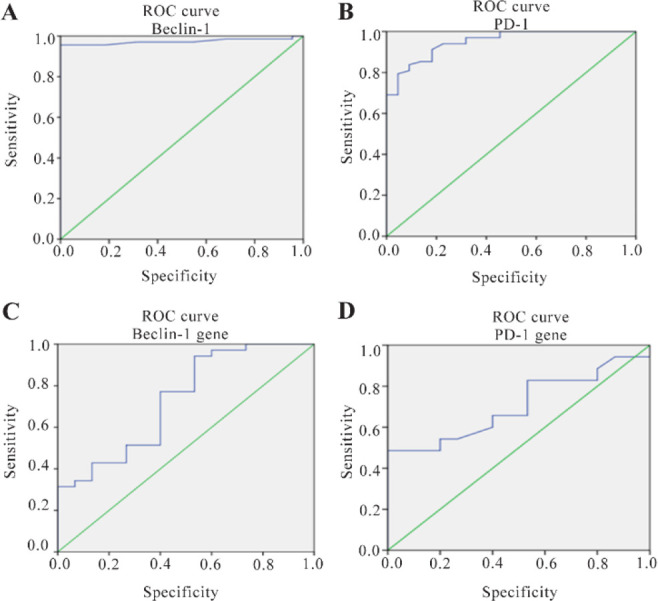
ROC curve analysis: ROC curve analysis was performed to evaluate the potential of serum Beclin-1 and PD-1 levels, as well as their corresponding gene expression levels, as diagnostic biomarkers for PCOS (Figure 1).
The ROC curve analysis of serum protein levels revealed excellent discriminatory power for both Beclin-1 (AUC=0.97) and PD-1 (AUC=0.95). These elevated area under the curve (AUC) values were accompanied by high accuracy, with specificity exceeding 96% for both markers, and sensitivity reaching 96% for Beclin-1 and 80% for PD-1. The optimal cut-off values for Beclin-1 and PD-1 serum levels were determined to be 0.895 ng/ml and 2.8 ng/ml, respectively, based on the ROC curve values. In contrast to the protein data, the ROC analysis of gene expression levels yielded fair discriminatory power for both Beclin-1 (AUC=0.731) and PD-1 (AUC=0.705). While the sensitivity of these markers remained relatively high (94% for Beclin-1 and 49% for PD-1), specificity was considerably lower (47% for Beclin-1 and 98% for PD-1). The best cut-off values for Beclin-1 and PD-1 gene expression were identified as 1.03 and 2.293, respectively.
Although the levels of testosterone, estrogen, and TSH were significantly different between groups, they remained within the normal hormonal range. Elevated testosterone levels are key diagnostic criteria for PCOS (22). Women with PCOS face various challenges, including reduced fertility, skin conditions such as acne, hirsutism, obesity, and insulin resistance. Furthermore, women with PCOS have a higher risk of developing cancer, coronary heart disease, and stroke compared to their counterparts (23).
Elevated prolactin levels in PCOS are associated with ovulatory dysfunction and menstrual irregularities (24). Studies highlight variable prolactin levels in PCOS, with some suggesting higher levels than controls (25, 26). Prolactin elevation may stem from reduced central dopaminergic tone and increased LH levels, contributing to PCOS pathophysiology (27). While such connection remains unclear, environmental, psychological, and physical factors may influence prolactin regulation (28).
Estrogen, mainly produced by the ovaries, is essential for reproductive health and menstrual regulation (29). Women with PCOS may exhibit estrogen dominance, leading to irregular periods, hirsutism, and acne (30). Despite presenting with symptoms of estrogen dominance, many individuals exhibit normal estrogen levels, potentially attributable to the conversion of insulin and testosterone (29). PCOS is also linked to elevated androgen and reduced estrogen, contributing to infertility (22).
Thyroid hormone abnormalities and thyroid autoimmunity are linked to infertility, miscarriage, premature birth, and metabolic dysfunctions which are prevalent in women with PCOS (31). Additionally, studies have reported a higher prevalence of PCOS in individuals with elevated TSH levels (32–34).
A conducted study demonstrated that PCOS group exhibited higher LH/FSH ratios, a key diagnostic marker of the condition, typically exceeding thresholds of 2:1 or 3:1 (35). Hyperinsulinemia and hyperandrogenism decrease FSH and increase LH secretion, disrupting follicular maturation and causing anovulation (36). Elevated LH stimulates ovarian theca cells to produce more androgens, worsening hyperandrogenism and its symptoms, including hirsutism, acne, and alopecia (37).
Autophagy, a crucial cellular degradation pathway for maintaining energy homeostasis, has garnered increasing attention in the context of PCOS and associated metabolic disorders such as autophagy and metabolic disorders (5). Our findings indicate a significantly increased expression of the Beclin-1 gene in patients with PCOS, which contradicts previous studies that reported no significant differences (38). Conversely, our data aligns with studies demonstrating elevated serum Beclin-1 levels in PCOS compared to controls (7, 39).
Elevated androgen levels, anovulation due to high LH, and increased reactive oxygen species (ROS) in PCOS are potential factors contributing to the observed upregulation of Beclin-1 (5). Oxidative stress, resulting from an imbalance between ROS production and antioxidant defenses, plays a significant role in ovarian tissue damage in PCOS (8).
Excessive ROS can impair follicular development, disrupt oocyte maturation, and damage granulosa cells, leading to compromised ovarian function (40). Additionally, oxidative stress may exacerbate hyperandrogenism and insulin resistance, creating a vicious cycle that further contributes to ovarian dysfunction and anovulation. These processes highlight the critical interplay between oxidative stress and autophagy in the pathophysiology of PCOS (41).
These factors may trigger autophagy and cyst formation, ultimately disrupting folliculogenesis (4). Autophagy plays a critical role in regulating the metabolic response in PCOS-affected tissues including adipose tissue, ovaries, skeletal muscles, heart, and liver, particularly under conditions of hyperinsulinemia and hyperandrogenism (5). Furthermore, heightened autophagic activity observed in granulosa cells of PCOS patients has been associated with follicular dysplasia and endocrine/metabolic disorders (42). This increased autophagy might contribute to higher spontaneous abortion rate and represent a significant mechanism in PCOS pathogenesis (43).
PD-1, a negative T-cell regulator, functions by delivering inhibitory signals to T-cells, leading to either negative regulation or apoptosis induction (12). Apoptosis can be triggered by PD-1 in T-cells, which in turn elicits immunosuppressive effects by stimulating the cells to release IL-10 (44). he elevated serum PD-1 levels in PCOS patients contradict previous findings (45), which reported a significant decrease in PD-1 levels among individuals with PCOS. This discrepancy may be linked to variations in sample characteristics, particularly disease duration. Our results align with studies (46, 47) that demonstrated higher serum PD-1 levels in PCOS, suggesting a potential link between elevated PD-1 and PCOS pathogenesis. Apoptosis of granulosa cells is recognized as a significant contributor to aberrant follicular development (48). A previous study demonstrated a notable upregulation of PD-1 expression in CD4+ or CD8+ T cells derived from infertile PCOS patients compared to the control group (49). This T-cell dysfunction could contribute to the immune pathogenesis observed in the ovaries of PCOS patients experiencing infertility (50). These findings suggest a potential link between chronic inflammation and PCOS pathogenesis (51).
Our study is the first to evaluate PD-1 gene expression in PCOS. The observed increased expression in PCOS patients might suggest its involvement in mechanisms beyond its typical inhibitory function. This elevated expression could be associated with the severity of PCOS, serving as a negative feedback mechanism to prevent excessive immune response-mediated tissue damage. Alternatively, it may be linked to abnormal follicular development and ovulatory dysfunction resulting from heightened granulosa cell apoptosis (52).
This study revealed upregulation of Beclin-1 and PD-1 in PCOS patients over 25 years of age, and the potential association between increased autophagy and apoptosis gene expression with long-term complications of PCOS, such as obesity, metabolic syndrome, and cardiovascular issues (52, 53). Age is a significant factor in PCOS. This study suggests that as the disease progresses, various factors, including lifestyle, nutritional choices, and the psychological state of patients may contribute to its progression. PCOS patients often experience psychological stress related to infertility, which can elevate the level of corticosteroid secretion. This increase in corticosteroids may impair immune system functionality, making individuals vulnerable to infection by various pathogens. Consequently, this may result in heightened levels of apoptosis and autophagy, potentially affecting ovarian function (50). Although the results of the statistical analysis in table 5 indicated no significant effect of disease duration, it remains an important and influential factor in the mechanism of the disease’s progression. As patients age, their likelihood of conception decreases, which increases psychological pressure and exacerbate the symptoms previously discussed regarding age-related factors.
Research indicates a significant association between PCOS and elevated WHR. Studies have shown that women with PCOS exhibit higher WHR values compared to controls, potentially demonstrating a predisposition towards central adiposity (fat accumulation around the waist) (16). This finding highlights the potential role of WHR as a non-invasive screening tool for identifying women at risk for PCOS. Obesity is linked to a higher prevalence of hirsutism and alopecia in women with PCOS compared to their overweight or lean counterparts (54). Additionally, autophagy is critical in regulating cellular bioenergetics during periods of starvation, underscoring its significant role in the development of obesity (5). Moreover, obesity can influence autophagy, either enhancing or suppressing its activity, depending on factors such as dyslipidemia and excessive caloric intake (55). Dysregulation of autophagy is implicated in the initiation and progression of metabolic disorders like obesity, insulin resistance, diabetes mellitus, atherosclerosis, and cardiovascular risk factors. This dysregulation exhibits tissue specificity and follows a biphasic pattern throughout overnutrition, ultimately contributing to obesity development (56). Impaired autophagy in adipose tissue, despite increased expression of autophagy genes, disrupts local and global metabolism, fostering metabolic disorders (56). Studies suggest a link between high LDL and increased autophagy in ovarian granulosa cells (57).
PCOS has a high prevalence among women with overweight or obesity in adolescence, with over 80% of diagnosed patients classified as obese. This strong correlation between PCOS and obesity might be due to shared genetic factors predisposing women to both conditions. Additionally, obesity is associated with immune exhaustion, impaired function of innate immune cells, increased immunosuppression, and inflammation driven by elevated IL-18 levels (58).
Several studies have reported a positive correlation between obesity and PD-1 expression, suggesting obesity-induced impairment of antigen-specific T-cell function (59). Furthermore, higher PD-1 expression in obese women has been linked to T-cell dysfunction and aging (60). The underlying mechanism for this elevated PD-1 expression in obesity may involve increased leptin levels, as observed in obese individuals (59, 60).
Obesity can induce programmed cell death and inflammation within adipose tissue, contributing to the development of metabolic syndrome (61). This chronic low-grade inflammation associated with obesity triggers a cascade of metabolic diseases. Cytokine signaling within adipose tissue mediates cell death and inflammation, leading to consequences such as insulin resistance, glucotoxicity, and lipid spillover. Ectopic lipid deposition, glucose intolerance, and other serious metabolic problems with potentially fatal outcomes are the results of these processes (62).
The statistical results in table 5 showed the effect of Beclin-1 in relation to disease history. PCOS is known to have a strong genetic component, with a higher prevalence observed among first-degree relatives of affected individuals (63). Therefore, this study suggested that certain genetic variations predisposing individuals to PCOS may also influence autophagy pathways. Genetic variations related to autophagy may be inherited alongside predispositions to PCOS, suggesting a potential link between these genetic factors and the development of the condition. Moreover, the statistical analysis in this study showed no effect of PD-1 and Beclin-1 on menstrual cycle among PCOS patients.
A correlation between testosterone (androgen), autophagy, and apoptosis was found in the current study. Excess testosterone can trigger cell death via many signal routes. Androgens may cause oocyte changes because they regulate gene expression (30). Additionally, androgen activates primordial follicles via the PI3K/AKT/FOXO3a pathway (64). However, it reduces the levels of growth differentiation factor 9 (GDF9) in oocytes, which may inhibit the development of secondary follicles from primary ones and potentially lead to oocyte apoptosis (65).
PCOS has been found to activate autophagy, based on recent studies (66). Furthermore, the accumulation of autophagosomes may result in the death of gastric cancer cells. Elevated levels of androgen can greatly stimulate the expression of autophagy-related genes, ATG5, ATG7, and Beclin-1, as well as the ratio of autophagy marker protein light chain 3B II/I (LC3 II/I) in individuals diagnosed with PCOS (66).
Moreover, this study found a correlation between prolactin, autophagy, and apoptosis. Prior research indicates that elevated levels of prolactin trigger apoptotic cell death in ovarian granulosa cells, leading to the activation of oxidative stress and autophagy pathways (67).
A notable limitation of this study is the sample size of the PCOS group. While PCOS is a recognized condition, a larger patient cohort would strengthen the generalizability of the findings. Furthermore, the underlying causes and optimal treatment strategies for PCOS remain elusive. Future research with larger and more diverse patient populations is essential to validate the observed associations between Beclin-1, PD-1, and PCOS and to explore their potential as therapeutic targets.
Future research should focus on investigating the molecular mechanisms linking oxidative stress, autophagy, apoptosis, and hormonal dysregulation in PCOS, particularly the role of Beclin-1 and PD-1 pathways. Studies should explore therapeutic interventions, such as antioxidants, to mitigate oxidative stress and its impact on autophagy and ovarian function. Additionally, identifying and analyzing the polymorphisms of target genes such as PD-1 and Beclin-1 could provide insights into genetic predispositions that influence PCOS pathophysiology. Longitudinal studies and patient subgroup analyses based on PCOS phenotypes (e.g., androgen levels or insulin resistance) are recommended to better understand the disease progression and treatment responses. Finally, clinical applications, such as developing biomarkers for oxidative stress and autophagy (e.g., PD-1 and Beclin-1 polymorphisms), should be explored for diagnostic and prognostic purposes. Furthermore, it is imperative to evaluate the effects of lifestyle modifications on oxidative stress reduction and ovarian health outcomes.
The present study demonstrates significantly elevated serum levels and upregulated gene expression of Beclin-1 and PD-1 in PCOS patients compared to controls. The findings suggest that autophagy and apoptosis, mediated by Beclin-1 and PD-1 respectively, may play a crucial role in PCOS pathogenesis. Moreover, apoptosis and autophagy may be influenced by factors such as advanced age, obesity, genetic factors, and hormonal profiles in patients. Targeting these pathways represents a promising therapeutic strategy to potentially reduce disease severity and associated complications. However, further investigation is warranted to elucidate the underlying mechanisms by which Beclin-1 and PD-1 contribute to PCOS development and progression. Additionally, studies are needed to evaluate the efficacy and safety of manipulating these pathways for therapeutic benefit in PCOS patients.
The authors would like to thank University of Baghdad and the Iraqi Ministry of Health for providing the necessary facilities to conduct the research.
Funding: The research and preparation of this manuscript were conducted without receiving any external funding or financial support. Every aspect of the research, encompassing the data collection, evaluation, and manuscript preparation was carried out independently by the authors.
