
Polycystic ovary syndrome (PCOS) is a heterogeneous metabolic disorder characterized by hyperandrogenism, polycystic ovaries, and ovulatory dysfunction in women of reproductive age (1). PCOS significantly impacts the reproductive, metabolic, and psychological health of women along with their overall quality of life. Symptoms of PCOS include irregular menstrual cycles, infertility, hirsutism, acne, obesity, and metabolic diseases (2). Although the exact etiology and pathophysiology of PCOS remain unclear, genetic, environmental, and lifestyle factors are believed to contribute to its development (3).
The pathophysiological features of PCOS can lead to adverse pregnancy outcomes, including an increased risk of miscarriage, pregnancy complications, and premature birth (4, 5). Studies suggest that infertility affects approximately 70% to 80% of women diagnosed with PCOS (6), while the prevalence of miscarriage ranges between 30% and 50% in this population (7). Given the regulatory role of thyroid hormones in metabolic processes, it is hypothesized that thyroid status might play a significant role in the pathogenesis of PCOS and its complications, including infertility and miscarriage. Notably, an elevated prevalence of thyroid disorders has been reported among women with PCOS compared to the general population (8–11). Recent studies indicate that members of the angiopoietin-like protein (ANGPTL) family may contribute to PCOS pathogenesis (12–15). ANGPTLs are orphan ligands with a coiled-coil domain and a fibrinogen-like domain that exhibit angiogenic effects (16, 17); however, their roles in metabolic regulation have been increasingly recognized (16).
Among these, ANGPTL6 also known as angiopoietin-related growth factor (AGF), has emerged as a hepatokine playing a pivotal role in glucose and lipid homeostasis and insulin sensitivity (18–20). Elevated ANGPTL6 levels have been linked to conditions such as preeclampsia (21), PCOS (15), type 2 diabetes mellitus (22), and metabolic syndrome (23), highlighting its potential significance in these contexts. In addition, a study suggests a potential correlation between ANGPTL6 levels and thyroid function, mediated by the influence of thyroid hormones on metabolic processes (24). Given the potential interrelationship among ANGPTL6, thyroid function, and metabolic processes, the purpose of the current study was to evaluate whether ANGPTL6 levels are associated with thyroid hormone profiles and metabolic dysfunction in women with PCOS. Recent findings suggest a potential association between ANGPTL6 and thyroid function, further highlighting its relevance in metabolic regulation. However, no prior studies have explored the relationship between ANGPTL6 levels and PCOS-related infertility or miscarriage, particularly in Iranian women. Therefore, an attempt was made to assess the serum levels of ANGPTL6 in Iranian women with PCOS and its association with miscarriage and infertility. Moreover, the association between ANGPTL6 level with thyroid hormone profile was examined in both PCOS and non-PCOS groups.
Study population: A dataset comprising 116 patients diagnosed with PCOS and 58 non-PCOS individuals was included in this investigation. The sample size was determined based on previous similar studies, considering a significance level (α) of 0.05, a statistical power (1−β) of 0.8, and an effect size (f) of 0.25 for one independent variable (k=1). Based on these parameters, approximately 60 participants per group were estimated to provide sufficient power to detect statistically significant differences. The study participants were selected from Shariati Hospital affiliated with Tehran University of Medical Sciences (TUMS) and Avicenna Fertility Center affiliated to Avicenna Research Institute in Tehran. All participants aged between 20 and 40 years had a body mass index (BMI) in the range of 17 to 35 kg/m2. Women diagnosed with PCOS (26) who met the 2003 Rotterdam criteria were included in the study. The criteria are defined as the presence of at least two of the following three features: irregular menstrual cycles, polycystic ovary morphology, and hyperandrogenism (1). PCOS patients were categorized into two subgroups: those with PCOS-associated infertility (n=58) and individuals experiencing PCOS-related miscarriage (n= 58). Infertile women were defined as those unable to achieve a pregnancy after 12 months or more of regular unprotected sexual intercourse. Recurrent miscarriage was characterized as the occurrence of a minimum of two consecutive pregnancy losses before 20 weeks of gestation. The control group consisted of 58 age- and BMI-matched women without PCOS to minimize confounding factors, thereby ensuring that the differences observed were due to PCOS rather than age or body composition. These women were screened to exclude any history of infertility, recurrent miscarriage, polycystic ovarian syndrome, hyperandrogenism or other endocrine disorders. This screening confirmed that the control group represented a healthy population without PCOS-related complications. Individuals with conditions such as hypertension, diabetes, coronary artery disease, current pregnancy, lactation, or those on medication regimens that could potentially affect metabolism or endocrine functions were excluded from the study. In addition, PCOS patients who had received treatment for PCOS were excluded from the study. All procedures performed in studies involving human participants were in accordance with the ethical standards of the institutional and/or national research committee, as well as the 1975 Helsinki Declaration, revised in 2008. Ethical approval for the research was obtained from the Ethics Committee of Tehran University of Medical Sciences (IR.TUMS.SHARIATI.REC. 1402.032). Informed consent was obtained by means of a written informed consent form prior to beginning the study. Efforts were made to minimize biases in sample selection by ensuring that participants were selected based on specific criteria, such as age range, absence of underlying chronic diseases, and adherence to the inclusion and exclusion criteria.
Laboratory analysis: Following a 12 hr period of overnight fasting, venous blood samples were collected. Fasting blood glucose (FBG) and the lipid profile, encompassing triglycerides (TG), total cholesterol (TC), low-density lipoprotein cholesterol (LDL-C), and high-density lipoprotein cholesterol (HDL-C) were determined as reported previously (26). All participants were specifically instructed to fast for 12 hr prior to blood sample collection, and this fasting period was strictly enforced and confirmed by the research team. Furthermore, using the enzyme-linked immunosorbent assay (ELISA) method as detailed in previous studies (26, 27), follicle-stimulating hormone (FSH), luteinizing hormone (LH), free testosterone (FT), and fasting serum insulin were measured. Thyroid function was assessed by measuring free T4, thyroid-stimulating hormone (TSH), and anti-thyroid peroxidase antibody (Anti-TPO) using the ELISA method. The assessment of insulin resistance was performed utilizing the HOMA-IR formula: [FBG (mg/dL)]×[fasting serum insulin (μU/ml)]/405 (28). The measurement of ANGPTL6 levels in the bloodstream was conducted using an ELISA kit (BioVendor, Czech Republic; catalog number: RAG001R), with intra- and inter-assay coefficients of variation (CV) of 3% and 6%, respectively. The detection limit of this assay is 1.2 ng/ml, as specified by the manufacturer.
Statistical analysis: The statistical analyses were conducted utilizing SPSS Statistics, version16.0 (IBM Corp., USA). Before statistical analysis, the normal distribution of the continuous data was evaluated using the Shapiro–Wilk test. Parametric datasets, meeting normality and homogeneity assumptions, were analyzed using independent t-tests and ANOVA, with results presented as mean ±standard deviation (SD). For non-parametric datasets with skewed distributions, the Mann-Whitney U and Kruskal-Wallis tests were applied, with results expressed as median and interquartile range (IQR). Pearson and Spearman correlation analysis were employed to assess the correlation between ANGPTL6 and the other variables. To evaluate the ability of ANGPTL6 to predict the risk of PCOS occurrence, logistic regression analysis was performed. A two-tailed p-value of less than 0.05 was considered statistically significant.
Participant’s characteristics: Clinical characteristics and biochemical parameters of both the non-PCOS and PCOS groups, along with their respective subgroups, namely PCOS-infertile and PCOS-miscarriage, are presented in table 1. As reported in previous studies (29, 30), significant differences in insulin, HOMA-IR, TC, FSH, FT, and adiponectin levels were observed when comparing the PCOS group and/or PCOS subgroups with the non-PCOS groups. Additionally, T4 levels were significantly lower in the PCOS group (2.5±1.9 μg/dl), as well as in the PCOS-infertile and PCOS-miscarriage subgroups, compared to the control group (3.9±4.6 μg/dl).
Table 1 Clinical characteristics of the study population
| Variables | Non-PCOS group (n=58) | PCOS group (n=116) | p-value Δ | PCOS-infertile (n=58) | PCOS-miscarriage (n=58) | p-value ΔΔ |
|---|---|---|---|---|---|---|
| Age (years) | 29.8±4.5 | 29.8±4 | 0.9 | 30±3.8 | 29.4±4.1b* | 0.5 |
| BMI (kg/m2) | 25.4±3.1 | 25.8±3.6 | 0.3 | 25.6±4 | 26±3 | 0.5 |
| FBG (mg/dl) | 91.8±9.5 | 89.8±10.3 | 0.2 | 89±11.3 | 90.1±9.3 | 0.4 |
| Insulin (μU/ml) | 3 (2.1–4.1) | 4.1 (2.7–7.1) | <0.0001 | 4.2 (3–7) a** | 3.9 (2.1–8.1) b** | <0.0001 |
| HOMA-IR | 0.64 (0.45–0.96) | 0.85 (0.59–1.5) | 0.002 | 0.86 (0.62–1.3) a* | 0.85 (0.53–1.8) b* | 0.007 |
| TG (mg/dl) | 126.1±34.9 | 133.8±57.9 | 0.3 | 126.3±59.2 | 141.2±56.1 | 0.1 |
| TC (mg/dl) | 160±40.5 | 177.2±34.3 | 0.004 | 171±30.9 | 182.6±36.8 b** | 0.004 |
| LDL-C (mg/dl) | 94.3±30.3 | 101.5±28.2 | 0.1 | 98.2±22.4 | 104.8±32.8 | 0.1 |
| HDL-C (mg/dl) | 46 (41.2–52) | 44 (39–50) | 0.1 | 43.5 (39–51) | 44 (39–49) | 0.3 |
| FSH (IU/L) | 8.2 (6.4–10.1) | 6.4 (4.8–7.8) | <0.0001 | 6.4 (5.1–7.6) a* | 6.4 (4.4–8.9) | 0.005 |
| LH (IU/L) | 6.5 (4.8–8.3) | 6.8 (4.7–8.7) | 0.2 | 7 (4.4–10.2) | 6.4 (5–8.5) | 0.1 |
| FT (pg/ml) | 1.5±0.35 | 3.3±1.2 | <0.0001 | 3.1±0.95 a** | 3.4±1.4 b** | <0.0001 |
| T4 (μg/dl) | 3.9±4.6 | 2.5±1.9 | <0.0001 | 1.7±2.4 a** | 1.4±1 b** | <0.0001 |
| TSH (mIU/L) | 2.8±3.4 | 2.5±1.9 | 0.5 | 2.6±1.9 | 2.5±1.8 | 0.7 |
| Anti-TPO (mIU/L) | 19.4±43.2 | 54.4±189.8 | 0.06 | 65.6±246 | 43.2±109.2 | 0.2 |
| Adiponectin (μg/ml) | 5.1 (3.6–7.8) | 2.5 (1.9–3.4) | <0.0001 | 2.4 (1.5–3.4) a** | 2.8 (2–3.5) b** | <0.0001 |
The data are presented in mean ± standard deviation (SD) or median (Q1–Q3)
To determine the differences of variables between the non-PCOS and PCOS groups, an independent t-test was used
To determine the differences of variables between the non-PCOS and PCOS sub-groups (infertile and miscarriage), a one-way ANOVA test with Tukey’s corrections post hoc was used. Statistical significance was indicated as
p<0.05 and
p<0.01
Comparison between control group and PCOS-infertile subgroup
Comparison between control group and PCOS-miscarriage subgroup
Comparison between PCOS-infertile and PCOS-miscarriage subgroup
Abbreviations: BMI: Body Mass Index, FBG: Fasting Blood Glucose, FSH: Follicle-Stimulating Hormone, HDL-C: High-Density Lipoprotein Cholesterol, HOMA-IR: Homeostasis Model Assessment of Insulin Resistance, LDL-C: Low-Density Lipoprotein Cholesterol, LH: Luteinizing Hormone, PCOS: Polycystic Ovary Syndrome, TC: Total Cholesterol, TG: Triglyceride, Anti-TPO: Anti-thyroid Peroxidase Antibody, TSH: Thyroid Stimulating Hormone
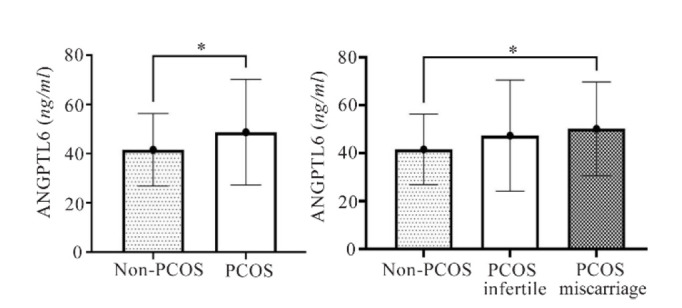
As shown in figure 1, the level of ANGPTL6 was significantly higher in the PCOS group (48.72±21.41) than in the non-PCOS group (41.56±14.74 ng/ml), (p=0.02). A similar rise in ANGPTL6 level was also noted in the PCOS-miscarriage subgroup (50.16±19.57 ng/ml) when compared to the control group (p<0.05), while the increase in PCOS-infertile women did not reach a significant level.
Clinical and biochemical parameters: The results of association between ANGPTL6 levels and the anthropometric, hormonal, and metabolic variables in both PCOS and non-PCOS groups are presented in table 2. ANGPTL6 showed a significant positive correlation with adiponectin in the PCOS group (p<0.01). However, no significant correlation was found between ANGPTL6 levels and thyroid function markers such as TSH, T4, and anti-TPO.
Table 2 Association of circulating ANGPTL6 levels and the anthropometric, hormonal, and metabolic variables
| Variables | Non-PCOS group (n=58) | PCOS group (n=116) |
|---|---|---|
| Age | 0.153 | 0.152 |
| BMI | −0.032 | −0.087 |
| FBG | 0.101 | 0.151 |
| Log insulin | 0.213 | −0.064 |
| Log HOMA-IR | 0.147 | −0.068 |
| TG | 0.225 | 0.079 |
| Log HDL-C | −0.178 | −0.173 |
| LDL-C | 0.05 | 0.142 |
| TC | 0.139 | 0.102 |
| FT | 0.071 | −0.068 |
| Log LH | −0.15 | 0.052 |
| Log FSH | 0.093 | −0.006 |
| Log adiponectin | −0.117 | 0.254** |
| T4 | −0.097 | −0.035 |
| TSH | −0.021 | −0.017 |
| Anti-TPO | 0.043 | 0.025 |
Pearson correlation coefficient is represented by r.
PCOS: Polycystic Ovary Syndrome, BMI: Body Mass Index, FBS: Fasting Blood Sugar, HOMA: Homeostasis Model Assessment, TG: Triglycerides, TC: Total Cholesterol, LDL-C: Low-Density Lipoprotein Cholesterol, HDL-C: High-Density Lipoprotein Cholesterol, FSH: Follicle-Stimulating Hormone, LH: Luteinizing Hormone, T: Free Testosterone, ANGPTL6: Angiopoietin-Like Protein 6
p<0.05,
p<0.01
The levels of ANGPTL6 and PCOS risk: Logistic regression analysis was used to estimate the relationship between ANGPTL6 with the risk of PCOS and the results are shown in table 3. ANGPTL6 was found to have a significant association with PCOS risk, with an odds ratio of 1.02 (95%CI [1.002–1.038]) (p=0.025), suggesting that higher ANGPTL6 levels are associated with a modestly increased risk of PCOS. This association remained significant even after adjusting for age, BMI, and Log HOMA-IR.
Table 3 The odds ratio of PCOS status according to circulating ANGPTL6 levels using logistic regression analysis
| Model | OR | 95%CI | p-value | |
|---|---|---|---|---|
|
| ||||
| Minimum | Maximum | |||
| Unadjusted model | 1.02 | 1.002 | 1.038 | 0.025 |
| Adjusted model for age and BMI | 1.021 | 1.003 | 1.039 | 0.02 |
| Adjusted model for age, BMI, and Log HOMA-IR | 1.027 | 1.027 | 1.049 | 0.02 |
PCOS: Polycystic Ovary Syndrome, BMI: Body Mass Index, HOMA-IR: Homeostasis Model Assessment of Insulin Resistance, CI: Confidence Interval
While the traditional role of ANGPTL6 in angiogenesis was initially described (17), several studies have subsequently revealed a broader impact, encompassing energy metabolism and lipid control (17, 19, 31). Exploring the role of ANGPTL6 in metabolic networks may offer promising avenues for addressing metabolic disorders. To date, some studies have investigated the association between ANGPTL6 and metabolic disorders such as diabetes mellitus (22), obesity (32), and metabolic syndrome (23). According to research findings, it has been proposed that ANGPTL6 opposes obesity and its associated insulin resistance by enhancing overall energy expenditure within the body (31).
The current study revealed a significantly higher level of ANGPTL6 in PCOS patients compared to the non-PCOS group. Additionally, logistic regression results showed that increased ANGPTL6 levels were associated with an increased risk of PCOS. Consistent with our results, there are several studies that reported the increased level of ANGPTL6 in metabolic disorders (22, 23, 33). The elevation of ANGPTL6 levels in patients with PCOS and other metabolic disorders may imply the potential existence of ANGPTL6 resistance or a compensatory mechanism in these conditions (22, 31, 33). Until now, only a few studies have investigated the levels of ANGPTL6 in women with PCOS. In a study conducted by Elci et al., ANGPTL6 levels in 30 obese and 30 non-obese women diagnosed with PCOS were evaluated. The results of the study showed a statistically significant increase in ANGPTL6 levels among obese and non-obese women with PCOS, as compared to the control subjects (34). They also reported that the increased level of ANGPTL6 was significantly higher in the obese PCOS group than the non-obese PCOS group (34). In another study in China involving 35 women with PCOS and 30 healthy control women, PCOS women showed significantly higher levels of ANGPTL6 compared to non-PCOS subjects (15). These findings suggest that ANGPTL6 may play a key role in the metabolic disturbances observed in PCOS, potentially through mechanisms such as ANGPTL6 resistance or compensatory responses.
To the best of our knowledge, this is the first study that evaluated the association between ANGPTL6, infertility, and miscarriage in Iranian women with PCOS. It was shown that the PCOS-miscarriage subgroup had a significantly higher level of ANGPTL6 in comparison to the non-PCOS group. Although the scientific community has not reached a consensus on the precise mechanism of miscarriage in PCOS patients, several factors have been proposed as potential contributors. These include the hypersecretion of luteinizing hormone, hyperandrogenemia, hyperinsulinemia, obesity, and abnormalities in folliculogenesis (35). According to the results of the present study and other studies, it seems that elevated levels of ANGPTL6 along with alteration in other metabolic factors may play a pivotal role in the pathogenesis of both PCOS and PCOS-related miscarriages.
The significant association between ANGPTL6 levels and PCOS risk suggests that ANGPTL6 could serve as a potential biomarker for early detection of PCOS, especially in women at risk for recurrent miscarriage. In addition, targeting ANGPTL6 could be explored as a therapeutic approach, potentially modulating metabolic and reproductive dysfunctions associated with PCOS. Further studies are needed to assess whether ANGPTL6-targeted interventions could be effective in improving clinical outcomes in PCOS patients.
Insulin resistance and dyslipidemia, two main features of metabolic syndrome (MetS), appear to have important pathophysiological implications for human well-being, particularly in connection to female reproductive potential (36). MetS is a chronic inflammatory state that, when coupled with dyslipidemia, has been linked to poor reproductive consequences (37, 38). Additionally, metabolic disorders have been linked to decreased fertility in women diagnosed with PCOS (39). In the present study, ANGPTL6 levels in the PCOS-infertile subgroup were not significantly elevated compared to controls. Drawing from the observed correlation between MetS and infertility and the significant associations between ANGPTL6 levels and metabolic disorders, it was postulated that the infertile subgroup would demonstrate elevated concentrations of ANGPTL6. A larger sample size may have been necessary in order to detect and analyze this significant discrepancy.
Although some studies have evaluated thyroid status in PCOS women (11, 40, 41), no research has investigated the relationship between ANGPTL6 levels and thyroid function. Our results showed that free T4 levels were significantly lower in PCOS women. In line with this result, Abdelsalam and Ibrahim reported a significant decrease in T4 in PCOS women as compared to the controls (42). However, there was no significant correlation between the levels of ANGPLT6 and TSH, free T4, and TPO in both PCOS and non-PCOS individuals. In this regard, a study by Lim et. al in 2015 showed the association of ANGPLT6 with TSH and free T4 levels. They also reported an increased level of ANGPTL6 in hypothyroid patients (24). The variation in findings between our study and that of Lim et al. may be attributed to differences in sample size, the characteristics of the studied populations, and possibly the methods used to measure ANGPTL6. Our study population consisted of PCOS women with varying clinical features, while Lim et al. focused on hypo/hyperthyroid patients, which could explain the observed discrepancy in results.
The present study is the first comprehensive investigation evaluating ANGPTL6 levels in Iranian women with PCOS and its association with miscarriage and infertility. However, several limitations should be acknowledged. Firstly, the case-control design of the study limits the ability to establish a definitive causal relationship between ANGPTL6 and PCOS. Secondly, the study’s focus on an Iranian population may limit the generalizability of the findings to other populations. The small sample size also restricts the statistical power of the results. Additionally, the absence of longitudinal data and causal analysis, as well as the lack of specific PCOS phenotypes for more detailed analysis, further constrains the interpretation of the findings.
This study demonstrated that serum level of ANGPTL6 is enhanced in PCOS group, as well as PCOS-miscarriage subgroup, when compared to non-PCOS. No significant association was found between ANGPTL6 and thyroid function tests. Thus, it can be concluded that ANGPTL6 levels might influence the metabolic status in PCOS patients, regardless of thyroid function. Moreover, ANGPTL6 could serve as a potential biomarker for PCOS, which may enhance the early detection and management of the condition. Further research is needed to explore the mechanisms linking ANGPTL6 with the pathogenesis of PCOS and to assess its clinical utility in PCOS management, particularly in diverse populations and clinical settings.
The authors are grateful to the Medical Research Council of Tehran University of Medical Sciences for supporting this project.
Funding: This study was supported by the Tehran University of Medical Sciences (grant number: 1402-2-101-67472).
